Last night saw the season finale of Numb3rs and the series finale of Star Trek: Enterprise. The finale of Numb3rs was the sort of episode you'd expect from a series that was pretty much sure of coming back next season. (Network upfronts are coming in the next week or so, but some series look to be confident about returning.) About the most spectacular thing about it was the complete absence of Sabrina Lloyd. She's been seen less in the past few episodes so maybe they're just phasing her character out. Shame on them if they are.
I really want to write about the Star Trek: Enterprise finale though, but first let me just repeat my usual refrain about it being long past time for the team of Berman & Braga to leave the Star Trek Franchise forever and not let the door hit them on the ass on the way out. They should go out backwards and let it hit them in the .... well you get the idea. There, that felt good.
The series finale was a two one hour episodes. The first was the wind up of last weeks episode in which Trip Tucker and T'Pol discover that there's a Human-Vulcan hybrid child with their DNA, created by an anti-alien group "Terra Prime", headed by the often underappreciated Peter Weller. In the episode, the Enterprise crew managed to defeat Terra Prime's nefarious scheme to destroy Star Fleet Command, prevent the signing of a trade agreement between Earth and a number of alien races, and force all aliens off earth. There's the usual amount of daring-do and in a touching note the baby - named Elizabeth by T'Pol and Trip - dies as a result of genetic complications. Phlox however leave the door open for a certain future blessed event when he explains that the cloning process used by Terra Prime was flawed and Human and Vulcan DNA is in fact compatible enough to allow a child to be born and survive.
On the whole that episode would have been a pretty good opener to a fifth season - the end point of a cliffhanger - or even an end the series, but no, someone couldn't leave well enough alone. We had to be treated to a different final episode. We are catapulted six years into the future, when the Enterprise is heading back to Earth to be decommissioned and put into the mothball fleet (a term that originated with the US Navy for ships that have been retained for emergency service but aren't crewed and receive minimal maintenance). Suddenly there's an announcement calling all senior staff to the bridge and we discover that what we're seeing is a holodeck program being run by Commander Bubble Butt - sorry, Commander William T. Riker. Yes they decided that they needed an episode with Next Generation characters, so we got to see William Frakes who appears to have been eating his way out of his depression after Thunderbirds flopped, and Marina Sirtis who really should lay off the Baklava and hit the gym if she wants to wear that uniform again.
The storyline is a disappointment after so many good episodes in the past year. Riker is participating in the Holodeck reconstruction of the final days of the new original Enterprise (as opposed to the original original Enterprise which was Kirk's ship) because he's pondering a decision. In fact it's the decision that he made in the Next Generation episode "The Pegasus", to disobey orders and tell Picard about the illegal tests of a Federation cloaking device that occurred aboard the USS Pegasus. Apparently Troi told him that he could get greater insights about the decision he has to make by experiencing the last days of Archer's Enterprise. The plot there focusses on Shran, who is supposed to be dead but is really on the run. After leaving the Andorian Imperial Guard (and why would he do that?) he fell in with an unsavoury element, who now want him to return something he doesn't have and have kidnapped his daughter to get it. Early on Troi and Riker let us know that Trip doesn't survive, so during the time that the crew are trying to rescue Shran's daughter on Rigel 10 we're wondering if this is when Tucker's going to kick the bucket. In fact, it doesn't happen until after the rescue when the guys who have kidnapped the child (and supposedly only have a Warp 2 ship) suddenly show up on Enterprise and want the Shran and the kid. Tucker does the heroic thing, putting himself in a potentially life threatening situation to kill the bad guys and save Archer. Throughout the episode we are treated with meetings between the Enterprise Chef and several senior crewmembers. Chef of course isn't the "real" Chef but Riker. Troi has told him that since the ship didn't have a counsellor (or a bar tender) people tended to talk to Chef. Needless to say the insights Riker gains all centre on the Archer-Tucker relationship, which gives Riker the answer he needs to decide to trust his instincts and tell the man he trusts unconditionally (that would be Picard) about the secret of the Pegasus. This episode was such a terrible send-off for the show that it is difficult to believe that Manny Cotto did it of his own free will, given the episodes that have come before in this season. The idea had to have come from higher up in the Paramount food chain.
Next year, for the first time in 18 years there will not be new episodes of a Star Trek series. For the first time in its history there won't be a Star Trek series on UPN. Unlike a lot of people I don't think that the franchise is dead. If anything the last season of Star Trek: Enterprise points the way forward. I've said it before and I'll say it as long as anyone wants, the time has come for Berman & Braga to go. It may be true that there can't really be a single vision for the whole franchise. If there ever is a new series (and if UPN gets desperate enough there might be) it may need a new vision, and a different vision from any future movies. The basic concepts are sound - a utopian future (because so many movies and TV shows give us a dystopic vision) and a focus on exploration rather than conflict - so a new show could be led by someone who isn't currently involved. I don't know what comes next, but I hope it's something interesting.
Saturday, May 14, 2005

Thursday, May 12, 2005
Thoughts On A "Season" Finale
Among the things I do besides writing this blog is to write recaps for the Amazing Race newsgroup, and believe me it's a taxing self imposed job to the point where I'm often totally exhausted on the day after because I've been up until four in the morning or later. Consequently I haven't reviewed two of my favourite series this year - House and Lost not to mention Smallville. I intend to remedy that now that Amazing Race is over... but not right now.
Actually this post is about a show I've reviewed earlier. Last night was billed by The WB as the season finale of Jack & Bobby but the whole exercise stank of being the series finale. Not only did we finally meet the boys' father, played by Lou Diamond Phillips with the thickest Hispanic accent I've ever heard him use, but we also found out how Jack dies - gun downed in a convenient store robbery after being a war hero, a conscientious public defender and a Democratic Congressman. It also seemed to wrap up the documentary on the life of President McAllister with a final coda from Bobby's mentor Peter Benedict, played as an old man by legendary TV producer Norman Lear, and the documentary narrator played by Gore Vidal. The episode was good and set up the course that Jack and Bobby's lives would take because of their trip to meet their father, but there's a depressing finality to it as a way to end a show's season.
Of course it probably is the series finale. While The WB hasn't announce its "upfronts" yet, Jack & Bobby has been the lowest rated show on any network (with the possible exception of the soon to be defunct PAX network of course) in the United States and being last on the ratings list doesn't normally get you renewed even on The WB. Which is a damned shame really because the show is generally quite good. The problem may well have been when they chose to show it. It stated out on Sunday nights with Charmed and was moved to Tuesday nights following Smallville. Neither show was exactly a good fit for it - a better match for Jack & Bobby might have been on Monday nights with either Seventh Heaven or Everwood but with both series continuing and the network not wanting to anger affiliates like WPIX, WGN or KTLA by running a third hour of shows (thereby postponing the local news) putting it on Monday night is out. And the network doesn't have another night where the shows they have will work with Jack & Bobby. It's a shame really that a show like this will likely get cancelled when Joey has been renewed for next year.
Actually this post is about a show I've reviewed earlier. Last night was billed by The WB as the season finale of Jack & Bobby but the whole exercise stank of being the series finale. Not only did we finally meet the boys' father, played by Lou Diamond Phillips with the thickest Hispanic accent I've ever heard him use, but we also found out how Jack dies - gun downed in a convenient store robbery after being a war hero, a conscientious public defender and a Democratic Congressman. It also seemed to wrap up the documentary on the life of President McAllister with a final coda from Bobby's mentor Peter Benedict, played as an old man by legendary TV producer Norman Lear, and the documentary narrator played by Gore Vidal. The episode was good and set up the course that Jack and Bobby's lives would take because of their trip to meet their father, but there's a depressing finality to it as a way to end a show's season.
Of course it probably is the series finale. While The WB hasn't announce its "upfronts" yet, Jack & Bobby has been the lowest rated show on any network (with the possible exception of the soon to be defunct PAX network of course) in the United States and being last on the ratings list doesn't normally get you renewed even on The WB. Which is a damned shame really because the show is generally quite good. The problem may well have been when they chose to show it. It stated out on Sunday nights with Charmed and was moved to Tuesday nights following Smallville. Neither show was exactly a good fit for it - a better match for Jack & Bobby might have been on Monday nights with either Seventh Heaven or Everwood but with both series continuing and the network not wanting to anger affiliates like WPIX, WGN or KTLA by running a third hour of shows (thereby postponing the local news) putting it on Monday night is out. And the network doesn't have another night where the shows they have will work with Jack & Bobby. It's a shame really that a show like this will likely get cancelled when Joey has been renewed for next year.
Tuesday, May 10, 2005
TV on DVD - May 10, 2005
American Chopper: Series: Season One
American Chopper: Series: Season Two
- Watching the Teutels - well mainly Paul Jr. - design and build custom motorcycles from the ground up isn't really the best part of this show. The best part of the show is watching Paul, Paulie and Mikey Teutel blow up at each other while the other people who work at Orange County Choppers run for cover. The fact that they produce some beautiful work despite having what can best be described as a disfunctional work environment is an added bonus.
Dastardly And Muttley: The Complete Series
Penelope Pitstop: The Complete Series
- Nostalgia's a funny thing. I never saw either of these two shows at the time, but they and shows of their ilk were held up as the very definition of the depths to which animation had fallen (which is wrong - if you want to see the depths, take a look at a Filmation series like Star Trek: The Animated series, but I digress). There was even a word for it Hanna-Barberianism. Looked at today after a generation of animation that cut even more corners - some of it produced by Hanna-Barbera but a lot of it not - shows like these seem to be sparkling example of what TV animation should be more like.
Ed Edd N Eddy: Volume 1 Season 1
- Another animation effort from Cartoon Network that I haven't seen and probably wouldn't like if I did. I seem to say that a lot don't I? Of course it would help if it was shown up here in Canada.
Entourage: The Complete First Season
- This is a series I've never heard of until it came up in this list. I mean never. Turns out that this HBO series is available in Canada on a movie package, but unlike other Canadian cable and satellite providers Shaw Cable doesn't make you sign up for a movie package to get the UPN and WB stations that are available in Canada - so I didn't. Which means missing an experience like Deadwood, but saves me about $11.
Have Gun Will Travel: Season 2
- It wasn't until I saw the series recently on the Lonestar cable network here in Canada that I realised two things. The first is that the Johnny Western theme that was one of my greatest memories of the series ("Have Gun Will Travel reads the card of the man,/ A soldier of fortune in a savage land") was in fact not the opening theme of the series but the closing theme and only really adopted in the second season. The opening was far more interesting and far less memorable (for a five year old kid) - the holster with the knight chess piece from which the big hand made revolver is pulled and pointed right at the camera as a line from the night's episode is read, after which the gun is slammed back into the holster. The other thing was that Richard Boone really was a homely as Paladin as he looked in later work like Hec Ramsey (which I liked a lot - apparently more than American audiences of the time) and the John Wayne movie Big Jake. Definitely a show worth seeing again but apparently not in Canada yet since Amazon.ca doesn't even have a date for it to be available.
In Living Color: Season 3
- Was never available on Canadian networks and we didn't get Fox in Saskatoon until well after the show was cancelled. It is currently seen on the Comedy Network up here but I haven't watched it. Notable for the collaboration between the various members of the Wayans Family, but also as the breakout showcase for Jim Carrey. Carrey had been seen on U.S. TV before in the sadly ignored Duck Factory (another show I liked more than American audiences of the time) but he was a lot freer to do what he wanted in this series. Apparently the third season also saw Jamie Foxx added to the cast and Jennifer Lopez on the show as a "Fly Girl". A lot of talent in that series.
Joan Of Arcadia: The First Season
- Buy this set if you want to be loved by the Parents Television Council. Here's the puzzling part though: Joan of Arcadia was the big new series of the 2003-04 season, and in the 2004-05 season is being threatened with cancellation due to lower than expected ratings. What changed between Season 1 and Season 2?
Kim Possible - The Movie: So the Drama (Extended Edition)
- I understand that this is another Nickelodeon series. Or is it Disney? Since I'm not interested that much in children's TV except from a nostalgia point of view I don't know which it is, and of course haven't seen it. Okay, I looked it up and this is a movie based on the Disney series of the same name.
Monster Garage: Season One
Monster Garage: Season Two
- This is sort of a companion piece to American Chopper except that instead of building custom motorcycles they build custom hot rods. For some reason I don't find it nearly as involving as American Chopper. Maybe it's just the personalities involved. All I know is that I've never seen a complete episode, and the one episode that I saw part of featured a Swedish kid who had come to the garage to learn how to build hot rods but was only allowed to sweep up the shop and clean the interiors of the cars. On the occasions when he tried to actually see how the work was done he was yelled at so much by the boss that he quit in disgust. The boss said good riddance.
Mutant X: Season 2
- Canadian show courtesy of CanWest-Global and co-production. I seem to recall that Fox Movies sued Marvel because the concept of the show was extremely close to The X-Men which Marvel had created in the first place. It was all about movie rights and being too close to originals. I wouldn't know because - yet again - this is a show I've never watched, but this may be the reason you'll never see Bruce Wayne on Smallville.
My Favorite Martian - Second Season
- Now this series I do remember. When I was a kid some of us created "Uncle Martin" antenna with sticks, tin foil, and rubber bands. Never did figure out how to get them to go up and down though. The chemistry between Tim O'Hara (Bill Bixby) and "Uncle Martin" (Ray Walston) was quite real and warm, but while Bixby was an enjoyable straight man the real attraction to the series was Ray Walston who could act circles around anyone else in the cast and frequently did.
Quantum Leap: The Complete Third Season
- I started watching this show, and somewhere along the line - well before the third season, and maybe even before the second - I stopped. I can't really tell you why though, except to say that while the concept was interesting the show just didn't interest me.
American Chopper: Series: Season Two
- Watching the Teutels - well mainly Paul Jr. - design and build custom motorcycles from the ground up isn't really the best part of this show. The best part of the show is watching Paul, Paulie and Mikey Teutel blow up at each other while the other people who work at Orange County Choppers run for cover. The fact that they produce some beautiful work despite having what can best be described as a disfunctional work environment is an added bonus.
Dastardly And Muttley: The Complete Series
Penelope Pitstop: The Complete Series
- Nostalgia's a funny thing. I never saw either of these two shows at the time, but they and shows of their ilk were held up as the very definition of the depths to which animation had fallen (which is wrong - if you want to see the depths, take a look at a Filmation series like Star Trek: The Animated series, but I digress). There was even a word for it Hanna-Barberianism. Looked at today after a generation of animation that cut even more corners - some of it produced by Hanna-Barbera but a lot of it not - shows like these seem to be sparkling example of what TV animation should be more like.
Ed Edd N Eddy: Volume 1 Season 1
- Another animation effort from Cartoon Network that I haven't seen and probably wouldn't like if I did. I seem to say that a lot don't I? Of course it would help if it was shown up here in Canada.
Entourage: The Complete First Season
- This is a series I've never heard of until it came up in this list. I mean never. Turns out that this HBO series is available in Canada on a movie package, but unlike other Canadian cable and satellite providers Shaw Cable doesn't make you sign up for a movie package to get the UPN and WB stations that are available in Canada - so I didn't. Which means missing an experience like Deadwood, but saves me about $11.
Have Gun Will Travel: Season 2
- It wasn't until I saw the series recently on the Lonestar cable network here in Canada that I realised two things. The first is that the Johnny Western theme that was one of my greatest memories of the series ("Have Gun Will Travel reads the card of the man,/ A soldier of fortune in a savage land") was in fact not the opening theme of the series but the closing theme and only really adopted in the second season. The opening was far more interesting and far less memorable (for a five year old kid) - the holster with the knight chess piece from which the big hand made revolver is pulled and pointed right at the camera as a line from the night's episode is read, after which the gun is slammed back into the holster. The other thing was that Richard Boone really was a homely as Paladin as he looked in later work like Hec Ramsey (which I liked a lot - apparently more than American audiences of the time) and the John Wayne movie Big Jake. Definitely a show worth seeing again but apparently not in Canada yet since Amazon.ca doesn't even have a date for it to be available.
In Living Color: Season 3
- Was never available on Canadian networks and we didn't get Fox in Saskatoon until well after the show was cancelled. It is currently seen on the Comedy Network up here but I haven't watched it. Notable for the collaboration between the various members of the Wayans Family, but also as the breakout showcase for Jim Carrey. Carrey had been seen on U.S. TV before in the sadly ignored Duck Factory (another show I liked more than American audiences of the time) but he was a lot freer to do what he wanted in this series. Apparently the third season also saw Jamie Foxx added to the cast and Jennifer Lopez on the show as a "Fly Girl". A lot of talent in that series.
Joan Of Arcadia: The First Season
- Buy this set if you want to be loved by the Parents Television Council. Here's the puzzling part though: Joan of Arcadia was the big new series of the 2003-04 season, and in the 2004-05 season is being threatened with cancellation due to lower than expected ratings. What changed between Season 1 and Season 2?
Kim Possible - The Movie: So the Drama (Extended Edition)
- I understand that this is another Nickelodeon series. Or is it Disney? Since I'm not interested that much in children's TV except from a nostalgia point of view I don't know which it is, and of course haven't seen it. Okay, I looked it up and this is a movie based on the Disney series of the same name.
Monster Garage: Season One
Monster Garage: Season Two
- This is sort of a companion piece to American Chopper except that instead of building custom motorcycles they build custom hot rods. For some reason I don't find it nearly as involving as American Chopper. Maybe it's just the personalities involved. All I know is that I've never seen a complete episode, and the one episode that I saw part of featured a Swedish kid who had come to the garage to learn how to build hot rods but was only allowed to sweep up the shop and clean the interiors of the cars. On the occasions when he tried to actually see how the work was done he was yelled at so much by the boss that he quit in disgust. The boss said good riddance.
Mutant X: Season 2
- Canadian show courtesy of CanWest-Global and co-production. I seem to recall that Fox Movies sued Marvel because the concept of the show was extremely close to The X-Men which Marvel had created in the first place. It was all about movie rights and being too close to originals. I wouldn't know because - yet again - this is a show I've never watched, but this may be the reason you'll never see Bruce Wayne on Smallville.
My Favorite Martian - Second Season
- Now this series I do remember. When I was a kid some of us created "Uncle Martin" antenna with sticks, tin foil, and rubber bands. Never did figure out how to get them to go up and down though. The chemistry between Tim O'Hara (Bill Bixby) and "Uncle Martin" (Ray Walston) was quite real and warm, but while Bixby was an enjoyable straight man the real attraction to the series was Ray Walston who could act circles around anyone else in the cast and frequently did.
Quantum Leap: The Complete Third Season
- I started watching this show, and somewhere along the line - well before the third season, and maybe even before the second - I stopped. I can't really tell you why though, except to say that while the concept was interesting the show just didn't interest me.
I Need Gas
Canadians have never done situation comedies well. We know the basic concepts, and indeed a lot of American sitcoms have involved Canadians both as stars and creators. However making our own sitcoms has never been a strong point. And we've tried too but what's been tried has resulted in a notable list of ignoble failures: The Trouble with Tracy, Excuse My French, and Blackfly to name just a few. Indeed it could be argued that until recently there has only been one truly memorable Canadian sitcom: King Of Kensington. Now however theres a new contender. It is Corner Gas starring Brent Butt, which just recently completed its second season on CTV.
Until recently I hadn't seen Corner Gas. Part of the reason is that I'm normally not home on Monday night - it's my bowling night - and both of my VCRs are busy taping other shows. The end of the bowling season has allowed me to see more shows on Monday nights - when I don't feel the overwhelming urge to have a nap - and one of the shows that I've picked up is Corner Gas. Despite a lot fo rave reviews, I wasn't expecting much. After all it was a Canadian sitcom, but it's produced here in Saskatchewan so I thought I should at least give it a try. After one episode I became a fan.
There's a tendency to compare shows with something familiar. One person commenting on the show in its IMDB listing compared it to Seinfeld because nothing really happens. The truth is, as usual, much more complex. The show has a lot in common with Northern Exposure. Both series have a "fish out of water" character; someone from the "Big City" who has moved to a small town. The town has of course proven to be full of quirky characters. On the other hand, while Northern Exposure made the "fish out of water" the lead character, Corner Gas has made its fish out of water one of the principal supporting characters. Corner Gas has also adopted an aspect of King of Kensington not only by making the lead character a store owner but by making his gas station the place that people come to. All of the important characters show up either at the gas station or at Lacey Burrows' restaurant The Ruby - which conveniently is attached to the gas station.
The quirkiness of the characters is the key point of course. As the show's motto says, Dog River is 40 kilometres from nowhere and way beyond normal. Lacey (Gabrielle Miller), the transplanted Torontonian, is the character that we're supposed to identify with, but everyone in town thinks she's a little "odd". They don't have any trouble putting together a time capsule every year to replace the previous time capsule. They'd rather have "road cookies" - the little packages of cookies that Brent Leroy (Brent Butt) sells at the station - rather than the freshly made cookies that Lacey makes at the Ruby. When she brings in Biscotti they tell her that thos are "so 1997".
The cast is very much an ensemble. Besides Brent and Lacey there are Brent's parents, Oscar and Emma played by Eric Petersen and Janet Wright. Oscar can best be described as a born again grouch (yeah I know but believe me it fits) while his wife Emma moderates his irritability. She bares the brunt of his irascible nature. Lorne Cardinal and Tara Spencer-Nairn play Davis Quinton and Karen Pelly, the two person town police force. (Normally a Saskatchewan town like Dog River would at best have an RCMP detachment for local policing but given what Davis and Karen get up to I doubt that the real RCMP would approve the use of their uniforms and logos in the show.) In one episode Karen is suspended (she took a cold medicine that caused her to fail a drug test) so Davis has to take twice as many naps to make up for her absence. Wanda (Nancy Robertson) works for Brent at the gas station and is the town's resident genius. She has partial degrees in Physics, History, Biology, and Comparative Religion but took the low wage job at the gas station because the last girl quit. Finally there's Brent's best friend Hank. Even for Dog River, Hank is a bit unusual. His mind seems to work in ways not fully understood by anyone but him, and he seems to think that hanging out with Brent is a full time job. His life-long ambition is to be stunned by a stun-gun, but Davis beat him to it (he shot himself with his own stun gun).
Corner Gas is unusual in that it doesn't give obvious clues when it's funny. The actors play their scenes dead straight to the point where, in the episodes I've seen, I've never seen Brent Butt smile. Beyond that, there's no laugh track, the closest they come is a musical sting at the end of scenes. And yet the show is undeniably funny. The show's humour is very verbal. The writing, by Butt, Mark Farrell and Paul Mather, is full of sharp and witty banter but with the exception of Oscar it's not humour based on put downs. The characters are portrayed as both human and absurd, but the writing isn't condescending either to the characters themselves or to the audience. It may be one of the best sitcoms in North America because of it. If you're in Canada, be sure to watch, and if you're in the United States well Corner Gas is out on DVD, and although apparently the transfer isn't as good as it might be, reviewers on Amazon.ca seem more than willing to look beyond that. This show is definitely worth making an effort to see even if you have to buy it.
Until recently I hadn't seen Corner Gas. Part of the reason is that I'm normally not home on Monday night - it's my bowling night - and both of my VCRs are busy taping other shows. The end of the bowling season has allowed me to see more shows on Monday nights - when I don't feel the overwhelming urge to have a nap - and one of the shows that I've picked up is Corner Gas. Despite a lot fo rave reviews, I wasn't expecting much. After all it was a Canadian sitcom, but it's produced here in Saskatchewan so I thought I should at least give it a try. After one episode I became a fan.
There's a tendency to compare shows with something familiar. One person commenting on the show in its IMDB listing compared it to Seinfeld because nothing really happens. The truth is, as usual, much more complex. The show has a lot in common with Northern Exposure. Both series have a "fish out of water" character; someone from the "Big City" who has moved to a small town. The town has of course proven to be full of quirky characters. On the other hand, while Northern Exposure made the "fish out of water" the lead character, Corner Gas has made its fish out of water one of the principal supporting characters. Corner Gas has also adopted an aspect of King of Kensington not only by making the lead character a store owner but by making his gas station the place that people come to. All of the important characters show up either at the gas station or at Lacey Burrows' restaurant The Ruby - which conveniently is attached to the gas station.
The quirkiness of the characters is the key point of course. As the show's motto says, Dog River is 40 kilometres from nowhere and way beyond normal. Lacey (Gabrielle Miller), the transplanted Torontonian, is the character that we're supposed to identify with, but everyone in town thinks she's a little "odd". They don't have any trouble putting together a time capsule every year to replace the previous time capsule. They'd rather have "road cookies" - the little packages of cookies that Brent Leroy (Brent Butt) sells at the station - rather than the freshly made cookies that Lacey makes at the Ruby. When she brings in Biscotti they tell her that thos are "so 1997".
The cast is very much an ensemble. Besides Brent and Lacey there are Brent's parents, Oscar and Emma played by Eric Petersen and Janet Wright. Oscar can best be described as a born again grouch (yeah I know but believe me it fits) while his wife Emma moderates his irritability. She bares the brunt of his irascible nature. Lorne Cardinal and Tara Spencer-Nairn play Davis Quinton and Karen Pelly, the two person town police force. (Normally a Saskatchewan town like Dog River would at best have an RCMP detachment for local policing but given what Davis and Karen get up to I doubt that the real RCMP would approve the use of their uniforms and logos in the show.) In one episode Karen is suspended (she took a cold medicine that caused her to fail a drug test) so Davis has to take twice as many naps to make up for her absence. Wanda (Nancy Robertson) works for Brent at the gas station and is the town's resident genius. She has partial degrees in Physics, History, Biology, and Comparative Religion but took the low wage job at the gas station because the last girl quit. Finally there's Brent's best friend Hank. Even for Dog River, Hank is a bit unusual. His mind seems to work in ways not fully understood by anyone but him, and he seems to think that hanging out with Brent is a full time job. His life-long ambition is to be stunned by a stun-gun, but Davis beat him to it (he shot himself with his own stun gun).
Corner Gas is unusual in that it doesn't give obvious clues when it's funny. The actors play their scenes dead straight to the point where, in the episodes I've seen, I've never seen Brent Butt smile. Beyond that, there's no laugh track, the closest they come is a musical sting at the end of scenes. And yet the show is undeniably funny. The show's humour is very verbal. The writing, by Butt, Mark Farrell and Paul Mather, is full of sharp and witty banter but with the exception of Oscar it's not humour based on put downs. The characters are portrayed as both human and absurd, but the writing isn't condescending either to the characters themselves or to the audience. It may be one of the best sitcoms in North America because of it. If you're in Canada, be sure to watch, and if you're in the United States well Corner Gas
is out on DVD, and although apparently the transfer isn't as good as it might be, reviewers on Amazon.ca seem more than willing to look beyond that. This show is definitely worth making an effort to see even if you have to buy it.
Monday, May 09, 2005
Part 3: The Ugly - Continued
CanWest Global: Okay I'm not going to say that they are evil but the company is probably my least favourite thing about Canadian television. There are a lot of reasons but I suppose the big one is simply this they talk a good game but when it comes down to it they not only don't deliver but they seem to approach things as if they have a divine right not to deliver.
CanWest broadcasting was licensed to bring a third service to Winnipeg. In bidding for the license they were in competition with West Manitoba broadcasting of Brandon Manitoba, which was owned by the Craig family who had been broadcasters since the 1940s. According to Live To Air by Chris Wood, the Craig family put forward a package that was on local news and participation from local groups, while the initial bid from the the CanWest partnership (at the time made up of former Manitoba Liberal leader Israel Izzy Asper, Winnipeg theatre owner Paul Morton, and broadcast engineer Seymour Epstein) was based on purchasing a U.S station called KCND which had been aimed at the Winnipeg market and essentially transferring the American stations schedule along with the transmitter and equipment. Upon hearing the Craig proposal during the CRTC licensing hearing Jerry Johnson, a member of bid team who had objected to the proposed schedule, was told to stay in the hotel room and the group presented an amended proposal to the CRTC which was heavier on Canadian content. They put the blamed the original proposal on Johnson.
This was to be a continuing pattern for CanWest, which became CanWest-Global in 1989 after the company had acquired the bankrupt Global network in Ontario (really a Toronto station with a number of rebroadcasting transmitters throughout the province) and Asper had forced Morton and Epstein out of the company. They also started two stations in Saskatchewan and acquired stations in British Columbia, Quebec and Atlantic Canada. Typically the company has made grandiose promises about producing Canadian programming but the promises have tended to be a lot of smoke and mirrors. Typical was their approach to two efforts to obtain licenses for fourth services in Edmonton and Calgary. While the Craig family's A Channel presented concrete proposals including a $14 million fund for Television Drama production in Alberta, analysis of CanWest Global's promise of $4 million for script development to be spent over the length of the license for the proposed Alberta stations was revealed to be less than $14,000 a year of new money added to CanWest's additional commitments.
Canwest-Global also seems to set Canadian shows up to fail. One popular program was an adaptation of W.O. Mitchell's Jake and the Kid radio series, which was well received but was cancelled after the Alberta Government ended its production fund for film and television made within the province. The extremely popular Traders starring Sonia Smits and Bruce Grey ran for five seasons, from 1996 to 2000 despite CanWest-Global running it opposite ER. It is hard to think of a bigger indicator that a show was intended to fail. At roughly the same time the company was lobbying the CRTC in an attempt to have Canadian made infomercials classified as Canadian Content. The Commission wasn't buying that argument.
CanWest-Global is one of the most profitable media companies in Canada. In 1996, at the time of the bids for the Alberta stations the company had revenues of $370 million and earnings of $125 million before interest depreciation and taxes, a margin of 35%.In 2004 the company had Canadian television revenues of over $690 million (this includes revenues for their various cable licenses as well as their over the air broadcasts). It's difficult to find earnings from Canadian broadcasting operations because the company has large overseas holdings and non-television assets in the form of radio stations and newspapers. What is apparent is that the company is not spending its money on Canadian programming. According to a 2001 briefing note from Friends of Canadian Broadcasting, CanWest-Global spent only 19.4% of on-air revenue on producing Canadian programming, while CTV spent 32.9% of on air revenue on Canadian shows. In 1999 12% of CTV's audience was watching Canadian shows in prime time which seems (and is) small until compared with only 5% of CanWest's audience watching Canadian shows.
CanWest broadcasting was licensed to bring a third service to Winnipeg. In bidding for the license they were in competition with West Manitoba broadcasting of Brandon Manitoba, which was owned by the Craig family who had been broadcasters since the 1940s. According to Live To Air
by Chris Wood, the Craig family put forward a package that was on local news and participation from local groups, while the initial bid from the the CanWest partnership (at the time made up of former Manitoba Liberal leader Israel Izzy Asper, Winnipeg theatre owner Paul Morton, and broadcast engineer Seymour Epstein) was based on purchasing a U.S station called KCND which had been aimed at the Winnipeg market and essentially transferring the American stations schedule along with the transmitter and equipment. Upon hearing the Craig proposal during the CRTC licensing hearing Jerry Johnson, a member of bid team who had objected to the proposed schedule, was told to stay in the hotel room and the group presented an amended proposal to the CRTC which was heavier on Canadian content. They put the blamed the original proposal on Johnson. This was to be a continuing pattern for CanWest, which became CanWest-Global in 1989 after the company had acquired the bankrupt Global network in Ontario (really a Toronto station with a number of rebroadcasting transmitters throughout the province) and Asper had forced Morton and Epstein out of the company. They also started two stations in Saskatchewan and acquired stations in British Columbia, Quebec and Atlantic Canada. Typically the company has made grandiose promises about producing Canadian programming but the promises have tended to be a lot of smoke and mirrors. Typical was their approach to two efforts to obtain licenses for fourth services in Edmonton and Calgary. While the Craig family's A Channel presented concrete proposals including a $14 million fund for Television Drama production in Alberta, analysis of CanWest Global's promise of $4 million for script development to be spent over the length of the license for the proposed Alberta stations was revealed to be less than $14,000 a year of new money added to CanWest's additional commitments.
Canwest-Global also seems to set Canadian shows up to fail. One popular program was an adaptation of W.O. Mitchell's Jake and the Kid radio series, which was well received but was cancelled after the Alberta Government ended its production fund for film and television made within the province. The extremely popular Traders starring Sonia Smits and Bruce Grey ran for five seasons, from 1996 to 2000 despite CanWest-Global running it opposite ER. It is hard to think of a bigger indicator that a show was intended to fail. At roughly the same time the company was lobbying the CRTC in an attempt to have Canadian made infomercials classified as Canadian Content. The Commission wasn't buying that argument.
CanWest-Global is one of the most profitable media companies in Canada. In 1996, at the time of the bids for the Alberta stations the company had revenues of $370 million and earnings of $125 million before interest depreciation and taxes, a margin of 35%.In 2004 the company had Canadian television revenues of over $690 million (this includes revenues for their various cable licenses as well as their over the air broadcasts). It's difficult to find earnings from Canadian broadcasting operations because the company has large overseas holdings and non-television assets in the form of radio stations and newspapers. What is apparent is that the company is not spending its money on Canadian programming. According to a 2001 briefing note from Friends of Canadian Broadcasting, CanWest-Global spent only 19.4% of on-air revenue on producing Canadian programming, while CTV spent 32.9% of on air revenue on Canadian shows. In 1999 12% of CTV's audience was watching Canadian shows in prime time which seems (and is) small until compared with only 5% of CanWest's audience watching Canadian shows.
Sunday, May 08, 2005
Canadian Television: The Good, The Bad, and The Ugly Part 3: The Ugly
What exactly do I mean by "Ugly"? Well, in the context of these articles Ugly should probably be taken as meaning the most egregiously bad aspects of Canadian broadcasting. The inability for Canadian producers to create more than a couple of successful sitcoms is Bad - the fact the there is little incentive or punishment for Canadian networks to provide quality Canadian programming is Ugly. Here - in my opinion - are two of the three Ugliest aspects of Canadian television in no particular order. I'll save what I think is the worst for later (mainly because this post is turning out to be quite big).
Canadian Content Regulations: Don't get me wrong, I think the idea of regulations requiring Canadian Content is a good thing. The trouble is the way these regulations are applied. Per the regulations defined by the CRTC, Private Broadcasters are required to make sure that 60% of their daily schedule, measured during the day (defined as 6 a.m. to Midnight) and 50% of their evening broadcast period (defined as 6 p.m. to Midnight) be Canadian programming. However the regulations also state that this is measured yearly rather than monthly or quarterly. This allows broadcasters to make up their Canadian quota during the summer when fewer people are watching TV. Sports like Blue Jays Baseball and CFL Football are popular ways to make up the quota. Of course the evening broadcast quota is frequently made up with little difficulty. In Saskatoon the schedule for the CTV station is 6 -7 p.m. Local News, 10:30-11 p.m. eTalk Daily (Canadian made entertainment news show), 11-11:30 p.m. National News, 11:30 p.m. - 12:05 a.m. Local News for a total of two and a half hours of Canadian Content. On the Canwest-Global station the schedule is a little different but not much: 6-6:30 p.m. National News, 10:30-11 p.m. Local News, 11-11:30 p.m. Sports, 11:30 p.m. - 12:00 midnight Train 48 (a Canadian made drama or another half hour Canadian show) for a total of two hours. In addition "interstitial" (defined as "programs" of less than five minutes in length) qualify as Canadian Content. Because of the differences in the amount of commercial time allowed between Canada and the United States, most Canadian stations run news breaks or other brief informational "programs" during American shows.
Per regulations passed in 1999, Canadian networks are also required to program at least eight hours per week of "priority Canadian Programming" defined as Canadian drama programs (which also includes sitcoms, specials mini-series, made for TV movies, animated programs and Canadian theatrical movies), Canadian music and dance and variety programs, Canadian long form documentary programs, regionally produced programs in all categories except news and sports, Canadian entertainment magazine programs during the "peak viewing period", defined as 7 -11 p.m. However that doesn't actually mean eight hours a week. A 125% time credit for new hours of Canadian drama that "a) is aired for the first time on television on or after 1 September 1998, b) has a duration of at least one half hour, including a reasonable amount of time for commercial breaks, c) is recognized as a Canadian program, and qualifies for either a "C number" or an "SR number" from the Commission." In other words an hour long show defined by the CRTC as "Canadian" actually counts as 75 minutes of Canadian content. Four hours of Canadian drama actually qualifies as five hours of priority programming.
Canadian Content regulations for radio, which required a minimum of 35% of the music aired on Canadian radio stations to be Canadian, were literally the making of the Canadian recording industry. Before these regulations were in place you were lucky to hear any Canadian music on a Canadian radio station; this is one reason why there are virtually no recordings of Canadian big bands from the 1940s. Canadian Content regulations for television haven't worked nearly as well. Co-productions are common - although with the collapse of the first run syndication market in the U.S. not as common as they were - and some broadcasters work very hard at getting around their commitment.
CBC Management: As much as I love the CBC sometimes their management does stupid stuff. The organization sometimes seems overburdened with executives and attitudes sometimes change rapidly, although this can be exacerbated by government funding issues. Regional broadcasting suffered a major hit during the budget cutbacks of the 1980s and 1990s. During the 1970s a key aspect of policy was that the primary owned and operated station in each province would be located in the provincial capital (this policy was supposedly promulgated after then Saskatchewan Premier Alan Blakeney objected to placing the main broadcast centre for Saskatchewan in Saskatoon rather than his home city of Regina despite the fact that Saskatoon was more centrally located in the province). The exception in British Columbia where Vancouver is the largest city and the CBC doesn't own a station in Victoria. In the first major round of budget cuts the CBC shut down the Saskatoon station although they maintained a small news staff and offices in the city, however all news would be done out of Regina with minimal input from Saskatoon. A group of now laid-off employees together with some local business people and community leaders put together a group to buy the license and revive the station as a CBC affiliate. They were informed that the CBC did not sell its licenses - once they had them they kept them. In a later round of budget cuts, regional news programs were themselves cut from an hour to half an hour with an early evening national news program created to fill in the hour. Most recently the latest group of managers at the CBC have announced their intention to expand regional news programming back to an hour and eliminate or reposition the early national news program.
An aspect in the past was the tendency of CBC managers to devalue on-air talent. They had a distinct tendency to end popular programs while they were still popular apparently fearing that performers were becoming "stars". The attitude was that there were no Canadian "stars" - producers were more important. A case in point was the Tommy Hunter Show. Hunter was a tremendously popular country singer known as "Canada's Country Gentleman". His hour long show was a fixture on the CBC for 27 years and was one of the most popular programs on Canadian TV at the time of its cancellation although audience numbers were slipping. It was shown in the United States three times a week on The Nashville Network from 1983 to 1991. It attracted a lot of American performers including Johnny Cash and Loretta Lynn as well as introducing Canadian musicians (Shania Twain made her debut on The Tommy Hunter Show as a 14 year-old). The CBC cancelled it, allegedly because it didn't reflect "current trends" in country music. The problem is that the program that replaced - which supposedly reflected those trends - lasted less than two years. If this were unique it might be excusable, but it is merely a part of a pattern that dates to at least the 1960s if not before and extends beyond variety programs to most of the genres that the network produced. There was a notorious problem with childrens programming that saw The Friendly Giant and Chez Helene (a 15 minute show that used a French immersion technique to encourage bilingualism) among others cancelled to free up funds for the American show Sesame Street. On the whole CBC management don't have a sterling record for sticking with success.
Canadian Content Regulations: Don't get me wrong, I think the idea of regulations requiring Canadian Content is a good thing. The trouble is the way these regulations are applied. Per the regulations defined by the CRTC, Private Broadcasters are required to make sure that 60% of their daily schedule, measured during the day (defined as 6 a.m. to Midnight) and 50% of their evening broadcast period (defined as 6 p.m. to Midnight) be Canadian programming. However the regulations also state that this is measured yearly rather than monthly or quarterly. This allows broadcasters to make up their Canadian quota during the summer when fewer people are watching TV. Sports like Blue Jays Baseball and CFL Football are popular ways to make up the quota. Of course the evening broadcast quota is frequently made up with little difficulty. In Saskatoon the schedule for the CTV station is 6 -7 p.m. Local News, 10:30-11 p.m. eTalk Daily (Canadian made entertainment news show), 11-11:30 p.m. National News, 11:30 p.m. - 12:05 a.m. Local News for a total of two and a half hours of Canadian Content. On the Canwest-Global station the schedule is a little different but not much: 6-6:30 p.m. National News, 10:30-11 p.m. Local News, 11-11:30 p.m. Sports, 11:30 p.m. - 12:00 midnight Train 48 (a Canadian made drama or another half hour Canadian show) for a total of two hours. In addition "interstitial" (defined as "programs" of less than five minutes in length) qualify as Canadian Content. Because of the differences in the amount of commercial time allowed between Canada and the United States, most Canadian stations run news breaks or other brief informational "programs" during American shows.
Per regulations passed in 1999, Canadian networks are also required to program at least eight hours per week of "priority Canadian Programming" defined as Canadian drama programs (which also includes sitcoms, specials mini-series, made for TV movies, animated programs and Canadian theatrical movies), Canadian music and dance and variety programs, Canadian long form documentary programs, regionally produced programs in all categories except news and sports, Canadian entertainment magazine programs during the "peak viewing period", defined as 7 -11 p.m. However that doesn't actually mean eight hours a week. A 125% time credit for new hours of Canadian drama that "a) is aired for the first time on television on or after 1 September 1998, b) has a duration of at least one half hour, including a reasonable amount of time for commercial breaks, c) is recognized as a Canadian program, and qualifies for either a "C number" or an "SR number" from the Commission." In other words an hour long show defined by the CRTC as "Canadian" actually counts as 75 minutes of Canadian content. Four hours of Canadian drama actually qualifies as five hours of priority programming.
Canadian Content regulations for radio, which required a minimum of 35% of the music aired on Canadian radio stations to be Canadian, were literally the making of the Canadian recording industry. Before these regulations were in place you were lucky to hear any Canadian music on a Canadian radio station; this is one reason why there are virtually no recordings of Canadian big bands from the 1940s. Canadian Content regulations for television haven't worked nearly as well. Co-productions are common - although with the collapse of the first run syndication market in the U.S. not as common as they were - and some broadcasters work very hard at getting around their commitment.
CBC Management: As much as I love the CBC sometimes their management does stupid stuff. The organization sometimes seems overburdened with executives and attitudes sometimes change rapidly, although this can be exacerbated by government funding issues. Regional broadcasting suffered a major hit during the budget cutbacks of the 1980s and 1990s. During the 1970s a key aspect of policy was that the primary owned and operated station in each province would be located in the provincial capital (this policy was supposedly promulgated after then Saskatchewan Premier Alan Blakeney objected to placing the main broadcast centre for Saskatchewan in Saskatoon rather than his home city of Regina despite the fact that Saskatoon was more centrally located in the province). The exception in British Columbia where Vancouver is the largest city and the CBC doesn't own a station in Victoria. In the first major round of budget cuts the CBC shut down the Saskatoon station although they maintained a small news staff and offices in the city, however all news would be done out of Regina with minimal input from Saskatoon. A group of now laid-off employees together with some local business people and community leaders put together a group to buy the license and revive the station as a CBC affiliate. They were informed that the CBC did not sell its licenses - once they had them they kept them. In a later round of budget cuts, regional news programs were themselves cut from an hour to half an hour with an early evening national news program created to fill in the hour. Most recently the latest group of managers at the CBC have announced their intention to expand regional news programming back to an hour and eliminate or reposition the early national news program.
An aspect in the past was the tendency of CBC managers to devalue on-air talent. They had a distinct tendency to end popular programs while they were still popular apparently fearing that performers were becoming "stars". The attitude was that there were no Canadian "stars" - producers were more important. A case in point was the Tommy Hunter Show. Hunter was a tremendously popular country singer known as "Canada's Country Gentleman". His hour long show was a fixture on the CBC for 27 years and was one of the most popular programs on Canadian TV at the time of its cancellation although audience numbers were slipping. It was shown in the United States three times a week on The Nashville Network from 1983 to 1991. It attracted a lot of American performers including Johnny Cash and Loretta Lynn as well as introducing Canadian musicians (Shania Twain made her debut on The Tommy Hunter Show as a 14 year-old). The CBC cancelled it, allegedly because it didn't reflect "current trends" in country music. The problem is that the program that replaced - which supposedly reflected those trends - lasted less than two years. If this were unique it might be excusable, but it is merely a part of a pattern that dates to at least the 1960s if not before and extends beyond variety programs to most of the genres that the network produced. There was a notorious problem with childrens programming that saw The Friendly Giant and Chez Helene (a 15 minute show that used a French immersion technique to encourage bilingualism) among others cancelled to free up funds for the American show Sesame Street. On the whole CBC management don't have a sterling record for sticking with success.
Tuesday, May 03, 2005
TV on DVD - May 3, 2005
Bless Me Father: The Complete Collection
- I have very fond memories of this British series. Starring Arthur Lowe as the occasionally irrascible Father Duddleswell ( but more commonly known as "Father D") it was a normally gentle comedy about a Catholic parish in London in the 1950s. Particularly funny was Mother Stephen, a particularly dour and autocratic nun who was focused on getting the apparently very gloomy (the portrait of the Mother Founder was surrounded by skulls) founder of her order of nuns made a saint. Sadly the series ended when Lowe died of a stroke. Well worth it.
Cold Feet: The Complete Collection, Volume 2
- A British series, but not one that I have any knowledge of. This sort of show gets missed by PBS stations that endlessly repeat Are You Being Served and Keeping Up Appearances.
Project: ALF
-This was the made for TV movie that tried to bring the character ALF back without the Tanner family to provide a sense of normalcy. The character is funny because of his interaction with normal humans (and trying to eat the cat), but Project ALF puts him in a situation where he's been discovered and is on the run from the authorities. What's funny about that?
Dawson's Creek: The Complete Fifth Season
- The WB came too late to my TV - thanks to a digital box - for me to see the early episodes of Dawson's Creek. Well that's not quite true since the series was seen on one of the Canadian channels. I don't think it was seen from the eh beginning and based on everything that I read about it I wasn't overly interested. So, another one I didn't see.
Dora the Explorer It's A Party!
- Another kid's show, unseen by people who don't have kids... like me.
Everybody Loves Raymond The Complete 3rd Season
- Not everybody. I always found Ray Romano exceptionally annoying, and the less said about Doris Roberts as Marie the better (and I usually like Doris Roberts). About the only saving grace the show had was an exceptionally dead pan performance from Brad Garrett as Robert.
Gilmore Girls The Complete 3rd Season
- I've been known to watch at least part of an episode of The Gilmore Girls. I like some of the writing and the two leads are rather attractive. That said, I don't think I've ever made it through to the end of an episode. Too much Estrogen I think.
I Love Lucy: The Complete Fourth Season
- Although the phase hadn't entered the lexicon at the time, the fourth season of I Love Lucy may have been when the show "jumped the shark". Until then it had been a domestic comedy with the twist that Lucy was married to a Cuban band leader. In the fourth season Lucy went to Hollywood, a move that not only took them out of the confines of the brownstone apartment building and the night club but also allowed a host of movie stars to appear. While the situations continued to be funny the chemistry of the show had changed. Don't get me wrong, there's some great comedic stuff here, like Lucy pretending to be Harpo Marx and then appearing with Harpo, or Lucy lighting here nose on fire (it's a fake nose in an attempt to disguise herself from William Holden), but the series has gotten away from it's roots. Season Five would finish the Hollywood storylines and then send the cast off to Europe, while the sixth season would move the show out of New York and into Connecticut.
King Of The Hill: Season 4
- I've seen bits and pieces of King Of The Hill and it is funny, but I have to say that it is not on my list of must see shows. Unlike The Simpsons it is a series that could quite easily be done as a live action show, which should lead to the question of what is gained by doing it as animation.
The Man Show: Season Three
- Never saw it. I know that the Comedy Channel up here had it, but I never actually felt motivated to watch it. On the other hand, any show with women known as Juggies! can't be a total loss can it?
Naked City: Box Set 1
- One of the minor irritations about being in Canada is that sometimes Amazon.ca has a different release date for DVDs than the United States. Amazon.com has this set available on May 3, but Amazon.ca has it available on May 10. Whatever date you choose this is a Major League, Grade A#1 Cherce keeper. Produced by Image it is a compilation of several previously released DVDs, with four episodes of what New York Police officers voted as the best cop show ever, ahead of Homicide: Life On The Streets, and any version of Law & Order. Based on the 1948 film of the same name which in turn was based on the photographs of the legendary Weegee, this set includes three disks with episodes from the second and third seasons (the first season was a half hour show with a different cast). The list of guest stars this series had was truly astonishing, a cavalcade of character actors like Sorrel Booke and Jack Klugman, soon to be stars like Robert Redford, and legitimate stars like Kim Stanley, Mickey Rooney, Martin Balsam, and Roddy McDowell. I've never seen it, but it contributed one of the great phrases to the lexicon - "There are eight million stories in the Naked City. This has been one of them."
Partridge Family: The Complete First Season
- A bona fide pre-teen hit from the days when I was a teen. Parent's probably liked it because these were "rock" musicians who were nice and clean cut, and as I recall teen-aged boys sort of lusted after Susan Dey (though why I can't remember - I saw her nude scenes in First Love and the woman had nothing up top) while the girls were lusting after David Cassidy, but the breakout star was Danny Bonaduce. The first season has some very good guest stars including Louis Gossett Jr., Richard Pryor (in one episode!) Johnny Cash, Ray Bolger and Rosemary deCamp, and a pre-Star Wars Mark Hamill.
Radio Free Roscoe: Season One: Greatest Hits
- Made in Canada, but I don't think I've ever seen it or even heard of it before this listing. Apparently most of the cast are Canadian, although they don't seem to have IMDB biographies. Just checked and it's on The Family Channel up here, which is no relation to The Family Channel in the U.S.
Star Trek Enterprise: The Complete First Season
- With Star Trek: Enterprise running down to its end, here's how it all started. Based on the last half of the third season and all of the fourth, it could have been so much better than it was. Blame of course goes to Berman and Braga, because by the time Manny Cotto got his hands on the show it was too late. Doctor Who used to change producers and script editors on an average of every three years. When they didn't, when John Nathan Turner became the permanent producer from 1980 to 1989, it went downhill fast. The same applies to Berman and Braga. They have stayed with the Star Trek franchise too long for any good they have done.
Three's Company: Season Four
- The last season with Suzanne Somers as Chrissy and the first season with the incredible Mr. Knotts. Despite all of the backstage sturm und drang, the fact is that the show had its best on screen chemistry with three original cast members. And despite the critics of the day talking about it being T&A fluff, the show has held up remarkably well. The mix was right between Somers' innocent sexiness and Miss Malaprop quality, John Ritter's tremendous ability as a physical comedian, and Joyce DeWitt's talent as a straight woman. That mix went wrong when Somers left and neither Jenilee Harrison nor Priscilla Barnes made up for it.
Touched By An Angel: Second Season
- Never got into it. Too much maudlin sentimentality mixed with copious amounts of God. I'm sure the PTC loved it.
- I have very fond memories of this British series. Starring Arthur Lowe as the occasionally irrascible Father Duddleswell ( but more commonly known as "Father D") it was a normally gentle comedy about a Catholic parish in London in the 1950s. Particularly funny was Mother Stephen, a particularly dour and autocratic nun who was focused on getting the apparently very gloomy (the portrait of the Mother Founder was surrounded by skulls) founder of her order of nuns made a saint. Sadly the series ended when Lowe died of a stroke. Well worth it.
Cold Feet: The Complete Collection, Volume 2
- A British series, but not one that I have any knowledge of. This sort of show gets missed by PBS stations that endlessly repeat Are You Being Served and Keeping Up Appearances.
Project: ALF
-This was the made for TV movie that tried to bring the character ALF back without the Tanner family to provide a sense of normalcy. The character is funny because of his interaction with normal humans (and trying to eat the cat), but Project ALF puts him in a situation where he's been discovered and is on the run from the authorities. What's funny about that?
Dawson's Creek: The Complete Fifth Season
- The WB came too late to my TV - thanks to a digital box - for me to see the early episodes of Dawson's Creek. Well that's not quite true since the series was seen on one of the Canadian channels. I don't think it was seen from the eh beginning and based on everything that I read about it I wasn't overly interested. So, another one I didn't see.
Dora the Explorer It's A Party!
- Another kid's show, unseen by people who don't have kids... like me.
Everybody Loves Raymond The Complete 3rd Season
- Not everybody. I always found Ray Romano exceptionally annoying, and the less said about Doris Roberts as Marie the better (and I usually like Doris Roberts). About the only saving grace the show had was an exceptionally dead pan performance from Brad Garrett as Robert.
Gilmore Girls The Complete 3rd Season
- I've been known to watch at least part of an episode of The Gilmore Girls. I like some of the writing and the two leads are rather attractive. That said, I don't think I've ever made it through to the end of an episode. Too much Estrogen I think.
I Love Lucy: The Complete Fourth Season
- Although the phase hadn't entered the lexicon at the time, the fourth season of I Love Lucy may have been when the show "jumped the shark". Until then it had been a domestic comedy with the twist that Lucy was married to a Cuban band leader. In the fourth season Lucy went to Hollywood, a move that not only took them out of the confines of the brownstone apartment building and the night club but also allowed a host of movie stars to appear. While the situations continued to be funny the chemistry of the show had changed. Don't get me wrong, there's some great comedic stuff here, like Lucy pretending to be Harpo Marx and then appearing with Harpo, or Lucy lighting here nose on fire (it's a fake nose in an attempt to disguise herself from William Holden), but the series has gotten away from it's roots. Season Five would finish the Hollywood storylines and then send the cast off to Europe, while the sixth season would move the show out of New York and into Connecticut.
King Of The Hill: Season 4
- I've seen bits and pieces of King Of The Hill and it is funny, but I have to say that it is not on my list of must see shows. Unlike The Simpsons it is a series that could quite easily be done as a live action show, which should lead to the question of what is gained by doing it as animation.
The Man Show: Season Three
- Never saw it. I know that the Comedy Channel up here had it, but I never actually felt motivated to watch it. On the other hand, any show with women known as Juggies! can't be a total loss can it?
Naked City: Box Set 1
- One of the minor irritations about being in Canada is that sometimes Amazon.ca has a different release date for DVDs than the United States. Amazon.com has this set available on May 3, but Amazon.ca has it available on May 10. Whatever date you choose this is a Major League, Grade A#1 Cherce keeper. Produced by Image it is a compilation of several previously released DVDs, with four episodes of what New York Police officers voted as the best cop show ever, ahead of Homicide: Life On The Streets, and any version of Law & Order. Based on the 1948 film of the same name which in turn was based on the photographs of the legendary Weegee, this set includes three disks with episodes from the second and third seasons (the first season was a half hour show with a different cast). The list of guest stars this series had was truly astonishing, a cavalcade of character actors like Sorrel Booke and Jack Klugman, soon to be stars like Robert Redford, and legitimate stars like Kim Stanley, Mickey Rooney, Martin Balsam, and Roddy McDowell. I've never seen it, but it contributed one of the great phrases to the lexicon - "There are eight million stories in the Naked City. This has been one of them."
Partridge Family: The Complete First Season
- A bona fide pre-teen hit from the days when I was a teen. Parent's probably liked it because these were "rock" musicians who were nice and clean cut, and as I recall teen-aged boys sort of lusted after Susan Dey (though why I can't remember - I saw her nude scenes in First Love and the woman had nothing up top) while the girls were lusting after David Cassidy, but the breakout star was Danny Bonaduce. The first season has some very good guest stars including Louis Gossett Jr., Richard Pryor (in one episode!) Johnny Cash, Ray Bolger and Rosemary deCamp, and a pre-Star Wars Mark Hamill.
Radio Free Roscoe: Season One: Greatest Hits
- Made in Canada, but I don't think I've ever seen it or even heard of it before this listing. Apparently most of the cast are Canadian, although they don't seem to have IMDB biographies. Just checked and it's on The Family Channel up here, which is no relation to The Family Channel in the U.S.
Star Trek Enterprise: The Complete First Season
- With Star Trek: Enterprise running down to its end, here's how it all started. Based on the last half of the third season and all of the fourth, it could have been so much better than it was. Blame of course goes to Berman and Braga, because by the time Manny Cotto got his hands on the show it was too late. Doctor Who used to change producers and script editors on an average of every three years. When they didn't, when John Nathan Turner became the permanent producer from 1980 to 1989, it went downhill fast. The same applies to Berman and Braga. They have stayed with the Star Trek franchise too long for any good they have done.
Three's Company: Season Four
- The last season with Suzanne Somers as Chrissy and the first season with the incredible Mr. Knotts. Despite all of the backstage sturm und drang, the fact is that the show had its best on screen chemistry with three original cast members. And despite the critics of the day talking about it being T&A fluff, the show has held up remarkably well. The mix was right between Somers' innocent sexiness and Miss Malaprop quality, John Ritter's tremendous ability as a physical comedian, and Joyce DeWitt's talent as a straight woman. That mix went wrong when Somers left and neither Jenilee Harrison nor Priscilla Barnes made up for it.
Touched By An Angel: Second Season
- Never got into it. Too much maudlin sentimentality mixed with copious amounts of God. I'm sure the PTC loved it.
Sunday, May 01, 2005
Canadian Television: The Good, The Bad, And The Ugly Part 2: The Bad
This is the second part of my series about the best and worst things about Canadian Television. The focus is on the industry as a whole and the behavior of people in it (more accurately the English Canadian TV industry primarily because it's what I know). This week I'm focussing on The Bad, but I'll confess that The Bad isn't that bad. I'm saving that for next week when I tackle the Ugly.
Media Concentration: In the United States the FCC restricts the number of televisions stations any single corporate entity can own. At one time it was five stations, and although the number of stations that can be owned has increased and looks likely to increase further, the fact is that it is still far more restrictive than anything that exists in Canada. Of 24 CTV stations, 21 are owned and operated by CTV itself (the company also own at least two CBC affiliated stations). CTV itself is owned by Bell Globemedia which is not just the phone company in much of Canada but also owns one of Canada's two national newspapers, The Globe and Mail and has full or partial ownership of 22 cable or digital cable specialty channels. The other major Canadian network, Canwest Global, owns 11 stations across the country as well as three stations branded as the CH Network in Hamilton, Montreal and Victoria, and two CBC affiliated stations. They also own or control TV networks in New Zealand (two), Australia, and the Republic of Ireland, and eight Canadian specialty channels . They also own 11 English language newspapers in Canada including five in single newspaper markets and both newspapers in Vancouver and the national daily The National Post. The only TV network ads in Canwest newspapers come from Canwest Global or its cable networks.
Co-productions: Pop Quiz - which of the following are Canadian shows: (a) Da Vinci's Inquest, (b) Andromeda, (c) Stargate SG1, (d) Highlander, (e) all of the above? If you said (e) you begin to understand a major component of Canadian television - the co-production - because all but DaVinci's Inquest are co-productions with other broadcasters. Co-productions are a way for Canadian networks to obtain high quality "Canadian" shows without paying anywhere near the full cost. It works like this: an foreign production company - in the case of Andromeda Tribune Entertainment and MBR productions - take a Canadian production company - Fireworks Entertainment and their parent company Global - as a production partner with the Canadian company paying part of the production costs. Using Canadian actors in some roles - five of the supporting actors in Andromeda are Canadian - as well as Canadian directors and crews earns the production Canadian status as defined by the CRTC, and frequently earns government film and TV grants for the Canadian producer in addition to tax breaks making the show in Canada. The Canadian network is then able to air a show which, although it has nothing to do with Canada, is considered Canadian for a fraction of the cost of making a show of the same length themselves.
CBC Funding: Funding for Canada's national broadcasting network is one fo the great irritants for Canadian nationalists. CBC/Radio Canada (as it is known in French) operates four radio networks (AM and FM in English and French) the national shortwave service Radio Canada International, two national Television networks (one English, one French), two English language cable networks, and one French language news network. While the networks accept advertising, much of its funding comes from a government grant because while other nations are able to charge license fees for TVs and radios, Canada was unable to maintain the licensing system so tax revenue was directed to the CBC. This has however meant that CBC funding has been subject to cuts during periods of budget reduction which would not have been the case if a license fee system had been in place. The CBC suffered major budget cuts in the 1980s and while the Chretien Liberals promised "stable funding for the CBC" it was another promise they never delivered on. At the same time there have been demands for increased Canadian Content - the CanCon requirements for CBC television are higher than for other Canadian broadcasters - and demands that the CBC stop airing American shows in prime time, and stop showing sports. The CBC did the former (which explains both Doctor Who and why Coronation Street is seen in prime time four nights a week) but refuses to do the latter since sports - mainly Hockey - contributes a high percentage of the commercial revenue the network earns. The private networks call this unfair.
Toronto-centric Broadcasting: This one isn't as bad as it once was, but there seems to be a tendency for all Canadian broadcasters to focus news coverage, sports and production on Toronto and the larger Windsor, Toronto, Ottawa, Montreal corridor. In terms of production, the rise of Vancouver as a major production location for American as well as Canadian programming has meant that a larger number of shows are being made there. It is true however that the networks all have their head offices in Toronto (even though Canwest Global has long operated out of Winnipeg their Canadian headquarters are in Toronto). Sports is a particular irritant. The major cable companies were forced to provide coverage of Major Junior Hockey playoffs this year despite the fact that Rogers Sportsnet was licensed to provide regional sports coverage, and TSN has long been said to stand for the "Toronto Sports Network" because of their focus on the Maple Leafs, the Raptors and the Blue Jays to the exclusion of other teams in the country (notably of course the Montreal Expos who essentially disappeared from English Canadian television with the arrival on the scene of the Toronto Blue Jays).
Simulcasting: Technically this isn't the correct term. I believe it's called signal substitution, but for a variety of reasons simulcasting is the term that most people use. When cable TV became a major force in Canadian broadcasting a number of advertisers began placing their commercials on US stations that were being carried on Canadian cable systems. This was particularly popular when the Canadian dollar was valued at or above par with the American dollar. This naturally hurt the Canadian networks and they complained to the CRTC which banned the practice. They went a step further however. On those occasions when a Canadian broadcaster played an American show at the same time as an American broadcaster, Canadian cable providers - satellite providers as well I think - have to replace the American signal with the Canadian signal. Thus if The Amazing Race is on CBS on Tuesdays at 8 p.m. Central Time (call it channel 4) and on CTV at the same time (call it channel 9), the CTV signal with the ads intended for the Canadian market is seen on both the channel 9 and channel 4. This is usually fine but it can be a massive pain in the butt. The whole process is automated so situations arise when times aren't accurate. It is infuriating to be watching a football game on CBS and suddenly have 60 Minutes appear in the middle of a play because the automated switcher at the cable company was instructed to put the appropriate Canadian signal over the American channel at precisely 6 p.m. Even the Canadian networks don't like the process. They've applied to the CRTC on several occasions to have Canadian "versions" of American shows (that is the American show with Canadian commercials inserted) replace the American version even if the Canadian network isn't broadcasting the show at the same time. They want this so that they can "program their own networks" a notion that the CRTC has rejected repeatedly.
Media Concentration: In the United States the FCC restricts the number of televisions stations any single corporate entity can own. At one time it was five stations, and although the number of stations that can be owned has increased and looks likely to increase further, the fact is that it is still far more restrictive than anything that exists in Canada. Of 24 CTV stations, 21 are owned and operated by CTV itself (the company also own at least two CBC affiliated stations). CTV itself is owned by Bell Globemedia which is not just the phone company in much of Canada but also owns one of Canada's two national newspapers, The Globe and Mail and has full or partial ownership of 22 cable or digital cable specialty channels. The other major Canadian network, Canwest Global, owns 11 stations across the country as well as three stations branded as the CH Network in Hamilton, Montreal and Victoria, and two CBC affiliated stations. They also own or control TV networks in New Zealand (two), Australia, and the Republic of Ireland, and eight Canadian specialty channels . They also own 11 English language newspapers in Canada including five in single newspaper markets and both newspapers in Vancouver and the national daily The National Post. The only TV network ads in Canwest newspapers come from Canwest Global or its cable networks.
Co-productions: Pop Quiz - which of the following are Canadian shows: (a) Da Vinci's Inquest, (b) Andromeda, (c) Stargate SG1, (d) Highlander, (e) all of the above? If you said (e) you begin to understand a major component of Canadian television - the co-production - because all but DaVinci's Inquest are co-productions with other broadcasters. Co-productions are a way for Canadian networks to obtain high quality "Canadian" shows without paying anywhere near the full cost. It works like this: an foreign production company - in the case of Andromeda Tribune Entertainment and MBR productions - take a Canadian production company - Fireworks Entertainment and their parent company Global - as a production partner with the Canadian company paying part of the production costs. Using Canadian actors in some roles - five of the supporting actors in Andromeda are Canadian - as well as Canadian directors and crews earns the production Canadian status as defined by the CRTC, and frequently earns government film and TV grants for the Canadian producer in addition to tax breaks making the show in Canada. The Canadian network is then able to air a show which, although it has nothing to do with Canada, is considered Canadian for a fraction of the cost of making a show of the same length themselves.
CBC Funding: Funding for Canada's national broadcasting network is one fo the great irritants for Canadian nationalists. CBC/Radio Canada (as it is known in French) operates four radio networks (AM and FM in English and French) the national shortwave service Radio Canada International, two national Television networks (one English, one French), two English language cable networks, and one French language news network. While the networks accept advertising, much of its funding comes from a government grant because while other nations are able to charge license fees for TVs and radios, Canada was unable to maintain the licensing system so tax revenue was directed to the CBC. This has however meant that CBC funding has been subject to cuts during periods of budget reduction which would not have been the case if a license fee system had been in place. The CBC suffered major budget cuts in the 1980s and while the Chretien Liberals promised "stable funding for the CBC" it was another promise they never delivered on. At the same time there have been demands for increased Canadian Content - the CanCon requirements for CBC television are higher than for other Canadian broadcasters - and demands that the CBC stop airing American shows in prime time, and stop showing sports. The CBC did the former (which explains both Doctor Who and why Coronation Street is seen in prime time four nights a week) but refuses to do the latter since sports - mainly Hockey - contributes a high percentage of the commercial revenue the network earns. The private networks call this unfair.
Toronto-centric Broadcasting: This one isn't as bad as it once was, but there seems to be a tendency for all Canadian broadcasters to focus news coverage, sports and production on Toronto and the larger Windsor, Toronto, Ottawa, Montreal corridor. In terms of production, the rise of Vancouver as a major production location for American as well as Canadian programming has meant that a larger number of shows are being made there. It is true however that the networks all have their head offices in Toronto (even though Canwest Global has long operated out of Winnipeg their Canadian headquarters are in Toronto). Sports is a particular irritant. The major cable companies were forced to provide coverage of Major Junior Hockey playoffs this year despite the fact that Rogers Sportsnet was licensed to provide regional sports coverage, and TSN has long been said to stand for the "Toronto Sports Network" because of their focus on the Maple Leafs, the Raptors and the Blue Jays to the exclusion of other teams in the country (notably of course the Montreal Expos who essentially disappeared from English Canadian television with the arrival on the scene of the Toronto Blue Jays).
Simulcasting: Technically this isn't the correct term. I believe it's called signal substitution, but for a variety of reasons simulcasting is the term that most people use. When cable TV became a major force in Canadian broadcasting a number of advertisers began placing their commercials on US stations that were being carried on Canadian cable systems. This was particularly popular when the Canadian dollar was valued at or above par with the American dollar. This naturally hurt the Canadian networks and they complained to the CRTC which banned the practice. They went a step further however. On those occasions when a Canadian broadcaster played an American show at the same time as an American broadcaster, Canadian cable providers - satellite providers as well I think - have to replace the American signal with the Canadian signal. Thus if The Amazing Race is on CBS on Tuesdays at 8 p.m. Central Time (call it channel 4) and on CTV at the same time (call it channel 9), the CTV signal with the ads intended for the Canadian market is seen on both the channel 9 and channel 4. This is usually fine but it can be a massive pain in the butt. The whole process is automated so situations arise when times aren't accurate. It is infuriating to be watching a football game on CBS and suddenly have 60 Minutes appear in the middle of a play because the automated switcher at the cable company was instructed to put the appropriate Canadian signal over the American channel at precisely 6 p.m. Even the Canadian networks don't like the process. They've applied to the CRTC on several occasions to have Canadian "versions" of American shows (that is the American show with Canadian commercials inserted) replace the American version even if the Canadian network isn't broadcasting the show at the same time. They want this so that they can "program their own networks" a notion that the CRTC has rejected repeatedly.
Saturday, April 30, 2005
Funny Women
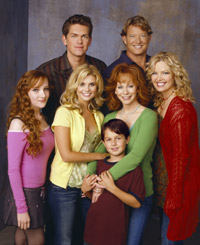
I've stated before that I don't watch that many sitcoms. It's hard to explain why, but in part the sitcom has become formulaic, and for whatever reason I just can't get interested in shows like Arrested Development or Scrubs which apparently try to break the formula. Maybe I'm just unwilling to find the time for them. That's part of what makes Reba so unusual - I am willing to find the time to watch it.
Reba is the WB series starring Reba McEntire. While the average sitcom usually features a stand-up comedian with little or no acting experience (see Kevin James or Ray Romano) and surrounds them with talented actors with the hope that something will rub off, Reba McEntire is a country singer with more than a little acting experience - the movie Tremors and Annie Get Your Gun on Broadway - who is surrounded by reasonably talented actors in hopes that something will rub off. The result is in truth not as bad as some people seem to think.
Reba plays Reba Hart, a single mom who works too hard, loves her kids and never stops: who she is is who she wants to be - that's from the theme song if you couldn't guess. Actually Reba is divorced and got the typical TV divorce settlement - a big house and enough money that she doesn't actually have to work as hard as the theme song indicates that she does - at least not outside of the house. Not that life is all sweetness and light at home. Her eldest daughter Cheyenne got pregnant and married in her senior year of high school. As she put it "the three months between getting my drivers license and getting pregnant were the freest I've ever felt." Cheyenne married Van the high school football star who did a year of college before turning pro and having a career ending injury. They (and the baby) live with Reba. Middle daughter Kyra is a typical sitcom teenage girl - a smart-ass in other words. In an act of teenaged rebellion she went to live with her father and his new wife. Youngest child Jake is typically sitcom pre-teen cute both in looks and acts. Rounding out the cast is Reba's ex, Brock and his new wife Barbara-Jean who got pregnant with Brock's baby while Brock was still married to Reba.
If most of that sounds like a typical sitcom play book, well throw it out. For one thing the absolute best thing about this show is Melissa Peterman as Barbara Jean. Barbara Jean isn't stupid, but she is more than a bit dense. Somehow she doesn't grasp the notion that Reba might not want to be friends with the woman who broke up her marriage by getting pregnant with Brock's child. She is always showing up at Reba's house behaving as though she is not just a friend but Reba's best friend - which in a bizarre sort of way she is! What makes the character is not just the writing but Peterman's delivery and her rubber-like face. She is a hoot and her scenes with McEntire are some of the best in the show in part because Peterman seems to bring out the goofy side of McEntire. It happens somewhat with the other characters but Peterman and McEntire together just cut loose. McEntire proves that she can mug for the camera almost as well as Peterman and that's saying a lot. For once Christopher Rich as Brock isn't the dumbest person in the cast. He's frequently a little thick but not stupid. The dumb character is Van, played by Steve Howey, and in the grand tradition of comedy he makes dumb funny. Just as one example there's a scene where Barbara Jean says "And what is dog spelled backwards?" It takes Van 15 seconds to figure out that dog spelled backwards is God. It's obviously a scene that plays better than it sounds. Van's interaction with his wife Cheyenne, played by Joanna Garcia, is done to perfection, even though Cheyenne's IQ seems to go down in her scenes with Van. Even Scarlett Pomers (who first appeared as Naomi Wildmon on Star Trek: Voyager) as Kyra manages to make her smart-assed teen character funny even though she's usually given precious little to work with.
Apparently Reba is either a show that people really love, or a show that people really love to hate. For me, while the writing isn't special and most of the characters aren't particularly original, the relationship between Barbara Jean and Reba and (more importantly) the way that Reba McEntire and Melissa Peterman play that relationship makes it a show that I try very hard not to miss.
Friday, April 29, 2005
Does The PTC Really Understand TV?
I got a missive a few days ago in that special little corner of my Hotmail account that I reserve for the PTC's mailing list (it's always nice when the other side sends you their plans). This time it wasn't a "buy our crap" solicitation, or a "we're so great that Time Magazine featured us in what we think is a positive light in an article about TV indecency" self-promo. It wasn't even a "boycott The Shield because it's on a lower level cable network that even kids can see (and just ignore the fact that the put it on at a time when any parent with sense would have their kids in bed dreaming even if it meant slipping tranquilizers into their Oreos) and it's full of the d--k word and the s--t word" e-alert. No this was a "save our show because it ain't indecent" missive, wrapped around a promo for the Highway to Heaven DVD set (because Michael Landon dedicated his life to giving us good wholesome programming). The show they're trying to save is Joan of Arcadia and on April 26 the PTC informed us that CBS has not yet renewed the show. In fact here's what the PTC says: "Joan of Arcadia, one of the most positive, family-affirming programs on television, is broadcasting its last show for this season and CBS has not renewed it for next year. Without a significant outpouring of public support, CBS may decide to cancel this superb show at the end of the season."
Here are a couple of news flashes for the PTC. First, very few shows have been renewed for next year. We won't know the exact composition of the network lineups until the "upfronts" where the networks reveal their lineups from next season - which for CBS happens on May 18. I suspect that the PTC knows this already of course and are just planning to inundate Les Moonves with mail so that he can't possibly refuse to renew. Second - and this is the part that I'm certain the PTC doesn't get - television isn't just about entertainment or providing "positive family-affirming programs". It is was, and always has been a business. The late Roy Thompson, at the time when he put Scottish TV on the air in Britain in 1957, called a television license "a license to print money". The job of television is to make money and the way to make money in broadcast television is to have shows that people watch so that advertisers will give you their money to to run their commercials. Based on the weekly ratings as published in the LA Times, Joan of Arcadia isn't doing that. Finishing 54th for the week of April 18-24 means that the show finished below the ending JAG, below the likely to be cancelled Blind Justice, below the "on-the-bubble" Alias. Most weeks it finishes below its timeslot competitor Dateline NBC. Logic dictates that if people aren't watching the show - and the episode that was seen on April 24 was not just a new episode but the season finale - then the advertising rates for the show are going to be lower. Business logic dictates that serious consideration should be given to cancelling the show if they have something that they think will work better in the timeslot.
I don't watch Joan of Arcadia - I tried to watch a couple of episodes in the first season, but it usually isn't a good sign when I fall asleep while watching a show - but a question that CBS undoubtedly can't answer - and the PTC undoubtedly won't answer - is why a show that was one of the most popular new shows last season and was nominated for three Emmys, is doing so poorly this season that it is being considered for cancellation.
(For the record, my best wild-ass guess is that Joan of Arcadia will be renewed but that there'll be some changes in writing and/or production, and that if it continues to slip next year CBS will drop it, but again I'm guessing.)
Here are a couple of news flashes for the PTC. First, very few shows have been renewed for next year. We won't know the exact composition of the network lineups until the "upfronts" where the networks reveal their lineups from next season - which for CBS happens on May 18. I suspect that the PTC knows this already of course and are just planning to inundate Les Moonves with mail so that he can't possibly refuse to renew. Second - and this is the part that I'm certain the PTC doesn't get - television isn't just about entertainment or providing "positive family-affirming programs". It is was, and always has been a business. The late Roy Thompson, at the time when he put Scottish TV on the air in Britain in 1957, called a television license "a license to print money". The job of television is to make money and the way to make money in broadcast television is to have shows that people watch so that advertisers will give you their money to to run their commercials. Based on the weekly ratings as published in the LA Times, Joan of Arcadia isn't doing that. Finishing 54th for the week of April 18-24 means that the show finished below the ending JAG, below the likely to be cancelled Blind Justice, below the "on-the-bubble" Alias. Most weeks it finishes below its timeslot competitor Dateline NBC. Logic dictates that if people aren't watching the show - and the episode that was seen on April 24 was not just a new episode but the season finale - then the advertising rates for the show are going to be lower. Business logic dictates that serious consideration should be given to cancelling the show if they have something that they think will work better in the timeslot.
I don't watch Joan of Arcadia - I tried to watch a couple of episodes in the first season, but it usually isn't a good sign when I fall asleep while watching a show - but a question that CBS undoubtedly can't answer - and the PTC undoubtedly won't answer - is why a show that was one of the most popular new shows last season and was nominated for three Emmys, is doing so poorly this season that it is being considered for cancellation.
(For the record, my best wild-ass guess is that Joan of Arcadia will be renewed but that there'll be some changes in writing and/or production, and that if it continues to slip next year CBS will drop it, but again I'm guessing.)
Mason Adams 1919-2005
Usually when an actor gets "The Big Break" and becomes famous for a role, you suddenly see him everywhere in series that were produced before the big break. Ed Asner suddenly became visible after he became Lou Grant on Mary Tyler Moore, and the same thing happened to Sorrell Booke after he put on the fat(ter) suit and became Boss Hogg on Dukes of Hazard. It wasn't the case with Mason Adams. If you look at his IMDB listing, you'll find a mere seven acting credits including two guest appearances in the 1950s, and a 1947 short about Alexander Graham Bell called Mr. Bell in which he played Thomas Watson. So you won't see Mason Adams in much before his breakthrough role as Charlie Hume in Lou Grant. But you'll hear him everywhere because, in the words of Leonard Cohen, Mason Adams was born with the gift of a golden voice and it was only after Lou Grant that we also saw that he had the sort of face that carried a great deal of authority and wisdom.
Mason Adams did a lot of radio work, starting in 1940 and continuing until pretty much the end of network radio in 1959. The was Pepper Young in Pepper Young's Family and played a lot of villains in other radio shows. He was the Kryptonite Man in The Adventures of Superman with Clayton "Bud" Collier (who hosted of course To Tell The Truth on TV). I recall hearing a comedy skit featuring Adams as an increasingly harried baseball announcer. According to the Internet Broadway Database Adams also appeared in six plays, five of them before Lou Grant.
Charlie Hume on Lou Grant was a breakthrough role of course. Charlie started as a sort of weak yes-man for Mrs. Pynchon, but as time went by he grew "a pair" and became more assertive, to the point where you could understand why Lou respected him and why. One episode I remember in particular had Charlie confronting the clueless wife of a Central American dictator about torture in her country - torture that he himself had been subjected to. Charlie was very much a supporting character but he had his moments, enough that he was nominated for the "Best Supporting Actor in a Drama" Emmy three years in a row. His role wasn't as showy as Nancy Marchand's Margaret Pynchon, or Robert Walden's Joe Rossi who ironically was also nominated for "Best Supporting Actor in a Drama" three years in a row; the same three years as Adams (they lost twice to Stuart Margolin in The Rockford Files and once to Michael Conrad in Hill Street Blues).
After Lou Grant left the air (and I'm one of those who is convinced that the cancellation had more to do with Ed Asner's politics than ratings) Adams went on to a host of appearances in TV movies and miniseries. and a comparatively small number of guest starring roles in TV series. His last listed acting appearance was in an episode of Oz in 2003, although the last part I saw him was as a Supreme Court Justice who takes Bartlett to task for not considering a real liberal as his replacement on the bench. In these roles he usually played a fatherly figure, but someone with a certain amount of authority. An example was his appearance in From The Earth To The Moon as Senator Clinton Anderson, who deflates Walter Mondale's attack on the space program by asking about Gus Grissom. It's a tiny role, but Adams brings the right level of gravity to it to make it believable. But it's as a voice actor that Mason Adams will be best remembered. He was the reader for the books on tape versions of Lillian Jackson Braun's "Cat" mystery novels (and probably many others), and was always in demand as a voice for commercials. For the past 30 years he's been the voice of Smuckers - "With a name like Smuckers, it has to be good."
Thursday, April 28, 2005
One Small Victory
You may remember a couple of months ago when there was a furor over The WB's plans to "update" Bugs, Daffy and the rest of the Looney Tunes characters with new designs. I did a piece on it, and so did a lot of people. Someone even did a hilarious if profanity filled animation of the "hip and edgy" version of Bugs Buzz Bunny, for which I don't have the URL. The fans were up in arms.
And it did no good. But THIS did.
It's so obvious of course. No one at The WB cares what a bunch of animation geeks think. Animation geeks will line up to buy whatever action figures and toys the studios throw at us. But animation geeks are getting older and are going to die off without new little animation geeks coming up to fill the ranks. That was the whole reason for coming up with Loonatics in the first place. So having an 11-year-old say that Loonatics sux carries a hell of a lot more weight than having someone like animation writer and historian Jerry Beck say that Loonatics is a travesty. An 11-year-old like Thomas Adams (from Oklahoma yet - don't want to irritate those Red Staters either or they'll sic the PTC on your Hollywood ass) is their target audience.
Thomas is just lucky this didn't happen when he was 13. His opinion would have been irrelevant.
And it did no good. But THIS did.
It's so obvious of course. No one at The WB cares what a bunch of animation geeks think. Animation geeks will line up to buy whatever action figures and toys the studios throw at us. But animation geeks are getting older and are going to die off without new little animation geeks coming up to fill the ranks. That was the whole reason for coming up with Loonatics in the first place. So having an 11-year-old say that Loonatics sux carries a hell of a lot more weight than having someone like animation writer and historian Jerry Beck say that Loonatics is a travesty. An 11-year-old like Thomas Adams (from Oklahoma yet - don't want to irritate those Red Staters either or they'll sic the PTC on your Hollywood ass) is their target audience.
Thomas is just lucky this didn't happen when he was 13. His opinion would have been irrelevant.
Tuesday, April 26, 2005
TV On DVD - April 26, 2005
Truly a banner week for TV shows on DVD, with MST3K supposed to come out last week but Amazon.ca stating that it was actually being released today. A couple of things that TV Shows on DVD has listed for this week won't be out until next week or later.
Mystery Science Theater 3000 Volume 7
- This was a series that I've never seen and probably never will. Not because I'm not interested in it, but because they can't clear it in Canada. The original material is fine, but the various network which might be interested in running the series always had problems clearing the movies that the episodes were built around for broadcast in Canada. And what fun would MST3K be without movies like The Killer Shrews?
Airline: Season 1
- One of the more interesting reality series that A&E has added to its lineup. Based on the British series called Airport instead of focusing on the day to day operations of a single airport, the series spends time with the passengers and ground personnel at Southwest Airlines in Los Angeles and Chicago. Based on the comments from various passengers, it's a wonder that Southwest is still in business based on the number of people vowing never to fly with them again for some problem, real or imagined. It's actually not too bad, to the point where I actually watch sometimes, which is more than I can say for Growing Up Gotti or Dog The Bounty Hunter. Still I remember when A&E actually took the Arts part of their name seriously.
Ancient Mysteries: Bigfoot
Ancient Mysteries: Camelot
- More shows that I haven't seen, these were part of a series of A&E documentaries about various myths and legends. Just how seriously you can take them I leave up to you. Not topics that I find interesting enough to spend money on though.
Crank Yankers: Season 2 Volume 1
- Yeah, I know what you're going to say, but this show isn't currently on in Canada and I don't know if it's ever been seen here by anyone who doesn't have a pirate dish. I don't so I haven't. The concept sounds as though it has the potential to be either very funny or extremely irritating. I guess it depends on whether you've ever been on the receiving end of a a crank phone call. Sorry, but I don't understand the need for the puppets.
ER: The Complete Third Season
- Ah yes, Season 3 of ER. This I saw, back in the days when ER wasn't as much of a soap opera as it became. Susan Lewis left (Sherry Stringfield apparently missed New York or her boyfriend) and Mark gets the crap beaten out of him in the men's room. Oh who do I think I'm kidding - it's always been a soap opera, it just used to be a good soap opera. Apparently not yet available in Canada, hence no link to Amazon.ca so the only way to get it in Canada at the moment is to buy a set with all three seasons. That doesn't seem right somehow.
Fraggle Rock: Live By The Rule Of The Rock
- Another series I remember very well. Interesting for kids of course, lacking much of the sophistication of The Muppet Show but there's much to be said for the show. It's fun to watch, particularly the "Uncle Travelling Matt" sequences. Jim Henson managed to get the CBC to part with some money to co-produce the show in Toronto. It's a fun little confection, but releasing it as individual episodes makes the show a potential cash cow for the releasing company.
Highway To Heaven: Season One
- I never "got" this show, by which I mean that I just didn't get it. A lot of people did though, including some members of my family who are on the whole not particularly religious. It was clearly a predecessor for Touched By An Angel which is another series that I just never got. From what I recall it was a rather gentle show with Michael Landon and Victor French. Maybe that was part of it - in a TV landscape dominated by automatic weapons and the people wielding them it was a gentle peaceful show. It didn't hurt that it was Michael Landon who if nothing else was adept at promoting series he was involved with.
Land Of The Lost: The Complete Third Season
- The 1970s original, not the crappy remake. I've never seen either though so don't take my word for it. Why haven't I? Well it was a Saturday morning show in the U.S. which was there and gone years before we had cable from Detroit - or even Williston North Dakota - in Saskatoon. I think about the only Sid and Marty Krofft series I ever saw was The Banana Splits. Oh Uh Chongo!
Quatermass: Set 1
- This was really the classic British science fiction series. It first appeared in 1953, when the BBC head of drama spent his entire budget for acquiring new scripts for the year (a magnificent 250 pounds - and how do I get that symbol in this blog!) on one set of scripts for a six episode science-horror series called The Quatermass Experiment. There followed two more series in the 1950s: Quatermass II and Quatermass and the Pit.All three were made into movies but the series went no further. Then in 1979 the private network ITV brought out the final story in the series Quatermass starring John Mills (who passed away a few days ago). It's generally regarded as good but not quite as good as shows from the 1950s despite, or perhaps because, of the improve special effects.
Survivor 2: The Australian Outback
- Survivor began back in the days when no one thought that you could sell DVD that were all the episodes of the show with a few special features and "never before seen footage". The original Survivor was released on a single DVD with no fuzzing over naked Richard Hatch (apparently there wasn't much to see) and a few interviews with cast members. The second Survivor got the same treatment and then no more. That was the season of Jerri (the Witch) Manthey, of the phantom beef jerky, the chef who couldn't cook rice, and while Elizabeth Filarski didn't win the show's million she did get the job on The View which over time has probably been more lucrative for her long term.
Teenaged Mutant Ninja Turtles: Season 2
- Once upon a time there was a little independent comic book about some pet shop turtles who were exposed to a radioactive isotope that gave them human-like intelligence and stature. Teenaged humans of course with all that meant in the late '80s. This became a couple of fairly cheesy movies. This in turn became a series of animated cartoons (the ones in this box set) which in turn spawned a comic book in the image of the cartoon series which was so totally alien to the original vision in the independent comics that it was a sin, but the new cartoons and comic series was very profitable for the two guys who created the original comic books so they were crying all the way to the bank because they owned their copyrights while guys like Jack Kirby, Stan Lee, Jerry Siegel and Joe Shuster didn't.
Trading Spaces: Creative Home Decor With Designer Doug Wilson
Trading Spaces: Great Kitchen Designs and More!
- Basically a set of highlights from past shows, focusing on creative decor and kitchen designs. Call me elitist, but I'm not sure I want decorating hints from people who do some of the "designs" these guys do on the show.
The Waltons: The Complete Second Season
- It's hard to think today about how big The Waltons was. It was a rural show just two seasons after Fred Silverman had "cleansed" the CBS line-up of rural shows, including Jim Nabor's variety show. It was a period piece, and no one watched those unless it was Bonanza or Gunsmoke. Worst of all it was on opposite Flip Wilson, who in the day qualified as a hip urban comic. All The Waltons had was good writing and solid actors. It couldn't last. By the end of the first season Flip Wilson was off the air and The Waltons had won four out of the five Emmys it was nominated for. The simple explanation is that in the days of the Vietnam War, civil protests and Watergate people wanted something they could watch with their kids and look back at what seemed like simpler times.
Wildboyz: The Complete Second Season
- Okay, I'm not even going to hazard a guess about what this could be, and reading the comments on the IMDB, I think I'm glad.
Mystery Science Theater 3000 Volume 7
- This was a series that I've never seen and probably never will. Not because I'm not interested in it, but because they can't clear it in Canada. The original material is fine, but the various network which might be interested in running the series always had problems clearing the movies that the episodes were built around for broadcast in Canada. And what fun would MST3K be without movies like The Killer Shrews?
Airline: Season 1
- One of the more interesting reality series that A&E has added to its lineup. Based on the British series called Airport instead of focusing on the day to day operations of a single airport, the series spends time with the passengers and ground personnel at Southwest Airlines in Los Angeles and Chicago. Based on the comments from various passengers, it's a wonder that Southwest is still in business based on the number of people vowing never to fly with them again for some problem, real or imagined. It's actually not too bad, to the point where I actually watch sometimes, which is more than I can say for Growing Up Gotti or Dog The Bounty Hunter. Still I remember when A&E actually took the Arts part of their name seriously.
Ancient Mysteries: Bigfoot
Ancient Mysteries: Camelot
- More shows that I haven't seen, these were part of a series of A&E documentaries about various myths and legends. Just how seriously you can take them I leave up to you. Not topics that I find interesting enough to spend money on though.
Crank Yankers: Season 2 Volume 1
- Yeah, I know what you're going to say, but this show isn't currently on in Canada and I don't know if it's ever been seen here by anyone who doesn't have a pirate dish. I don't so I haven't. The concept sounds as though it has the potential to be either very funny or extremely irritating. I guess it depends on whether you've ever been on the receiving end of a a crank phone call. Sorry, but I don't understand the need for the puppets.
ER: The Complete Third Season
- Ah yes, Season 3 of ER. This I saw, back in the days when ER wasn't as much of a soap opera as it became. Susan Lewis left (Sherry Stringfield apparently missed New York or her boyfriend) and Mark gets the crap beaten out of him in the men's room. Oh who do I think I'm kidding - it's always been a soap opera, it just used to be a good soap opera. Apparently not yet available in Canada, hence no link to Amazon.ca so the only way to get it in Canada at the moment is to buy a set with all three seasons. That doesn't seem right somehow.
Fraggle Rock: Live By The Rule Of The Rock
- Another series I remember very well. Interesting for kids of course, lacking much of the sophistication of The Muppet Show but there's much to be said for the show. It's fun to watch, particularly the "Uncle Travelling Matt" sequences. Jim Henson managed to get the CBC to part with some money to co-produce the show in Toronto. It's a fun little confection, but releasing it as individual episodes makes the show a potential cash cow for the releasing company.
Highway To Heaven: Season One
- I never "got" this show, by which I mean that I just didn't get it. A lot of people did though, including some members of my family who are on the whole not particularly religious. It was clearly a predecessor for Touched By An Angel which is another series that I just never got. From what I recall it was a rather gentle show with Michael Landon and Victor French. Maybe that was part of it - in a TV landscape dominated by automatic weapons and the people wielding them it was a gentle peaceful show. It didn't hurt that it was Michael Landon who if nothing else was adept at promoting series he was involved with.
Land Of The Lost: The Complete Third Season
- The 1970s original, not the crappy remake. I've never seen either though so don't take my word for it. Why haven't I? Well it was a Saturday morning show in the U.S. which was there and gone years before we had cable from Detroit - or even Williston North Dakota - in Saskatoon. I think about the only Sid and Marty Krofft series I ever saw was The Banana Splits. Oh Uh Chongo!
Quatermass: Set 1
- This was really the classic British science fiction series. It first appeared in 1953, when the BBC head of drama spent his entire budget for acquiring new scripts for the year (a magnificent 250 pounds - and how do I get that symbol in this blog!) on one set of scripts for a six episode science-horror series called The Quatermass Experiment. There followed two more series in the 1950s: Quatermass II and Quatermass and the Pit.All three were made into movies but the series went no further. Then in 1979 the private network ITV brought out the final story in the series Quatermass starring John Mills (who passed away a few days ago). It's generally regarded as good but not quite as good as shows from the 1950s despite, or perhaps because, of the improve special effects.
Survivor 2: The Australian Outback
- Survivor began back in the days when no one thought that you could sell DVD that were all the episodes of the show with a few special features and "never before seen footage". The original Survivor was released on a single DVD with no fuzzing over naked Richard Hatch (apparently there wasn't much to see) and a few interviews with cast members. The second Survivor got the same treatment and then no more. That was the season of Jerri (the Witch) Manthey, of the phantom beef jerky, the chef who couldn't cook rice, and while Elizabeth Filarski didn't win the show's million she did get the job on The View which over time has probably been more lucrative for her long term.
Teenaged Mutant Ninja Turtles: Season 2
- Once upon a time there was a little independent comic book about some pet shop turtles who were exposed to a radioactive isotope that gave them human-like intelligence and stature. Teenaged humans of course with all that meant in the late '80s. This became a couple of fairly cheesy movies. This in turn became a series of animated cartoons (the ones in this box set) which in turn spawned a comic book in the image of the cartoon series which was so totally alien to the original vision in the independent comics that it was a sin, but the new cartoons and comic series was very profitable for the two guys who created the original comic books so they were crying all the way to the bank because they owned their copyrights while guys like Jack Kirby, Stan Lee, Jerry Siegel and Joe Shuster didn't.
Trading Spaces: Creative Home Decor With Designer Doug Wilson
Trading Spaces: Great Kitchen Designs and More!
- Basically a set of highlights from past shows, focusing on creative decor and kitchen designs. Call me elitist, but I'm not sure I want decorating hints from people who do some of the "designs" these guys do on the show.
The Waltons: The Complete Second Season
- It's hard to think today about how big The Waltons was. It was a rural show just two seasons after Fred Silverman had "cleansed" the CBS line-up of rural shows, including Jim Nabor's variety show. It was a period piece, and no one watched those unless it was Bonanza or Gunsmoke. Worst of all it was on opposite Flip Wilson, who in the day qualified as a hip urban comic. All The Waltons had was good writing and solid actors. It couldn't last. By the end of the first season Flip Wilson was off the air and The Waltons had won four out of the five Emmys it was nominated for. The simple explanation is that in the days of the Vietnam War, civil protests and Watergate people wanted something they could watch with their kids and look back at what seemed like simpler times.
Wildboyz: The Complete Second Season
- Okay, I'm not even going to hazard a guess about what this could be, and reading the comments on the IMDB, I think I'm glad.
Monday, April 25, 2005
My First Meme!
1. What time did you get up this morning? 10 a.m. thanks to my alarm clock. It's just lucky it's on the other side of the room from my bed.
2. Diamonds, pearls or silver? So boring. I like something with colour like rubies, emeralds or saphires. Still, if I have to choose from this list I'd say pearls, but only if they're the rarer coloured ones. The golden pearls that I saw a few weeks ago on The Apprentice are among the most stunning things I have ever seen.
3. What was the last film you saw at the cinema? Lord of the Rings: Fellowship of the Ring. It's just too much of a hassle to go downtown to a movie and spend $10 or whatever it is here now, particularly when I can buy a movie I really want to see for the same amount of money if I go to the right place.
4. What is your favorite TV show? Currently The Amazing Race. I know it's a reality show but on the whole there isn't the backstabbing that you see on Survivor or The Apprentice. I used to like The Mole as well but it died when they put celebrities on it. Looking back a bit I liked Hill Street Blues, St. Elsewhere, and Crime Story. Oh yeah, and there's also the new version of Doctor Who.
5. What did you have for breakfast? I so rarely eat breakfast that it's criminal. Actually about the only time I eat breakfast is when I'm traveling which happens less often than I'd like.
6. What is your middle name? Strictly speaking it's Brent. I share - or rather shared - a birthday with my great-uncle Stan. He was born in 1916 (roughly; his birth records were about the worst I've ever seen - for his pension we found that the only record anyone had for his year of birth was a newspaper item for when he enlisted in the army and that could have been 1916 or 1915) so we were about 40 years apart. No one has ever ever called me Stanley or Stan, and they'd better not.
7. What is your favorite cuisine? I don't really have a favourite kitchen (snicker) but as far as styles of food, I'm pretty flexible. (Cuisine - French for Kitchen. High school French strikes again.)
8. What foods do you dislike? Don't like liver and I'm not crazy about any fish that looks back at you, but the absolute worst is Steak and Kidney Pie. I don't mind the steak part but to me the kidneys taste like the end product of what they process.
9. What is your favorite chip/crisp flavor? For potato chips Miss Vickie's Sea Salt and Vinegar. On the other hand Doritos has just come out with a Dill Pickle Tortilla Chip which may be the best chip to cross my lips. Going beyond chips a bit, Hawkins Cheezies have been a staple with me since before I can remember.
10. What is your favorite CD at the moment? I so rarely use my CD player that I can't really answer. Besides, my taste in music is thoroughly archaic. Just as an example I have the Swing Canada series on a private label that hasn't produced any more.
11. What kind of car do you drive? I don't drive. In the winter or wet weather I take the bus or get a ride with someone. In weather like this I ride my bike when I want to go somewhere. In just about any weather I walk a lot.
12. Favorite sandwich? Corned Beef, preferably on Winnipeg Rye but I'm willing to settle for a Kaiser Roll if that's all I've got. I also like Peanut Butter and Dill Pickle (slice the pickle into thick rounds and put between two pieces of white or whole wheat bread with peanut butter - preferably crunchy - on both).
13. What characteristics do you despise? The combination of greed, selfishness and dishonesty is the worst.
14. Favorite item of clothing? A sweat shirt.
15. If you could go anywhere in the world on vacation, where would you go? I've always wanted to take a cruise around South America. The old Britannis used to do a circumnavigation but she's been gone for a few years.
16. What color is your bathroom? A sort of beigy pink, with some faux white and blue tiles. I need to do something about it.
17. Favorite brand of clothing? I don't really worry about brands.
18. Where would you retire to? The Monterey Peninsula of California - not too hot, not too cold. I hate temperature extremes.
19. Favorite time of day? Evenings, a bit before dusk.
20. What was your most memorable birthday? In truth none stick out. That's really sad.
21. Where were you born? Saskatoon Saskatchewan, Canada.
22. Favorite sport to watch? Curling. I haven't watched Hockey much since well before the strike, and I'm off of baseball since the Expos moved south, but ask any Canadian and he or she will be able to talk about raises and draws even if they've never played the game.
23. Who do you least expect to send this back to you? Did I happen to mention that I'm a meme virgin. I know Sutpen would ignore it - not sure about his blogging partner Stephen Cooke though.
24. Person you expect to send it back first? No one, but I wouldn't mind seeing answers from Tim and Ronniecat.
25. What fabric detergent do you use? I don't do the washing myself (my mother lives with me and does it) but I believe the preference is for Tide.
26. Coke or Pepsi? Coke, but the Canadian kind please (it has sugar not - or more likely in addition to - corn syrup). In the U.S. apparently the only way to get sugar in your Coke is to buy Kosher Coke around Passover. Actually I prefer a Double Gulp Dr. Pepper but my neighbourhood 7-11 closed in January and I haven't found a replacement yet.
2. Diamonds, pearls or silver? So boring. I like something with colour like rubies, emeralds or saphires. Still, if I have to choose from this list I'd say pearls, but only if they're the rarer coloured ones. The golden pearls that I saw a few weeks ago on The Apprentice are among the most stunning things I have ever seen.
3. What was the last film you saw at the cinema? Lord of the Rings: Fellowship of the Ring. It's just too much of a hassle to go downtown to a movie and spend $10 or whatever it is here now, particularly when I can buy a movie I really want to see for the same amount of money if I go to the right place.
4. What is your favorite TV show? Currently The Amazing Race. I know it's a reality show but on the whole there isn't the backstabbing that you see on Survivor or The Apprentice. I used to like The Mole as well but it died when they put celebrities on it. Looking back a bit I liked Hill Street Blues, St. Elsewhere, and Crime Story. Oh yeah, and there's also the new version of Doctor Who.
5. What did you have for breakfast? I so rarely eat breakfast that it's criminal. Actually about the only time I eat breakfast is when I'm traveling which happens less often than I'd like.
6. What is your middle name? Strictly speaking it's Brent. I share - or rather shared - a birthday with my great-uncle Stan. He was born in 1916 (roughly; his birth records were about the worst I've ever seen - for his pension we found that the only record anyone had for his year of birth was a newspaper item for when he enlisted in the army and that could have been 1916 or 1915) so we were about 40 years apart. No one has ever ever called me Stanley or Stan, and they'd better not.
7. What is your favorite cuisine? I don't really have a favourite kitchen (snicker) but as far as styles of food, I'm pretty flexible. (Cuisine - French for Kitchen. High school French strikes again.)
8. What foods do you dislike? Don't like liver and I'm not crazy about any fish that looks back at you, but the absolute worst is Steak and Kidney Pie. I don't mind the steak part but to me the kidneys taste like the end product of what they process.
9. What is your favorite chip/crisp flavor? For potato chips Miss Vickie's Sea Salt and Vinegar. On the other hand Doritos has just come out with a Dill Pickle Tortilla Chip which may be the best chip to cross my lips. Going beyond chips a bit, Hawkins Cheezies have been a staple with me since before I can remember.
10. What is your favorite CD at the moment? I so rarely use my CD player that I can't really answer. Besides, my taste in music is thoroughly archaic. Just as an example I have the Swing Canada series on a private label that hasn't produced any more.
11. What kind of car do you drive? I don't drive. In the winter or wet weather I take the bus or get a ride with someone. In weather like this I ride my bike when I want to go somewhere. In just about any weather I walk a lot.
12. Favorite sandwich? Corned Beef, preferably on Winnipeg Rye but I'm willing to settle for a Kaiser Roll if that's all I've got. I also like Peanut Butter and Dill Pickle (slice the pickle into thick rounds and put between two pieces of white or whole wheat bread with peanut butter - preferably crunchy - on both).
13. What characteristics do you despise? The combination of greed, selfishness and dishonesty is the worst.
14. Favorite item of clothing? A sweat shirt.
15. If you could go anywhere in the world on vacation, where would you go? I've always wanted to take a cruise around South America. The old Britannis used to do a circumnavigation but she's been gone for a few years.
16. What color is your bathroom? A sort of beigy pink, with some faux white and blue tiles. I need to do something about it.
17. Favorite brand of clothing? I don't really worry about brands.
18. Where would you retire to? The Monterey Peninsula of California - not too hot, not too cold. I hate temperature extremes.
19. Favorite time of day? Evenings, a bit before dusk.
20. What was your most memorable birthday? In truth none stick out. That's really sad.
21. Where were you born? Saskatoon Saskatchewan, Canada.
22. Favorite sport to watch? Curling. I haven't watched Hockey much since well before the strike, and I'm off of baseball since the Expos moved south, but ask any Canadian and he or she will be able to talk about raises and draws even if they've never played the game.
23. Who do you least expect to send this back to you? Did I happen to mention that I'm a meme virgin. I know Sutpen would ignore it - not sure about his blogging partner Stephen Cooke though.
24. Person you expect to send it back first? No one, but I wouldn't mind seeing answers from Tim and Ronniecat.
25. What fabric detergent do you use? I don't do the washing myself (my mother lives with me and does it) but I believe the preference is for Tide.
26. Coke or Pepsi? Coke, but the Canadian kind please (it has sugar not - or more likely in addition to - corn syrup). In the U.S. apparently the only way to get sugar in your Coke is to buy Kosher Coke around Passover. Actually I prefer a Double Gulp Dr. Pepper but my neighbourhood 7-11 closed in January and I haven't found a replacement yet.
Subscribe to:
Posts (Atom)