 Why is it that the British do certain types of shows on their main broadcast networks - in prime time mind you - that no North American programmer outside of some cable channel would think of running. At least until it hits big. I mean look at the record. Ball room dancing, with C-list celebrities. British. Figure skating with C-list celebrities. British. Wanna-be singers auditioning to get a big time recording contract singing pre-packaged pop tunes. British. A game show so insanely simplistic that all the player has to decide is which briefcase will be opened next and whether they'll take an offered prize amount based on what amounts are unknown at this point in the game. Well okay Deal Or No Deal was originally Australian but it and several other prime time game shows are hits in Britain, and two of those were hits in the US until American programmers decided to "improve" them to the point of cancellation. Then there are the self-help shows. The British had a home renovation show in prime time - Changing Rooms - and a gardening program - Ground Force - was there until last year. The British love cooking shows - they gave us Gordon Ramsey, and didn't give us Delia Smith (for which we should be terribly grateful - one Martha Stewart is enough, even though before there was Martha there was Delia). They even have a show about evaluating antiques - Americans were openly amazed when PBS introduced The Antiques Roadshow but the British version had been running for almost twenty years by the time the Americans caught on, and they still don't do it right.
Maybe its the way the British do shows. Take Top Gear. It's a show about cars, or as the British would put it "motoring". Now in North America this would be a half hour program on some obscure cable channel, or if the producers are lucky on a sports network like TSN in Canada. The cast would consist of two, maybe three guys who would talk ever so earnestly about new cars that they were testing. Words like "brake horsepower" and "pounds of torque" would earnestly pass their lips, and you would see earnestly shot footage of cars being driven around by people who are probably not the earnest hosts. There's no physical structure unless the show spends some time in a garage where they show you what's under the hood and maybe how you can make minor repairs. Obviously there's no live audience - why would even the most earnest car lover want to watch these guys taping their show.
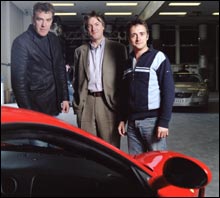
Ah but the British; the British do things differently. Top Gear is funny. You know that because the live studio audience laughs and applauds. And this isn't just an anonymous studio audience that may or may not be somewhere behind the cameras. The studio portions of Top Gear are quite literally "theatre in the round" as the audience stands a few respectful feet away from presenters Richard "Hamster" Hammond, James May and "head boy" Jeremy Clarkson, listening in rapt attention to their every opinion and on occasion actually getting to voice their opinions when a microphone is stuck in front of their face, usually by Clarkson, who is the most opinionated of the lot. Apparently - for example - he recently stirred more than a little controversy when he stated that the German built Mini-Cooper should have a "quintessentially German" satellite navigation system that leads only to Poland. But then listening to Clarkson go on in this manner is part of the fun of the show. There's a news segment in which the hosts comment on press releases, suggestions for finding good deals, and the Wall Of Cool, where the hosts rate cars as "Sub-Zero, Cool, Uncool, and Seriously Uncool" based on appearance and performance - but mostly appearance.
Of course the most important parts of the show don't happen in the studio. Even these aren't ordinary. There are of course the reviews of the cars. Sure these have all the comments about brake horsepower and torque, but they seem to have so much fun driving the damned cars - hard and fast (they like cars that go hard and fast - you don't want to know what they have to say about cars like the Prius except that it is so "uncool" that it isn't even on the Wall Of Cool). They don't like cars that are boring and sedate to drive but feel mushy to drive. For that matter they don't like American cars primarily because they're American and Americans don't build "good" or even adequate cars (well actually Clarkson so fell in love with the new Ford GT that he apparently bought one - it immediately went to the "Seriously Uncool" section of the shows Wall Of Cool because of it).
But the show does so much more with its outdoors segments. There are on occasion races of various types. The show has at various times sought the fastest religion; a priest a minister and a rabbi got into a Suzuki Lianna together and met an imam there - that's not a joke, that's basically what happened. In similar race they tried to find the fastest political party in Britain, but my favourite was when they tried to find the fastest "science fiction monster" they had a Klingon (apparently there's a Klingon word for understeer), Darth Vader, a Cyberman, and a Dalek, with a special appearance from a chap in a blue police box (Colin Baker looking very much his 60 years at the time) - the Cyberman won, but the Dalek was angry because he was unable to actually get in the car and exterminated everyone but James May and The Doctor. Another form of race pits the show's host against some other form of transport. They had a race from London to Monte Carlo where Clarkson drove an Aston Martin DB8 while May and Hammond travelled by TGV - Clarkson won. One of the most famous incidents occurred when they took a 13 year old Toyota Hi-Lux truck (the type is currently known in North America as a Toyota Tacoma) and, to illustrate just how durable it was) ran it through a torture test that included driving down a set of stairs, crashing it into various things including a landmark tree (for which they were fined) hit it a few times with a wrecking ball (they didn't drop the ball into it) tied it to a jetty in the Severn Estuary where the tides were so powerful that the ropes snapped and the truck was pulled out to sea. They found it and after digging out all of the silt it still ran. In a later episode the put the truck on top a 24 story apartment block scheduled for implosion. After the building collapsed, they found the truck and not only started it up but were actually able to drive it into the studio despite the fact that the frame had entirely sheered apart.
The outside sequences do sometimes have a serious bent. Clarkson drove a Mercedes Turbo from London to Edinburgh and back on a single tank of gas to illustrate techniques for saving gas (closed windows and no heating or air conditioning, the radio is fine but nothing else like the CD player or a satellite navigation system, accelerate before you get to a hill and let the speed bleed off as you go up). He made he trip - barely. May once demonstrated satellite navigation systems by racing a homing pigeon - the bird beat him! In another sequence, Richard Hammond showed escape methods for people who are in a car that is going into the water. The recommended technique, which was to wait for pressure to equalize between the inside of the car and thene open the doors would have resulted in him dying if there hadn't been a diver with a scuba outfit sitting behind him in the car. They then demonstrated getting out as soon as the car hit the water. It was considerably more effective.
Two of the most enjoyable parts of the show are the Power Laps in which a professional race driver known only as "The sties" (but currently rumoured to be Damon Hill among others) takes a high performance car around the Top Gear test track. Among the fastest cars the Stig has driven have been the Pagani Zonda, the Ariel Atom, the Mercedes-Benz SLR McLaren, and the Koenigsegg CC8S. The other highlight of the show is the Star In A Reasonably Priced Car in which a celebrity drives a Suzuki Lianna (the American version is the Aerio) around the test track. Among the Stars who have appeared in this segment are Patrick Stewart, Roger Daltry, Gordon Ramsay (who tied with Jamie Oliver), Christian Slater, David Soul (who broke two of the Lianna's - wasn't used to a manual transmission) and Simon Cowell who has the third fastest time around the track. Two "Stars" - Terry Wogan and Richard Whitely - actually posted slower times that a Billy Baxter, a British veteran who was blinded during the Bosnian war.
Top Gear was seen on the Discover Channel in the United States between June and October 2005, and more extensively on BBC World in areas where that channel can be seen. However these were heavily edited episodes, cut down from one hour to thirty minutes by cutting out a lot of the studio segments and in particular the "Wall of Cool" and "Star In A Reasonably Priced Car" segments. This led to rather baffling credits where you'd see the name of a celebrity guest who viewers of the edited version have never seen. If this is the only version of Top Gear that you have seen, then you haven't seen the show. An hour long episode (minus a few minutes cut for commercials) have been running on BBC Canada, but seems to only be showing the thirty-two 2003-2004 episodes so far. Apparently Discovery Channel in the US will be producing their own version of Top Gear, reportedly with the British Stig as the only carryover from the original show. Hopefully in this domestic version they might consider doing their own versions of the Wall Of Cool and Star In A Reasonably Priced Car and the other segments that are cut for the half hour show. I suspect that this American version might be successful. The problem is that it probably won't be as good as the original, just as the American Antiques Roadshow isn't as good as the British (or even the Canadian), the American What Not To Wear is inferior to the British version with Trinny & Susannah (who've been on Top Gear) and Trading Spaces isn't as good as Changing Rooms was. If you get a chance to see the full hour version of Top Gear do so. You won't be as happy with the half hour version if you do.
