This is the start of a three week series looking at what I think are the best and worst things about Canadian television. Please note that I didn't say Canadian television shows - that would be too specific. My focus is on aspects of the industry. First up: Five things I like about Canadian television (in no particular order of course).
Tits and Cussing: I'm talking about over the air network television here too. While it's not prevalent on the private networks, for reasons I'll get into in a moment, Canadian broadcast regulations are structured in such a way that pretty much anything goes the later you get in the night. CBC may have shown the first bare breast in a drama in North America around 1970, and as far as swearing goes the limits on that have been pushed pretty far back as well. Some years ago the CBC showed the British series The Camomile Lawn, complete with full frontal Tara Fitzgerald, and all the usual swearing. In 2000 CTV counterprogrammed the Sydney Olympics with the first season of The Sopranos - no bleeps, no fuzzed over nipples, everything as it was shot for HBO. There could be a lot more nudity and cursing on Canadian TV were it not for the fact that the private English language networks buy most of their product from the United States, and even when they buy movies they tend to be versions that have been sanitized for the American market. The CRTC (the Canadian Radio Television and Telecommunications Commission - the Canadian equivalent to the FCC) limits its censorship role considerably, and there is no strong organized pressure group like the Parents Television Council in Canada. We accept it.
Curling: I know it's a silly thing to put down, but I think it's indicative of something that not only do Canadian televisions stations broadcast Curling but that there was controversy when a new broadcasting deal was signed that reduced the number of hours of the Men's and Women's Canadian and World Championships that would be broadcast, forcing rights holder to scramble to find a partner network to show extra hours. Curling is a sport which even it's strongest supporters will admit is lighter on speed and conflict than golf - I tend to liken it to chess played using the Newtonian laws of motion - but the networks indulge the passion.
CBC Kids Programs: I've mentioned this before, but it's worth repeating. Since the very beginning, CBC has taken the responsibility of crafting shows for children very seriously. Fred Rogers got his earliest network exposure with a Canadian show called Butternut Square, and morning kids programs have included iconic shows like Chez Helene, The Friendly Giant, and Mr. Roger's former puppet master Ernie Coombs, Mister Dress Up. In the afternoons there was Razzle Dazzle, The Forest Rangers and Drop In. For many years Sesame Street was seen in Canada with Canadian material inserted - something that was actually harmful to children's programming in Canada because the show tended to suck money away from Canadian programs to pay the hefty license fee. Current programming includes both shows from the United States such as Clifford The Big Red Dog and domestic production such as Poko, The Save-ums, and Nanalan in the mornings for pre-school viewers - all shown without commercials - and a variety of Canadian made shows for school aged children and younger teens in the 4 to 5 p.m. slot.
News: This is a bit of tough issue, but all three of the main Canadian networks make a major effort at doing news all day long. This is in addition to two Canadian cable news services CBC Newsworld and CTV Newsnet. There has also been a recent application to the CRTC for a third cable service which would rebroadcast local CTV news programs from each province. These services exist because Canadians say that they want them, and although some politicians on the right may say that the CBC is biased towards the Liberal Party, the general perception is that none of the networks has a particular bias towards any political party.
Comedy: Canadians seem to laugh at different stuff than Americans. How else do you explain that the year it was cancelled in the States, Caroline In The City was the top rated show in Canada? CBC in particular has made a major commitment to Canadian comedy, mostly satire with shows like Red Green, This Hour Has 22 Minutes and Royal Canadian Air Farce. In addition they show segments from the Montreal Comedy Festival Just Pour Rire/Just For Laughs. The Comedy Network has a new original show called Popcultured with Elvira Kurt which is in the style of The Daily Show, and Puppets Who Kill which is difficult to explain. As well they show classic Canadian comedy programming including SCTV, Kids In The Hall, and (though you have to look for it) Wayne & Shuster. Sitcoms have never done as well but last year CTV started Corner Gas starring Brent Butt which has turned into a significant hit for a Canaidan comedy.
And hey, what can you say about a country where The Amazing Race is the most popular show on Tuesday nights (and third for the week) ahead of American Idol and Law & Order: SVU?
Saturday, April 23, 2005

Friday, April 22, 2005
It's Earth Day...
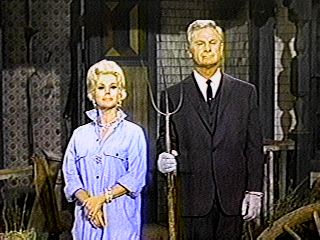
...so Happy 97th Birthday to Eddie Albert, aka Carlton Travis (Falcon Crest 1981), Frank McBride (Switch 1975), Larry Tucker (Leave It To Larry 1952) and of course our beloved Oliver Wendell Douglas (Green Acres 1965). Actor, Singer, Inventor, Environmentalist, American Hero at the invasion of Tarawa.
Thursday, April 21, 2005
Housekeeping
A few additions to the Blogroll and I give in to the dark side.
As you can see, I've decided to go with the Amazon.ca Associates program. I'll try to keep references to the minimum, but if you do want to buy from Amazon I won't object if you use my links. Somehow I feel so dirty ;-) so I think I'll atone by also adding a link to the Blue Ribbon Campaign against Internet Censorship (the Canadian campaign of course).
Additions to the Blogroll:
As you can see, I've decided to go with the Amazon.ca Associates program. I'll try to keep references to the minimum, but if you do want to buy from Amazon I won't object if you use my links. Somehow I feel so dirty ;-) so I think I'll atone by also adding a link to the Blue Ribbon Campaign against Internet Censorship (the Canadian campaign of course).
Additions to the Blogroll:
- Hearing Loss is my friend Ronniecat from rec.arts.comics.strips. She recently received a Coclear Implant which has restored her hearing after a number of years of deafness.
- TV Nights is a blog listing nightly schedules from the various American commercial networks in various years. Interesting reading, in a disorganized sort of way.
- Just Another Blowhard is a blog from a guy in Brooklyn who occasionally posts about the various media, but even when he doesn't is usually pretty funny, in a ranting sort of way.
- SpeakSpeak News is a major blog focusing on the fight against media censorship in general with special attention to the PTC (thanks to Tony Figueroa for letting me know about this site).
- Blog Maverick is Mark Cuban's blog. As most of you may know Cuban is an internet multi-millionaire and owner of the Dallas Mavericks. As fewer of you may remember he was also briefly a faux Donald Trump who starred on ABC's stinker The Benefactor. His blog has some pretty interesting stuff on business and new technology.
- Respectful Insolence is a blog from "an academic surgeon and scientist" specializing in research about Cancer. He doesn't just focus on medicine, and has some rather interesting thoughts on a variety of subjects, both around science and general politics.
- Yet Another Journal is an enjoyably light personal blog that sometimes touches on television and fandom.
- Jim Hill Media is a blog that I just added today. Jim writes about the Disney Organization, particularly the theme parks. He was recently banned from Disneyland for leading an unauthorized tour. He's not particularly hostile to the House of the Mouse, but he's not criticism free either. Thanks for the information Linda (of Yet Another Journal).
CSI -A Tale Of Three Series: New York
In the next to last episode of the second season of CSI: Miami a murder in Miami led Horatio Caine north from the Florida sun to the grey urban canyons of New York. There he met Detective First Grade Mac Taylor, the head of a New York CSI unit. That's how viewers were introduced to the third series in the CSI franchise, CSI: New York.
There had been a lot of speculation among fans when it was announced that CBS and Jerry Bruckheimer were bringing a third CSI series to television. The speculation centred around what city it should be set in and who should star. The feeling expressed by a lot of fans was that the series should follow its predecessors and be set in an "exotic" American city; New Orleans was a fan favourite. Avery Brooks (who had previously appeared as Hawk in Spenser For Hire and Benjamin Sisko in Star Trek: Deep Space Nine) was suggested as the lead actor. Thus there was some hostility when it was announced that the new series would focus on crime in New York - New York had been done to the point where it was thought to be overexposed. There was some surprise that the producers were able to lure an actor of the caliber of Gary Sinise to play the lead role in a TV series.
When series finally debuted it was not initially well-regarded, which in all honesty is a bit surprising. In form it is a lot closer to the original CSI than CSI: Miami is. Although Sinise is clearly the lead in the series, the focus of the show is far less on him than is the case with David Caruso in CSI: Miami. They have surrounded Sinise with a strong supporting cast led by Melina Kanakeredes (previously the star of Providence although for fans of Due South she will forever by Victoria - or "Vile Vicki" - from the episode Victoria's Secret) as the principal supporting character, with Vanessa Ferlito and Carmine Giovinazzo as the younger investigators in his squad, and Hill Harper (from the ill-fated series The Handler) as the chief coroner. In addition producers clearly listened to the fans who were critical of the extensive character development for the character of Horatio Caine on the "Miami" series. What we know about Mac Taylor is that he lost his wife on September 11, 2001 (a development that many viewers felt was highly manipulative) and that as a result he has changed significantly - he doesn't sleep much. Kanakeredes character is single and was raised in an orphanage, and that's all we know about her. The producers seem willing to let any character development stretch out over time far more than was the case on CSI: Miami or even the original CSI.
As with all of the CSI shows, the look and feel of CSI: New York is expressed through set design and the way it's shot. While the offices in the Las Vegas and Miami series are modern and (particularly in the Miami series) pretty dark, the labs in CSI: New York are well lit and seem older. This is particularly true in the morgue. While Doc Robbins operates in a room full of stainless steel and carefully located lights, and Alexx works in a dark autopsy room with a viewers gallery a story above her, Hill Harper's Dr. Sheldon Hawkes resides in a white tiled room in the bowels of a building that was probably built at the turn of the 20th century, complete with Gothic style arches. It effectively creates the impression that New York is much older than either Las Vegas or Miami, but in its own way just as exotic. In terms of shooting exteriors, while Las Vegas is a city best seen at night, and yellow filters are used to create the feeling of heat in Miami, the impression created for the New York series is one of cold. This is done by using a blue filter for daytime exteriors which not only creates the sense of cold but also of gloom.
The unfortunate fact is that CSI: New York is not performing as well as either the original or CSI: Miami and it's difficult to understand why. Certainly it's not the cast. Sinise is probably the best actor of the three leads, something proven not only by his Oscar nomination for Forrest Gump but also as one of the founders of Chicago's Steppenwolf Theater Company (one actor who worked with the company was William Petersen, now the star of CSI). Several of his fellow cast members are also first rate actors. Part of the problem is that CSI: New York opposite the original Law & Order. Another problem seems to be that the subject matter has in some cases been too "down market" and gloomy. Indeed CBS is reported to have told the producers to "lighten" the show up; to show the more glamourous side of New York. The biggest thing seems to be that a lot of viewers - or at least a lot of fans - are being hypercritical of the show, and in my opinion unfairly so. Interestingly, while some people expect CSI: New York to be cancelled an analysis of ratings indicates that on most nights the show finishes second in overall ratings and, when there's a new episode it usually finishes first in the 18-49 age group ahead of Law & Order. (There was a major ratings dip last week apparently based on the high ratings that NBC's show Revelations received and apparently staying on to watch Law & Order. I'm not one of them, and I'm afraid you won't be seeing a review of Revelations in this blog.)
I don't pretend to be the voice of the audience, but I like CSI: New York. In terms of format it tends to be much closer to the original CSI, and corrects the things that critics of CSI: Miami say are wrong with that series. In fact I think that the biggest problem the New York show faces - besides being opposite Law & Order of course - is that some people are either unwilling to accept anything but the original CSI or are unwilling to give CSI: New York the time to develop that they gave CSI: Miami and indeed the original CSI. If the show is cancelled - which I don't expect to happen - because of this it will be a pity.
There had been a lot of speculation among fans when it was announced that CBS and Jerry Bruckheimer were bringing a third CSI series to television. The speculation centred around what city it should be set in and who should star. The feeling expressed by a lot of fans was that the series should follow its predecessors and be set in an "exotic" American city; New Orleans was a fan favourite. Avery Brooks (who had previously appeared as Hawk in Spenser For Hire and Benjamin Sisko in Star Trek: Deep Space Nine) was suggested as the lead actor. Thus there was some hostility when it was announced that the new series would focus on crime in New York - New York had been done to the point where it was thought to be overexposed. There was some surprise that the producers were able to lure an actor of the caliber of Gary Sinise to play the lead role in a TV series.
When series finally debuted it was not initially well-regarded, which in all honesty is a bit surprising. In form it is a lot closer to the original CSI than CSI: Miami is. Although Sinise is clearly the lead in the series, the focus of the show is far less on him than is the case with David Caruso in CSI: Miami. They have surrounded Sinise with a strong supporting cast led by Melina Kanakeredes (previously the star of Providence although for fans of Due South she will forever by Victoria - or "Vile Vicki" - from the episode Victoria's Secret) as the principal supporting character, with Vanessa Ferlito and Carmine Giovinazzo as the younger investigators in his squad, and Hill Harper (from the ill-fated series The Handler) as the chief coroner. In addition producers clearly listened to the fans who were critical of the extensive character development for the character of Horatio Caine on the "Miami" series. What we know about Mac Taylor is that he lost his wife on September 11, 2001 (a development that many viewers felt was highly manipulative) and that as a result he has changed significantly - he doesn't sleep much. Kanakeredes character is single and was raised in an orphanage, and that's all we know about her. The producers seem willing to let any character development stretch out over time far more than was the case on CSI: Miami or even the original CSI.
As with all of the CSI shows, the look and feel of CSI: New York is expressed through set design and the way it's shot. While the offices in the Las Vegas and Miami series are modern and (particularly in the Miami series) pretty dark, the labs in CSI: New York are well lit and seem older. This is particularly true in the morgue. While Doc Robbins operates in a room full of stainless steel and carefully located lights, and Alexx works in a dark autopsy room with a viewers gallery a story above her, Hill Harper's Dr. Sheldon Hawkes resides in a white tiled room in the bowels of a building that was probably built at the turn of the 20th century, complete with Gothic style arches. It effectively creates the impression that New York is much older than either Las Vegas or Miami, but in its own way just as exotic. In terms of shooting exteriors, while Las Vegas is a city best seen at night, and yellow filters are used to create the feeling of heat in Miami, the impression created for the New York series is one of cold. This is done by using a blue filter for daytime exteriors which not only creates the sense of cold but also of gloom.
The unfortunate fact is that CSI: New York is not performing as well as either the original or CSI: Miami and it's difficult to understand why. Certainly it's not the cast. Sinise is probably the best actor of the three leads, something proven not only by his Oscar nomination for Forrest Gump but also as one of the founders of Chicago's Steppenwolf Theater Company (one actor who worked with the company was William Petersen, now the star of CSI). Several of his fellow cast members are also first rate actors. Part of the problem is that CSI: New York opposite the original Law & Order. Another problem seems to be that the subject matter has in some cases been too "down market" and gloomy. Indeed CBS is reported to have told the producers to "lighten" the show up; to show the more glamourous side of New York. The biggest thing seems to be that a lot of viewers - or at least a lot of fans - are being hypercritical of the show, and in my opinion unfairly so. Interestingly, while some people expect CSI: New York to be cancelled an analysis of ratings indicates that on most nights the show finishes second in overall ratings and, when there's a new episode it usually finishes first in the 18-49 age group ahead of Law & Order. (There was a major ratings dip last week apparently based on the high ratings that NBC's show Revelations received and apparently staying on to watch Law & Order. I'm not one of them, and I'm afraid you won't be seeing a review of Revelations in this blog.)
I don't pretend to be the voice of the audience, but I like CSI: New York. In terms of format it tends to be much closer to the original CSI, and corrects the things that critics of CSI: Miami say are wrong with that series. In fact I think that the biggest problem the New York show faces - besides being opposite Law & Order of course - is that some people are either unwilling to accept anything but the original CSI or are unwilling to give CSI: New York the time to develop that they gave CSI: Miami and indeed the original CSI. If the show is cancelled - which I don't expect to happen - because of this it will be a pity.
Tuesday, April 19, 2005
TV On DVD - April 19, 2005
Another relatively weak week on the DVD front, in part because several things that TV Shows on DVD has listed have been delayed.
But first a word from our sponsors.
Or at least about sponsors. I'd like to run a bit of an informal poll. Money grubbing whore that I am, I am considering becoming an Amazon.ca associate. What I'd like to do (assuming that I can) is link the weekly TV on DVD titles to the appropriate Amazon.ca site. I know it won't bring in a lot of money - in the time that I've had the Google Adsense ads I've racked up the magnificent sum of $8.40 - but at the very least it will help me next time I want to buy something from Amazon. Still, I don't want to seem overly commerical, and maybe you guys can give me some better advice.
And now, without further ado we return you to your regularly scheduled blog.
Blue's Clues - Blue's Room: Beyond Your Wildest Dreams
- Well I'm a little old for Blue's Clues and I don't get to see my two year old nephew nearly enough to know how he reacts to it. Still, what I've seen seems innocuous enough. I just wish that the network weasels at the CBC would reconsider releasing some of their classic kids shows, like The Friendly Giant and Chez Helene as well as Mr. Dress-up. CBC execs contend that The Friendly Giant and Chez Helene aren't active and up to date enough for modern kids, but the audience keeps renewing itself and the shows are amazingly gentle, and way better than a purple dinosaur, a blue dog or a group of guys calle The Wiggles. (BTW this isn't available in Canada yet.)
The Jacques Cousteau Odyssey: The Complete Series
- Captain Cousteau was a staple of my childhood, to the point where teachers would tell us to watch whenever The Undersea World of Jacques Cousteau was on. His shows were always worth the time in terms of educational value and sheer beauty, so sight unseen this one gets a heartfelt recommendation from me. (Just to let you know, Cousteau's most famous research ship Calypso sank in Singapore harbour in 1996. Carnival Cruises is restoring the ship with a completion date set for the end of 2005.)
Dynasty: Season 1
- From the sublime to the ridiculous. The first season is the one without Joan Collins, so the cat-fight quotient is way down. Actually the first season was almost the last. The series tended to be regarded as a very weak Dallas clone and was on the edge of being cancelled. It was only when Esther Shapiro came up with the idea of bringing on Elizabeth Taylor to play Alexis Carrington that the series was renewed - then they found out that Liz wasn't interested!
Garfield & Friends: Volume 3
- It is accepted wisdom in the rec.arts.comics.strips newsgroup that Garfield has long since stopped actually being funny. The TV series on the other hand apparently seems to get funnier as time goes by. Amazingly enough it ran for six years (which is quite amazing for a cartoon even today) and only ended in 1995.
Miracles: The Complete Series
- I never saw this show but by all accounts I missed something spectacular. When the show premiered it apparently drew large ratings, but was largely killed by the Iraq War coverage on ABC. Six episodes were aired on ABC before it was cancelled, although 13 were made. This set contains all 13.
That '70s Show, Volume 2
- Never watched it. I lived through the '70s (and it wasn't one of my best times - I was 4F in the Sexual Revolution), why would I want to watch a show about it?
But first a word from our sponsors.
Or at least about sponsors. I'd like to run a bit of an informal poll. Money grubbing whore that I am, I am considering becoming an Amazon.ca associate. What I'd like to do (assuming that I can) is link the weekly TV on DVD titles to the appropriate Amazon.ca site. I know it won't bring in a lot of money - in the time that I've had the Google Adsense ads I've racked up the magnificent sum of $8.40 - but at the very least it will help me next time I want to buy something from Amazon. Still, I don't want to seem overly commerical, and maybe you guys can give me some better advice.
And now, without further ado we return you to your regularly scheduled blog.
Blue's Clues - Blue's Room: Beyond Your Wildest Dreams
- Well I'm a little old for Blue's Clues and I don't get to see my two year old nephew nearly enough to know how he reacts to it. Still, what I've seen seems innocuous enough. I just wish that the network weasels at the CBC would reconsider releasing some of their classic kids shows, like The Friendly Giant and Chez Helene as well as Mr. Dress-up. CBC execs contend that The Friendly Giant and Chez Helene aren't active and up to date enough for modern kids, but the audience keeps renewing itself and the shows are amazingly gentle, and way better than a purple dinosaur, a blue dog or a group of guys calle The Wiggles. (BTW this isn't available in Canada yet.)
The Jacques Cousteau Odyssey: The Complete Series
- Captain Cousteau was a staple of my childhood, to the point where teachers would tell us to watch whenever The Undersea World of Jacques Cousteau was on. His shows were always worth the time in terms of educational value and sheer beauty, so sight unseen this one gets a heartfelt recommendation from me. (Just to let you know, Cousteau's most famous research ship Calypso sank in Singapore harbour in 1996. Carnival Cruises is restoring the ship with a completion date set for the end of 2005.)
Dynasty: Season 1
- From the sublime to the ridiculous. The first season is the one without Joan Collins, so the cat-fight quotient is way down. Actually the first season was almost the last. The series tended to be regarded as a very weak Dallas clone and was on the edge of being cancelled. It was only when Esther Shapiro came up with the idea of bringing on Elizabeth Taylor to play Alexis Carrington that the series was renewed - then they found out that Liz wasn't interested!
Garfield & Friends: Volume 3
- It is accepted wisdom in the rec.arts.comics.strips newsgroup that Garfield has long since stopped actually being funny. The TV series on the other hand apparently seems to get funnier as time goes by. Amazingly enough it ran for six years (which is quite amazing for a cartoon even today) and only ended in 1995.
Miracles: The Complete Series
- I never saw this show but by all accounts I missed something spectacular. When the show premiered it apparently drew large ratings, but was largely killed by the Iraq War coverage on ABC. Six episodes were aired on ABC before it was cancelled, although 13 were made. This set contains all 13.
That '70s Show, Volume 2
- Never watched it. I lived through the '70s (and it wasn't one of my best times - I was 4F in the Sexual Revolution), why would I want to watch a show about it?
CSI - A Tale Of Three Series: Miami
At the end of the second season of CSI: Crime Scene Investigation a case sent Catherine Willows and Warrick Brown from Las Vegas to Miami where they worked with a Miami based CSI unit, Thus was the audience introduced to Lieutenant Horatio Caine and the characters of the new series, CSI: Miami.
The creation of CSI: Miami wasn't as smooth as might have been Hoped. CBS, having found themselves with a surprise hit in the original CSI decided that they could catch lightning in a bottle a second time with another CSI series. Other people weren't quite so sure or quite so enthusiastic. William Petersen, who was credited as one of the original show's producers as well as the leading actor in the series, was particularly vocal. His position was that the series should be allowed to run at least five years before a spinoff was tried. Even today the actors on the original CSI are more than a little disdainful of the spinoffs. Still the executives at CBS and Alliance-Atlantis, as well as Jerry Bruckheimer and series creator Anthony Zuiker, were sure that a second series could work, and so, in September 2003, CSI: Miami debuted as a series.
The selection of Miami as the site for the second series was inspired. The city has always had a stylish, almost exotic image which was reinforced by Miami Vice, a series full of art deco buildings and pastel colours. While CSI: Miami doesn't play up the exotic aspect as much as the older show (probably because most interiors and exteriors are shot in California rather than Florida), it does have its own distinct feel. Use of a yellow tint for exterior scenes is intended to create the psychological impression of heat in much the same way that shooting at night creates an impression about Las Vegas.
It wasn't entirely clear sailing for the new show. Cast as Horatio Caine was David Caruso, an actor best remembered for walking out of NYPD Blue after the first season in the mistaken impression that he had a big movie career in his future. There was a certain amount of antipathy in some fans of the original show directed against him for that. Also retained from the pilot were Emily Proctor as ballistics expert Calliegh Duquesne, Adam Rodriquez as Eric Delko, and Khandi Alexander as Chief Coroner Alexx Woods. Rory Cochrane was also in the pilot as Tim Speedle, but the character of Speedle had been changed considerably between the pilot and the series. In the pilot Speedle had been upbeat and enthusiastic, but as the series progressed he became increasingly downbeat and even cynical. By the time that Cochrane decided to leave the series (to concentrate on his movie career, although his IMDB biography states that he grew tired of the medical and scientific terminology used in the show) Speedle looked on crime scene investigation as just a job. In an effort to recreate the dynamic between Grissom (William Petersen) and Willows (Marg Helgenberger) that existed in the original series, a new character named Megan Donner (played by another NYPD Blue alumnus, Kim Delaney) was added. This caused more than a little friction on the set and Delaney was off the show after about half a season.
The departure of Delaney was a clear signal that while CSI: Miami may be a spinoff it is scarcely a copy. The dynamic of the show is different from the "mothership". While the original CSI is very much an ensemble show, to the point where there is at least one episode where Willows and Grissom - the leading characters - are absent except for all but one and two scenes respectively, CSI: Miami is very much about Horatio Caine. In fact that's probably a major reason for Delaney's departure; as much as anything her character wasn't able to establish herself alongside Caine. His private life is far more exposed than anyone on either the original show or CSI: New York, and certainly more than those of his supporting characters. Horatio is a former member of the Bomb Squad who became a Crime Scene Investigator, although he's clearly more at home in the field or in the interrogation room. We know that Horatio had a brother, another cop killed while undercover on a drug case (apparently anyway), and that he is in love with his sister-in-law, Detective Yelena Salas (played by Sofia Milos), which complicates their working relationship since she works a lot of cases with him. Complicating matters further is that she is involved with the rather slimy Internal Affairs officer, Rick Stetler, who is Horatio's nemesis within the department. It is difficult to imagine an episode of CSI: Miami without David Caruso being present. Although this is in part because of the way his character is written, it is also because none of the other major characters - and maybe none of the actors - is strong enough to fully carry an episode on their own. Of the investigators, Emily Proctor's character is about the closest to being able to carry an episode but it is difficult to imagine her character as the main one for a whole episode. Certainly the other two investigators - Adam Rodriguez's Delko and Ryan Wolfe, played by Jonathon Togo - don't work as leading characters yet. I think perhaps this weakness of CSI: Miami is a direct result of the decision to make Caine such a dominant figure. The chemistry that exists between the characters on the original CSI doesn't exist as strongly on this show. The problem is that it doesn't exist because it doesn't have to because these characters are only meant to support Caine, not to be anything approaching his equal.
The creation of CSI: Miami wasn't as smooth as might have been Hoped. CBS, having found themselves with a surprise hit in the original CSI decided that they could catch lightning in a bottle a second time with another CSI series. Other people weren't quite so sure or quite so enthusiastic. William Petersen, who was credited as one of the original show's producers as well as the leading actor in the series, was particularly vocal. His position was that the series should be allowed to run at least five years before a spinoff was tried. Even today the actors on the original CSI are more than a little disdainful of the spinoffs. Still the executives at CBS and Alliance-Atlantis, as well as Jerry Bruckheimer and series creator Anthony Zuiker, were sure that a second series could work, and so, in September 2003, CSI: Miami debuted as a series.
The selection of Miami as the site for the second series was inspired. The city has always had a stylish, almost exotic image which was reinforced by Miami Vice, a series full of art deco buildings and pastel colours. While CSI: Miami doesn't play up the exotic aspect as much as the older show (probably because most interiors and exteriors are shot in California rather than Florida), it does have its own distinct feel. Use of a yellow tint for exterior scenes is intended to create the psychological impression of heat in much the same way that shooting at night creates an impression about Las Vegas.
It wasn't entirely clear sailing for the new show. Cast as Horatio Caine was David Caruso, an actor best remembered for walking out of NYPD Blue after the first season in the mistaken impression that he had a big movie career in his future. There was a certain amount of antipathy in some fans of the original show directed against him for that. Also retained from the pilot were Emily Proctor as ballistics expert Calliegh Duquesne, Adam Rodriquez as Eric Delko, and Khandi Alexander as Chief Coroner Alexx Woods. Rory Cochrane was also in the pilot as Tim Speedle, but the character of Speedle had been changed considerably between the pilot and the series. In the pilot Speedle had been upbeat and enthusiastic, but as the series progressed he became increasingly downbeat and even cynical. By the time that Cochrane decided to leave the series (to concentrate on his movie career, although his IMDB biography states that he grew tired of the medical and scientific terminology used in the show) Speedle looked on crime scene investigation as just a job. In an effort to recreate the dynamic between Grissom (William Petersen) and Willows (Marg Helgenberger) that existed in the original series, a new character named Megan Donner (played by another NYPD Blue alumnus, Kim Delaney) was added. This caused more than a little friction on the set and Delaney was off the show after about half a season.
The departure of Delaney was a clear signal that while CSI: Miami may be a spinoff it is scarcely a copy. The dynamic of the show is different from the "mothership". While the original CSI is very much an ensemble show, to the point where there is at least one episode where Willows and Grissom - the leading characters - are absent except for all but one and two scenes respectively, CSI: Miami is very much about Horatio Caine. In fact that's probably a major reason for Delaney's departure; as much as anything her character wasn't able to establish herself alongside Caine. His private life is far more exposed than anyone on either the original show or CSI: New York, and certainly more than those of his supporting characters. Horatio is a former member of the Bomb Squad who became a Crime Scene Investigator, although he's clearly more at home in the field or in the interrogation room. We know that Horatio had a brother, another cop killed while undercover on a drug case (apparently anyway), and that he is in love with his sister-in-law, Detective Yelena Salas (played by Sofia Milos), which complicates their working relationship since she works a lot of cases with him. Complicating matters further is that she is involved with the rather slimy Internal Affairs officer, Rick Stetler, who is Horatio's nemesis within the department. It is difficult to imagine an episode of CSI: Miami without David Caruso being present. Although this is in part because of the way his character is written, it is also because none of the other major characters - and maybe none of the actors - is strong enough to fully carry an episode on their own. Of the investigators, Emily Proctor's character is about the closest to being able to carry an episode but it is difficult to imagine her character as the main one for a whole episode. Certainly the other two investigators - Adam Rodriguez's Delko and Ryan Wolfe, played by Jonathon Togo - don't work as leading characters yet. I think perhaps this weakness of CSI: Miami is a direct result of the decision to make Caine such a dominant figure. The chemistry that exists between the characters on the original CSI doesn't exist as strongly on this show. The problem is that it doesn't exist because it doesn't have to because these characters are only meant to support Caine, not to be anything approaching his equal.
Monday, April 18, 2005
This Old House On Speed

One thing is for sure: viewers of ABC's Extreme Makeover: Home Edition will never be mistaken for a show where you can learn anything. A one hour commercial for Sears and Disney, yes. An example of a show that is heartwarming well beyond the point of cloying, undoubtedly. An example of bad amateur comedy, almost certainly. But a show where you can seriously learn anything about renovations or improving your home? You must be joking. Who'd watch that?
Originally I wanted to write this as a "compare and contrast" exercise with a show that NBC had aired on Sunday called Home Intervention which featured designer Vern Yip from Trading Spaces but for a variety of reasons (well one actually; I forgot to turn the timer on the VCR on before I had a nap and so didn't tape it - I've been taking a lot of naps lately) I missed it. Still - and despite the fact that Sunday's Extreme Makeover: Home Edition was previously aired episode - I decided to press on with the reviewing process. I will admit that Extreme Makeover: Home Edition is a show that I watch on occasion, usually when Cold Case is a repeat - and I don't feel like having a nap - and I have to admit that the show is entertaining in a "they must be doing this on the cheap" sort of way. Or at least they must be doing the production on the cheap, since I be they run up a big bill for construction materials not to mention labour.
A typical episode of Extreme Makeover: Home Edition starts with the design team, led by former Trading Spaces carpenter Ty Pennington, in their luxury bus watching a video from the people they are going to help. Somehow it all has the feel of "Your mission, should you choose to accept it, is to..." from Mission: Impossible mixed with those videos of people in the third world that Sally Struthers used to voice-over. The people usually have some sort of health emergency or a recent death in the family which makes them "worthy" (and believe me I'm not saying they aren't but when you consider how many applications the show must get in season, how do you decide that the mother with two adopted kids - their birth mother was a drug addict - and a contractor that took the money and ran gets a makeover before or even instead of the woman who has cancer). The family story usually prompts some "ahs" from the assembled "design team" and the encouragement of "touching" Ty. Then they arrive at the house and "goofy" Ty takes over. Out comes the bullhorn that has rapidly become Ty's trademark (you just know that if he had more than one he'd try the Bart Simpson trick) and to the shock of the family in question - and presumably the consternation of their neighbours - Ty yells for the family to show themselves. Thus it begins. In the course of the next 30 minutes (adding in commercials will pretty much take it to the right length) of TV time and seven days of real time the show tears out all the bad stuff - or sometimes just tears down the whole house - and builds up what is usually a spectacular new home. Frequently there's some sort of cameo appearance by some celebrity who shows up for a minute or two to talk contribute something to the place. Then in the last 15 minutes they show it to the family who are appropriately appreciative.
The idea of the show is that the design team will come up with a super special design that will not only reflect the family's needs but also their interests (with plenty of products from Sears) but also be able to do it during the seven days that the family is off on an enforced vacation (frequently at a Disney resort or cruise). The whole thing must take tremendous logistical work before hand of course. Ask any builder and he'll tell you that just the process of getting city building permits can take months and we're supposed to believe that Ty and his crew not only assess the family's needs but throw together the design in about a day and get the permits either for massive additions or building a totally new house? Sorry, I ain't buying it. There are other questions of course. How does a family which can't afford to renovate their home in the first place manage to pay the taxes on a newly reconstructed palace, which is frequently better than any other house in the neighborhood? Not to mention the increased utility bills from all the new appliances and plasma TVs (supplied by Sears or have I mentioned them). I don't know that many viewers think of it, but I worry that some of the people who have been forced to give up their new house. Indeed the Pope Family who were featured in a 2003 episode are facing a property tax bill that doubled to $6,500, and an electrical bill that went more than tripled as well as a potential state and federal income tax liability of $664,500 based on the amount of goods and services used in building their new house.
That said the show is good, entertaining, television. Ty Pennington has a certain goofy, frenetic charisma that works well on TV. The design team is good if a little overly fond of themed rooms for kids. However, for me the real stars of the show are the ones who don't get much credit - the contractors and building tradespeople. It's estimated than on a recent episode in the Phoenix area approximately 1,600 tradespeople were working to build the house. In the case of the Pope Family (mentioned above) the estimated value of labour plus goods in the form of construction materials as well as appliances (from Sears mostly and probably donated) was $1.5 million, and according to a subcontractor who worked on a show ABC pays for nothing, refuses to allow any logo other than the general contractor's to be shown, and gives only a brief credit to subs at the end of the episode (the kind of credit that runs at 150 mph and generally gets squished for previews of the next show). Clearly it take a lot to rebuild a home in five days and I can't help wondering if it isn't building up unrealistic expectations in more ways than one.
Friday, April 15, 2005
CSI - A Tale Of Three Series: Las Vegas
Nobody gave CSI: Crime Scene Investigation much of a chance when it debuted in 2000. The hot show that year was supposed to be the remake of The Fugitive starring Tim Daly and Mikelti Williamson in the roles played by David Jansen and Barry Morse in the original series. CSI wasn't given much of a chance because it was "science" and conventional wisdom had it that people didn't want "science". As so often happens, conventional wisdom was wrong. The Fugitive was a colossal dud, in part I think because the producers were unable to capture qualities that made the original work and indeed weren't working hard to try, while CSI so dominated its Friday night time slot that CBS decided to try it against NBC's dominant comedy lineup on Thursday night. At 9 p.m. Eastern it went up against Will & Grace and Just Shoot Me on NBC and Who Wants To Be A Millionaire on ABC. It killed Millionaire (although so did overexposure) and eventually pushed Will & Grace into an earlier time slot, while Just Shoot Me was moved to a different night. Not only that, the series was so strong in reruns that CBS has used CSI reruns during the regular season as temporary replacements for series that have been cancelled and for which no replacement is available. In addition they've added two spin off series to the mix as well as a host of imitators. So what made the original CSI so successful? After all, it wasn't apparent in the beginning - ABC rejected the show as being "too confusing" for the ordinary viewer and San Francisco Chronicle reviewer John Carman said that the reason a show with this take on investigating crimes hadn't been done before was that it was "boring". (On the other hand he like Bette Midler's show.)
The biggest thing that the show has going for it is the cast and crew. While William Petersen was scarcely a household name before CSI, he did have fans from movies like To Live And Die in LA and Manhunter. Playing Gil Grissom isn't a major step for Petersen, but playing him with a mixture of laid back humour and quiet thoughtful eccentricity would seem to be a departure for the actor who appeared in those two movies where he played intense characters. Yet the show doesn't really revolve around him. While Marg Helgenberger's Catherine Willows may not be Grissom's equal she is in some ways a more rounded - and grounded - character. She has a personal life and a back story, and it's not clear that Grissom does. Certainly we know more about her past than we do about his, and it's a not entirely savory past either. Of course, Catherine is the exception rather than the rule simply because we know more about her past than that of the other characters. The secondary roles of Sarah Sidle (Jorja Fox), Warrick Brown (Gary Dourdan), Nick Stokes (George Eads), and police Captain Jim Brass have personal lives that only appear when they have some relevancy to the story being told, and that isn't all that often. In some ways we know more about two of the supporting characters - former DNA expert and now junior investigator Greg Sanders, and Coroner Dr. Albert Robbins - than we do about the others. Indeed, Sanders may give us something of an insight into the younger Grissom if only because Greg is a person of catholic interests and a scientific way of thinking who gives up focusing on a scientific specialty (DNA for Greg, Forensic entomology for Grissom) in order to see the wider picture.
Writing and direction are also important to the series. The show is in essence a police procedural but the procedure is different in that the focus is as much as proving how it was done as it is on proving who did it. While other shows depend on eye witnesses to make their case, on all of the CSI shows the focus is on the evidence because the evidence doesn't lie and more importantly doesn't interpret itself. This brings up a major aspect of the show, the "oh wow" and "oh gross" moments. The producers of CSI don't just explain what the evidence is or what happened, they show it. If a victim has been shot for instance, they won't just explain the damage that the bullet did, they show the path the bullet traveled when it entered the body and the damage that it does. They'll also recreate the crime as envisioned by Grissom or one of the others. As for the "oh gross" factor, they have shown more than a few extremely graphic autopsies; in Thursday night's episode they showed Robbins removing the brain from a corpse, and at various times they've shown considerable amounts of blood.
The final piece of the puzzle for the original CSI is that it's set in Las Vegas on the night shift. In the first episode, Grissom tells a character that the Las Vegas crime lab is the second best in the country. In fact the real Las Vegas crime lab is the second busiest in the United States behind only the FBI lab at Quantico Virginia. This may be why the series was set in Las Vegas, but the city is very much a character in it's own right. It's important that it's the night shift because the perception is that Las Vegas comes alive at night. The city is almost ordinary in the daylight but when the neon shines it acquires a glamour that hides the less savory side. It's a city where the bizarre can happen because the city actively promotes that aspect of it's personality. You expect that almost anything can happen in Vegas and in the end it helps to both set the mood and allow us to suspend our disbelief.
The biggest thing that the show has going for it is the cast and crew. While William Petersen was scarcely a household name before CSI, he did have fans from movies like To Live And Die in LA and Manhunter. Playing Gil Grissom isn't a major step for Petersen, but playing him with a mixture of laid back humour and quiet thoughtful eccentricity would seem to be a departure for the actor who appeared in those two movies where he played intense characters. Yet the show doesn't really revolve around him. While Marg Helgenberger's Catherine Willows may not be Grissom's equal she is in some ways a more rounded - and grounded - character. She has a personal life and a back story, and it's not clear that Grissom does. Certainly we know more about her past than we do about his, and it's a not entirely savory past either. Of course, Catherine is the exception rather than the rule simply because we know more about her past than that of the other characters. The secondary roles of Sarah Sidle (Jorja Fox), Warrick Brown (Gary Dourdan), Nick Stokes (George Eads), and police Captain Jim Brass have personal lives that only appear when they have some relevancy to the story being told, and that isn't all that often. In some ways we know more about two of the supporting characters - former DNA expert and now junior investigator Greg Sanders, and Coroner Dr. Albert Robbins - than we do about the others. Indeed, Sanders may give us something of an insight into the younger Grissom if only because Greg is a person of catholic interests and a scientific way of thinking who gives up focusing on a scientific specialty (DNA for Greg, Forensic entomology for Grissom) in order to see the wider picture.
Writing and direction are also important to the series. The show is in essence a police procedural but the procedure is different in that the focus is as much as proving how it was done as it is on proving who did it. While other shows depend on eye witnesses to make their case, on all of the CSI shows the focus is on the evidence because the evidence doesn't lie and more importantly doesn't interpret itself. This brings up a major aspect of the show, the "oh wow" and "oh gross" moments. The producers of CSI don't just explain what the evidence is or what happened, they show it. If a victim has been shot for instance, they won't just explain the damage that the bullet did, they show the path the bullet traveled when it entered the body and the damage that it does. They'll also recreate the crime as envisioned by Grissom or one of the others. As for the "oh gross" factor, they have shown more than a few extremely graphic autopsies; in Thursday night's episode they showed Robbins removing the brain from a corpse, and at various times they've shown considerable amounts of blood.
The final piece of the puzzle for the original CSI is that it's set in Las Vegas on the night shift. In the first episode, Grissom tells a character that the Las Vegas crime lab is the second best in the country. In fact the real Las Vegas crime lab is the second busiest in the United States behind only the FBI lab at Quantico Virginia. This may be why the series was set in Las Vegas, but the city is very much a character in it's own right. It's important that it's the night shift because the perception is that Las Vegas comes alive at night. The city is almost ordinary in the daylight but when the neon shines it acquires a glamour that hides the less savory side. It's a city where the bizarre can happen because the city actively promotes that aspect of it's personality. You expect that almost anything can happen in Vegas and in the end it helps to both set the mood and allow us to suspend our disbelief.
Tuesday, April 12, 2005
TV On DVD - We're Back
After skipping the listing of new releases of TV shows on DVD last week for a variety of reasons (not the least of which being that last week's listing was weak, and late thank you very much TVGeekSpeak.com) I'm reviving the feature. From now on however the listings will come from TVShowsOnDVD.com because you might as well go right to the source.
All In The Family: Complete Fourth Season
- People do realize that you were supposed to sympathize with Meathead Mike rather than Archie, right? The problem is that there are a lot more Archies in this world (hard working guys trying to get along in life) than there are Mikes (overeducated guys who have a good theoretical game but aren't in the trenches), and they watch TV... a lot of TV.
The A-Team: Season 2
- I love it when a plan comes together. This was the season where Marla Heasley replaced Melinda Cullea as the female on the show until George Peppard let it be known that girls had cooties and didn't want them on his show. The show was so far away from reality anyway, given all the car crashes and automatic weapons fire which never gave anyone anything more than abrasions and contusions, that not having a regular cast member of the sex that makes up more than half the population manage not to make anyone look gay.
The Bob Newhart Show: The Complete First Season
- Some things are just perfect, and this is one of them. Everything just fit together perfectly, even better than the later Newhart. If you want a diagram for the perfect sitcom, this is it.
Harvey Birdman: Attorney At Law, Volume 1
- I love this show...whenever I can remember that it's on that is. Full of topical references mingled with self-referencing to the Hanna-Barbera character library and a nearly surreal sense of humour. Fred Flintstone as Tony Soprano - classic.
The Hitchhiker: The Complete Seasons 1 and 2
- I refer you to this statement from TVNorth, the guide to Canadian TV series: "Dreadful, dreadful fantasy series that typified the worst of early pay television. Inane storylines, terrible direction, and overblown acting conspired to sink this to the bottom of the genre. Pointless introductions featured the laconic Hitchhiker, neither mysterious nor frightening, traipsing through an unnamed American desert, offering simple-minded moralizations about the show's goings-on." So of course its on DVD.
The Jeffersons: Complete Third Season
- I hate to admit this but I've always enjoyed The Jeffersons more than All In The Family, and certainly more than Maude (I never watched Good Times). I think that the big thing is that The Jeffersons has more of a timeless quality. Archie going on about Nixon and the war in Vietnam dates the show, but George going on about a business deal or pretending to be a descendant of Thomas Jefferson could be 30 years ago or today.
Knight Rider: Season 2
- The genius of the late Brandon Tartikoff is that he could make a dumb joke about creating a series with a hunky leading man who had six lines in each episode and the car does the rest of the talking and turn it into a series with a hunky leading man where the car does most of the talking. Granted David Hasselhof has more than six lines in an episode but the principle holds.
Invader Zim: Box Set
- Okay I've never heard of this one.
Magnum PI: Complete Second Season
- A completely marvellous melding of actors, location and producer. This is the series that Donald P. Bellisario and Tom Selleck are going to be remembered for. There's always talk about a reunion movie but I hope it never happens. I want to remember Magmum as a thirty-ish guy living high off Robin Masters' hog and doing some occassional detective work.
Sledge Hammer: Season 2
- A cult classic, but I never joined the cult. In fact I don't think I ever saw an episode.
Space Ghost Coast to Coast: Volume 3
- I know I haven't seen this and I'm not sure it's ever been seen in Canada. In fact I don't think that I've ever seen the original series that Space Ghost came from.
Teen Titans: Volume 2 Switched
- This does air in Canada but I've never seen it. I think the anime stylizations of the characters - who I know from the comic books of the 1980s - really turned me off so I don't watch. Not a comment on quality though.
Trailer Park Boys: Season 4
- Never watched it. They say it's quite good but from the commercials I've seen I just don't find the characters likeable enough to get me to watch.
There's also some Mr Rogers episodes and three episodes of Goosebumps coming out today as well as something called Viva La Bam that I not only have never heard of but undoubtedly don't want to know about.
All In The Family: Complete Fourth Season
- People do realize that you were supposed to sympathize with Meathead Mike rather than Archie, right? The problem is that there are a lot more Archies in this world (hard working guys trying to get along in life) than there are Mikes (overeducated guys who have a good theoretical game but aren't in the trenches), and they watch TV... a lot of TV.
The A-Team: Season 2
- I love it when a plan comes together. This was the season where Marla Heasley replaced Melinda Cullea as the female on the show until George Peppard let it be known that girls had cooties and didn't want them on his show. The show was so far away from reality anyway, given all the car crashes and automatic weapons fire which never gave anyone anything more than abrasions and contusions, that not having a regular cast member of the sex that makes up more than half the population manage not to make anyone look gay.
The Bob Newhart Show: The Complete First Season
- Some things are just perfect, and this is one of them. Everything just fit together perfectly, even better than the later Newhart. If you want a diagram for the perfect sitcom, this is it.
Harvey Birdman: Attorney At Law, Volume 1
- I love this show...whenever I can remember that it's on that is. Full of topical references mingled with self-referencing to the Hanna-Barbera character library and a nearly surreal sense of humour. Fred Flintstone as Tony Soprano - classic.
The Hitchhiker: The Complete Seasons 1 and 2
- I refer you to this statement from TVNorth, the guide to Canadian TV series: "Dreadful, dreadful fantasy series that typified the worst of early pay television. Inane storylines, terrible direction, and overblown acting conspired to sink this to the bottom of the genre. Pointless introductions featured the laconic Hitchhiker, neither mysterious nor frightening, traipsing through an unnamed American desert, offering simple-minded moralizations about the show's goings-on." So of course its on DVD.
The Jeffersons: Complete Third Season
- I hate to admit this but I've always enjoyed The Jeffersons more than All In The Family, and certainly more than Maude (I never watched Good Times). I think that the big thing is that The Jeffersons has more of a timeless quality. Archie going on about Nixon and the war in Vietnam dates the show, but George going on about a business deal or pretending to be a descendant of Thomas Jefferson could be 30 years ago or today.
Knight Rider: Season 2
- The genius of the late Brandon Tartikoff is that he could make a dumb joke about creating a series with a hunky leading man who had six lines in each episode and the car does the rest of the talking and turn it into a series with a hunky leading man where the car does most of the talking. Granted David Hasselhof has more than six lines in an episode but the principle holds.
Invader Zim: Box Set
- Okay I've never heard of this one.
Magnum PI: Complete Second Season
- A completely marvellous melding of actors, location and producer. This is the series that Donald P. Bellisario and Tom Selleck are going to be remembered for. There's always talk about a reunion movie but I hope it never happens. I want to remember Magmum as a thirty-ish guy living high off Robin Masters' hog and doing some occassional detective work.
Sledge Hammer: Season 2
- A cult classic, but I never joined the cult. In fact I don't think I ever saw an episode.
Space Ghost Coast to Coast: Volume 3
- I know I haven't seen this and I'm not sure it's ever been seen in Canada. In fact I don't think that I've ever seen the original series that Space Ghost came from.
Teen Titans: Volume 2 Switched
- This does air in Canada but I've never seen it. I think the anime stylizations of the characters - who I know from the comic books of the 1980s - really turned me off so I don't watch. Not a comment on quality though.
Trailer Park Boys: Season 4
- Never watched it. They say it's quite good but from the commercials I've seen I just don't find the characters likeable enough to get me to watch.
There's also some Mr Rogers episodes and three episodes of Goosebumps coming out today as well as something called Viva La Bam that I not only have never heard of but undoubtedly don't want to know about.
Monday, April 11, 2005
The Series That Came In From The Cold
Canadian TV drama series don't have that good a reputation, and in many cases they don't deserve a good reputation. Still there's one thing that Canadian producers do that is surprising. They come up with ideas first. Before there was Crossing Jordan there was DaVinci's Inquest, based in part on the true story of former British Columbia Chief Coroner Larry Campbell (Campbell ran for and won the office of Mayor of Vancouver; there are rumours that his fictional counterpart will become the mayor of the fictional Vancouver). Before that there was Quincy M.E. on NBC in the 1970s, but before that came CBC's Wojeck in the 1960s starring John Vernon as a character based on the real Toronto Coroner Dr. Morton Schulman. Before there was CSI there was a little known Canadian show from the early 1970s called The Collaborators focusing on forensic scientists working for the Ontario Provincial Police in Toronto. And then there's Cold Case.
Cold Case is a direct steal of the Canadian series Cold Squad. In Cold Case you have a squad of detectives, led by Detective Lilly Rush (Kathryn Morris), who investigate previously unsolved cases in Philadelphia. In Cold Squad you have a squad of detectives, led by Sergeant Ali McCormick (Julie Stewart), who investigate previously unsolved cases in Vancouver. Cold Case is produced by Jerry Bruckheimer, who is a partner with Alliance-Atlantis Productions on CSI. Cold Squad is produced by Alliance Atlantis Productions. Bruckheimer claims never to have seen Cold Squad, and I suppose it's possible, but the structural similarities are close enough to be scary.
None of this is to say that Cold Case is a bad show - it's not. Indeed it's usually compelling entertainment. It's also far more stylish than it's Canadian counterpart (although Cold Squad has it's moments as in a recent episode where Stewart wears an assortment of gaudy wigs apparently as a device to show us how the suspect views her). The show tells a portion of each story through flashbacks, accompanied by the music of the day - or a close approximation. Another of the show's conceits is introducing a character, suspect or witness, as they appeared at the time of the crime and then as they appear today. From time to time after that they'll snap between the way the character looks today and the way they looked at the time of the crime. Each episode begins with some aspect of the discovery of the crime and then the file box with the evidence being put into storage. It ends with Rush, or one of the other detectives in the squad putting the box back into storage with the word "Closed" written on it. Once the crime is solved we see see a montage of the people still living who were involved in the case, as they were and then as they are. Finally there's always the image of the victim, usually smiling now that their case has been solved. As I said, very stylized.
None of this would work if the writing wasn't good and the cast solid. A show like this is usually dependent on the quality of the mysteries and for the most part they're solid if at times predictable. The initial suspect will usually be the wrong person and lead us to a surprising conclusion. The writers seem a little heavy handed when dealing with the personal lives of the various characters, and while I'm one of the few who would like to see a bit more of the characters on CSI away from work, I could do with less of the personal stories for the people on Cold Case. The emotional roller coaster that Scotty Valens (played by Danny Pino) has been on over the last little while has been distracting, and I guess I need my hand held a bit because I don't really get the reason for the coldness between Rush and Valens after Scotty slept with Lilly's bar waitress sister.
The actors in Cold Case are well chosen. Kathryn Morris's Lilly Rush is suitably unglamorous, with a hair style that can charitably be described as haphazard, but with a first class mind and a strong ability as an interrogator, qualities she shares with her Canadian counterpart (well except for the hair). Pino's character is younger and I suppose a bit of a hunk (although I'm not qualified to judge). He's also impetuous and sometimes a bit of a loose cannon. Administration is in the hands of Lieutenant John Stillman, who is respected by his people but not afraid to use discipline if needed. Perhaps the most interesting supporting character are the ever calm veteran Will Jeffries, played by Thom Barry, and the tough but funny Detective Nick Vera who works hard when interrogating a suspect. Of the four main supporting characters, we know the least about Jeffries, but not knowing about him is somehow appropriate for his character.
Cold Case is definitely a keeper on Sunday night which used to be a poor night for good TV. Indeed Sunday is becoming overcrowded with good shows as every network in the US except CBS and UPN are programming new shows instead of theatrical or made for TV movies. It's sometimes a hard choice between Cold Case, Extreme Makeover Home Edition, The Simpsons, Arrested Development, and Charmed, and that's just at 7 p.m. Central. I just wish that someone in charge of Cold Case would acknowledge a bit of a debt to the real innovator, Cold Squad.
Cold Case is a direct steal of the Canadian series Cold Squad. In Cold Case you have a squad of detectives, led by Detective Lilly Rush (Kathryn Morris), who investigate previously unsolved cases in Philadelphia. In Cold Squad you have a squad of detectives, led by Sergeant Ali McCormick (Julie Stewart), who investigate previously unsolved cases in Vancouver. Cold Case is produced by Jerry Bruckheimer, who is a partner with Alliance-Atlantis Productions on CSI. Cold Squad is produced by Alliance Atlantis Productions. Bruckheimer claims never to have seen Cold Squad, and I suppose it's possible, but the structural similarities are close enough to be scary.
None of this is to say that Cold Case is a bad show - it's not. Indeed it's usually compelling entertainment. It's also far more stylish than it's Canadian counterpart (although Cold Squad has it's moments as in a recent episode where Stewart wears an assortment of gaudy wigs apparently as a device to show us how the suspect views her). The show tells a portion of each story through flashbacks, accompanied by the music of the day - or a close approximation. Another of the show's conceits is introducing a character, suspect or witness, as they appeared at the time of the crime and then as they appear today. From time to time after that they'll snap between the way the character looks today and the way they looked at the time of the crime. Each episode begins with some aspect of the discovery of the crime and then the file box with the evidence being put into storage. It ends with Rush, or one of the other detectives in the squad putting the box back into storage with the word "Closed" written on it. Once the crime is solved we see see a montage of the people still living who were involved in the case, as they were and then as they are. Finally there's always the image of the victim, usually smiling now that their case has been solved. As I said, very stylized.
None of this would work if the writing wasn't good and the cast solid. A show like this is usually dependent on the quality of the mysteries and for the most part they're solid if at times predictable. The initial suspect will usually be the wrong person and lead us to a surprising conclusion. The writers seem a little heavy handed when dealing with the personal lives of the various characters, and while I'm one of the few who would like to see a bit more of the characters on CSI away from work, I could do with less of the personal stories for the people on Cold Case. The emotional roller coaster that Scotty Valens (played by Danny Pino) has been on over the last little while has been distracting, and I guess I need my hand held a bit because I don't really get the reason for the coldness between Rush and Valens after Scotty slept with Lilly's bar waitress sister.
The actors in Cold Case are well chosen. Kathryn Morris's Lilly Rush is suitably unglamorous, with a hair style that can charitably be described as haphazard, but with a first class mind and a strong ability as an interrogator, qualities she shares with her Canadian counterpart (well except for the hair). Pino's character is younger and I suppose a bit of a hunk (although I'm not qualified to judge). He's also impetuous and sometimes a bit of a loose cannon. Administration is in the hands of Lieutenant John Stillman, who is respected by his people but not afraid to use discipline if needed. Perhaps the most interesting supporting character are the ever calm veteran Will Jeffries, played by Thom Barry, and the tough but funny Detective Nick Vera who works hard when interrogating a suspect. Of the four main supporting characters, we know the least about Jeffries, but not knowing about him is somehow appropriate for his character.
Cold Case is definitely a keeper on Sunday night which used to be a poor night for good TV. Indeed Sunday is becoming overcrowded with good shows as every network in the US except CBS and UPN are programming new shows instead of theatrical or made for TV movies. It's sometimes a hard choice between Cold Case, Extreme Makeover Home Edition, The Simpsons, Arrested Development, and Charmed, and that's just at 7 p.m. Central. I just wish that someone in charge of Cold Case would acknowledge a bit of a debt to the real innovator, Cold Squad.
Saturday, April 09, 2005
I Love Franny
Let me start out with a disclaimer. I was predisposed to like Living With Fran, and that's largely because I like Fran Drescher. If The Nanny was a retread of I Love Lucy with different accents (and think about it: Max and Fran as Ricky and Lucy, Niles and C.C. as Fred and Ethel) it was still funnier than a lot of shows of the same period. Besides, Fran Drescher made me laugh during one of the darker periods of my life and for that I am eternally grateful. That said, I will now state that I am somewhat disappointed with Living With Fran. The WB aired two episodes of the show tonight (separated by an episode of Reba, a show which is a guilty pleasure of mine) and while it's not the worst comedy currently on the air, it doesn't live up to the standards set by The Nanny, at least not yet.
Drescher plays Fran Reeves. Fran has been divorced for a couple of years and of course lives in a typical TV divorcee's house - big and with lots of rooms that are in the process of expensive renovations - that indicates that she took her ex to the cleaners in the divorce. What sets Fran apart from her time slot neighbour Reba is that not only is she sexually active but she's living with a much younger man. How much younger? Well it's not explicitly stated in the episodes that aired tonight but at one point he was supposed to be younger than Fran's son, although that concept seems to have been abandoned. Riley - or "R-dog" as he suggests the son can call him - is a 26 year-old contractor played with a certain charming density by Ryan McPartlin, formerly of the soap Passions, while the son, Josh, is played by new comer Ben Feldman. In the pilot episode Josh returns home after being expelled from Medical School (he suffered a nervous breakdown after 72 hours and 46 cups of coffee, and attacked a male nurse with a bone saw). Josh has issues, and they aren't improved with the jock who is now sleeping with his mother, or that they've changed his old room into a home gym (based on the equipment in that room she must have hit the jackpot in the divorce). To top it off there's a bass player named Duane (Branden Williams) living in Josh's old closet. About the only thing stable is that - like all sitcom siblings - Josh and his sister (Misti Traya) couldn't agree on what colour the White House is.
Originally called Shacking Up the show probably should be more ground breaking than it actually is. Except for the fact that Drescher's character is in her 40s and living with a man almost half her age, this could be just about any current sitcom, the elements are all there. It's a good idea, particularly in a world where people are wondering if Ashton Kutcher is going to make Demi Moore a mother again, but the execution may not be up to the job. The writing, particularly in the pilot episode felt weak and consequently the laughs seemed forced. Misti Traya is good as the teenaged sister, but the character is the typical sitcom rebellious teen. Feldman is quite good as the neurotic son, but has to contend with writing that at times makes him seem like an obnoxious jerk. In the two episodes screened on Friday, Branden Williams played a minimal role in the first episode, and was totally absent in the second. Actually the writing seemed to improve in the second episode shown, which happened to be the tenth episode shot. It also benefitted from the presence of Marilu Henner as Ryan's mother, who is as set against the relationship as Josh is, although she softens her objections when she hears the story of how the couple came together.
Of course the series will live and die on Fran Drescher's portrayal of Fran Reeves. At various times she's a woman at her sexual peak with a younger man to make love to, a very Jewish mother (she almost seems to be channelling the Sylvia Fine character played by Renee Taylor in The Nanny), and a woman who is finally happy with her life. As Fran describes her life she went from her parents' house directly to her husband's house and only now has found happiness in her life. Her son even notices it - he says that he's never really seen her smile during her marriage, to which she replied that the only time she'd smiled was when she threw her husband out. Drescher has to sell us on that and also that she's the sot of woman who can attract and keep a man almost half her age. It's not just a question of looks - at 47 Drescher is gorgeous - it's also a question of attitude. I think she carries it off but the question is how long she can carry it. In The Nanny she had a strong supporting cast most notably the extremely versatile Daniel Davis and Lauren Lane to work off of. In the new series her supporting cast is much weaker meaning that the show is even more of a potential showcase for Drescher than The Nanny was. I expect that I'll keep watching if only to see Fran work, and hope that the show improves around her. For now it goes on the guilty pleasure list.
Friday, April 08, 2005
This Old Show
I think I've mentioned that I like home renovation shows. The grand-daddy of all home renovation shows in North America is This Old House. Through twenty five years and three very different hosts, the show has been a standard on most PBS stations with some, such as WTVS Detroit (which serves eastern and central Canada including Saskatoon) airing the show in prime time, along with its much newer companion show Ask This Old House.
I haven't seen every episode of This Old House. I pretty much missed the fifth or sixth season when the nature of the show changed radically from what it had been and would be later. Until that time the show would buy a property, renovate it and put it on the market. One season they actually built, from the ground up, an energy efficient house that had all of the bells and whistles that, at the time, were expected from an energy efficient property - solar heating, partially buried structure, heavy insulation, and solar cells for power generation. It was a nice house but I gather they had trouble selling it because the next season was spent doing "small" one or two episode projects in and around the Boston area in a style much like the current Ask This Old House. Subsequent jobs have primarily been "sweat equity" projects where home owners have been required to provide some of the labour and more importantly, most of the money.
Over the past 25 years the show has had three very different hosts. The first host was Bob Villa, a Miami born contractor who hosted the show for the first ten years (1979-89). He was selected as host because of his background in journalism and because his work on restoring an Italianate style house won an award from Better Homes and Gardens Magazine. In the beginning he very much was the show, but over the next couple of years carpenter and (at the time) general contractor Norm Abram effectively became the show's co-host and is the only on-air personality who has been with the show since the beginning. The Villa-Abram relationship was at least in part the genesis for the characters of Tim Taylor and Al Borland in Home Improvement. Villa left the show in 1989, reportedly over a conflict over advertising that Villa had done for Time-Life Books and his relationship with Sears. He was replaced by Steve Thomas. Thomas, who had previously worked in the construction industry in various capacities, but at the time probably best known as a sailor who had written a book and made an episode in the PBS television show Adventure about his experience learning about star path navigation from a master navigator in Micronesia. Thomas was with the show from 1989 to 2003, a period which saw Abram secure his position as co-host as well as a start his own PBS show The New Yankee Workshop. This period also saw the emergence of general contractor Tom Silva, plumbing and heating contractor Rich Trethewy, and landscaper Roger Cook as major figures on the show. In Thomas's last year as host a companion show Ask This Old House was started. This show had the This Old House experts travelling around the country (although the country seemed to consist mostly of the Boston area) helping ordinary people with home renovation questions. One of the people who appeared on that show was a young man named Kevin O'Connor. He became the current host of This Old House and Ask This Old House in 2003.
A lot of factors help make the show work. O'Connor is an ideal host because, while he is articulate he is also an every man. A vice president in Sports Finance with the old Fleet Bank, O'Connor isn't a professional in the building trades. As a result there's a feeling that he's learning something at the same time as the audience. He contrasts nicely with master carpenter Norm Abram. Another factor is that the principal trades people are not only proficient in their areas but are actually doing the jobs,because they are. Indeed Villa has said that while he was hosting the show he was also continuing to work as a contractor - the salary for doing This Old House was never great enough that he could make a living from doing the program. While Rich, Tommy and Roger are polished and capable of explaining what they're doing, you are never permitted to forget that they are in fact amateurs in the TV business, and if it went away tomorrow they'd still make a very good living in their respective trades.
Another factor of This Old House is the projects they undertake. One of the complaints about the show is that the projects are bigger than what the average person would undertake. They aren't renovating a $100,000 bungalow or ranch style house, a lot of the projects have renovation budgets larger than that. However big projects allow them to do two things that the show does very well: show the techniques that are used, and show innovative products. In the episode that aired this Thursday on WTVS, viewers not only saw the manufacturing process for polyurethane moldings but also the installation process for installing a window casing using the product. Even failures can be used to illustrate a point. In the same episode it was revealed that the oak lintel that had been intended as a fireplace mantle wasn't approved by the local building inspector despite what the people involved in installing it regarded as adequate protection. To appeal the decision test results were needed that proved that the installation was safe. The testing techniques were explained as were the standards that had to be met. When the tests were completed it was discovered that the lintel was in fact inadequately protected and because of time constraints on the project it would have to be replaced rather than been brought up to standards. It's true that few of us are going to try to turn a 150 year old barn into a home, but it's also true that the techniques for installing a wood laminate floor don't change much whether you're putting down 1000 square feet or 50.
This Old House is an interesting combination of a instruction and entertainment. Most home owners have renovation projects they need or want to undertake - I know I have - and it is also a fact that most guys who have been through a couple of shop classes think that they're capable of at least trying most jobs. What This Old House does is show the wannabe handyman how to do projects and new ways to do projects. They also make clear that there are some projects that the home owner needs to hire professionals for. And in a rather strange sort of way it's sort of entertaining to watch professionals doing their job and trying to explain it.
I haven't seen every episode of This Old House. I pretty much missed the fifth or sixth season when the nature of the show changed radically from what it had been and would be later. Until that time the show would buy a property, renovate it and put it on the market. One season they actually built, from the ground up, an energy efficient house that had all of the bells and whistles that, at the time, were expected from an energy efficient property - solar heating, partially buried structure, heavy insulation, and solar cells for power generation. It was a nice house but I gather they had trouble selling it because the next season was spent doing "small" one or two episode projects in and around the Boston area in a style much like the current Ask This Old House. Subsequent jobs have primarily been "sweat equity" projects where home owners have been required to provide some of the labour and more importantly, most of the money.
Over the past 25 years the show has had three very different hosts. The first host was Bob Villa, a Miami born contractor who hosted the show for the first ten years (1979-89). He was selected as host because of his background in journalism and because his work on restoring an Italianate style house won an award from Better Homes and Gardens Magazine. In the beginning he very much was the show, but over the next couple of years carpenter and (at the time) general contractor Norm Abram effectively became the show's co-host and is the only on-air personality who has been with the show since the beginning. The Villa-Abram relationship was at least in part the genesis for the characters of Tim Taylor and Al Borland in Home Improvement. Villa left the show in 1989, reportedly over a conflict over advertising that Villa had done for Time-Life Books and his relationship with Sears. He was replaced by Steve Thomas. Thomas, who had previously worked in the construction industry in various capacities, but at the time probably best known as a sailor who had written a book and made an episode in the PBS television show Adventure about his experience learning about star path navigation from a master navigator in Micronesia. Thomas was with the show from 1989 to 2003, a period which saw Abram secure his position as co-host as well as a start his own PBS show The New Yankee Workshop. This period also saw the emergence of general contractor Tom Silva, plumbing and heating contractor Rich Trethewy, and landscaper Roger Cook as major figures on the show. In Thomas's last year as host a companion show Ask This Old House was started. This show had the This Old House experts travelling around the country (although the country seemed to consist mostly of the Boston area) helping ordinary people with home renovation questions. One of the people who appeared on that show was a young man named Kevin O'Connor. He became the current host of This Old House and Ask This Old House in 2003.
A lot of factors help make the show work. O'Connor is an ideal host because, while he is articulate he is also an every man. A vice president in Sports Finance with the old Fleet Bank, O'Connor isn't a professional in the building trades. As a result there's a feeling that he's learning something at the same time as the audience. He contrasts nicely with master carpenter Norm Abram. Another factor is that the principal trades people are not only proficient in their areas but are actually doing the jobs,because they are. Indeed Villa has said that while he was hosting the show he was also continuing to work as a contractor - the salary for doing This Old House was never great enough that he could make a living from doing the program. While Rich, Tommy and Roger are polished and capable of explaining what they're doing, you are never permitted to forget that they are in fact amateurs in the TV business, and if it went away tomorrow they'd still make a very good living in their respective trades.
Another factor of This Old House is the projects they undertake. One of the complaints about the show is that the projects are bigger than what the average person would undertake. They aren't renovating a $100,000 bungalow or ranch style house, a lot of the projects have renovation budgets larger than that. However big projects allow them to do two things that the show does very well: show the techniques that are used, and show innovative products. In the episode that aired this Thursday on WTVS, viewers not only saw the manufacturing process for polyurethane moldings but also the installation process for installing a window casing using the product. Even failures can be used to illustrate a point. In the same episode it was revealed that the oak lintel that had been intended as a fireplace mantle wasn't approved by the local building inspector despite what the people involved in installing it regarded as adequate protection. To appeal the decision test results were needed that proved that the installation was safe. The testing techniques were explained as were the standards that had to be met. When the tests were completed it was discovered that the lintel was in fact inadequately protected and because of time constraints on the project it would have to be replaced rather than been brought up to standards. It's true that few of us are going to try to turn a 150 year old barn into a home, but it's also true that the techniques for installing a wood laminate floor don't change much whether you're putting down 1000 square feet or 50.
This Old House is an interesting combination of a instruction and entertainment. Most home owners have renovation projects they need or want to undertake - I know I have - and it is also a fact that most guys who have been through a couple of shop classes think that they're capable of at least trying most jobs. What This Old House does is show the wannabe handyman how to do projects and new ways to do projects. They also make clear that there are some projects that the home owner needs to hire professionals for. And in a rather strange sort of way it's sort of entertaining to watch professionals doing their job and trying to explain it.
Wednesday, April 06, 2005
Nine Days Of the Doctor - Day 9
Here it is finally, Nine Days Of The Doctor - Day 9
Christopher Eccleston: 2005
Companion: Rose Tyler (Billie Piper)
Comments: The first thing I have to say is WOW! The second thing I have to say is that Christopher Eccleston is a bloody idiot for giving up this job, although to be fair a recent report indicates that the BBC was aware when he took the part that he didn't intend to go beyond one year.
The first episode focusses on Rose Tyler. Rose is a clerk in a department store who starts out having a not so bad day. She's got a good job and a boyfriend and so what if she quit high school. But when the security guard gives her the money to take to the guy who buys the group lottery tickets things start to go a bit badly. "Wilson" is supposed to be in the basement but instead of finding him she finds a bunch of living shop dummies, and an odd sort of bloke in a black leather jacket and tight jeans who proceeds to get her out of the department store and then blows the place up, but not without telling us that he's called The Doctor. Rose is so intent on getting away that she doesn't notice an odd blue telephone booth.
The first episode is very much structured as a way to introduce new viewers to the show while still keeping long time fans involved. By focussing on Rose and her attempts to deal with what she's experiencing the viewers get a comprehensive introduction to the characters. Besides her boyfriend Mickey, Rose has a rather eccentric mother who brings more than a little comic relief to the situation. Through a character named Clive Finch the mystery nature of The Doctor is brought into focus. Clive's an Internet conspiracy nut but he's got a real one this time, full of cryptic mentions in ministerial diaries and of course pictures. Pictures of the Ninth Doctor at the Kennedy Assassination, with a family who did not board the Titanic in 1912, and a drawing that washed up on the shores of Sumatra after the explosion of Krakatoa. When Rose asks him what he thinks The Doctor is he says that he thinks The Doctor is an immortal, an alien and that his only companion is Death. Well two out of three ain't bad. The point is that Clive is our introduction to the mystery that is The Doctor, a mystery that Rose is already immersed in and doesn't really know it. This isn't to say that we don't see a lot of The Doctor, but we only see the layers of his character revealed gradually. At first he seems like a "nutter" but in time Rose comes to realize that he isn't crazy and that he really is alien. Unlike previous Doctors, he seems - initially at least - to want to keep his distance from Rose and humans in general. There are lots of nice touches for him as well. It's fairly clear that he's only recently regenerated; when he looks into a mirror at Rose's home he comments on his new face and particularly the ears. His explanation of who he is has all the charm mystery and wonder that you could ever expect from The Doctor telling us about himself and leaving us no wiser than we were before. It's his big thing - he's charmingly mysterious and always has been.
The selection of the villain in the first episode is perfect. The Nestene Consciousness, working through it's plastic agents the Autons (the shop dummies, equipped with guns in their hands) is an old villain, having appeared twice during Pertwee's time in the role. It's familiar a dangerous but not major foe like the Daleks, the Cybermen or even the Sontarans. Better, this time they gave the Consciousness a reason for its actions, which has also provided us with a tantalizing glimpse at what has been going on since the last time we've seen The Doctor, and it's not pleasant. There's been a war and the Doctor fought in it. The war destroyed the Nestene's food planets. Earth is ideal.
The dialogue is absolutely spot on, a mix of technobabble, nice speeches and plenty of sharp banter. Russell T. Davies, who wrote most of this season (he's written 11 episodes; Steve Moffat who create Coupling wrote the other two), got the mix just right. The banter in particular was nice. After telling Rose about all the things the Consciousness will be able to control to attack humanity - the shop dummies, the telephones, the cables - Rose adds "The breast implants." Earlier Rose asks The Doctor why he sounds like he comes from the North (Eccleston has a pronounced Lancashire accent) to which he replies "Lots of planets have a North." In terms of effects the show is a massive step up from the old continuing series. The interior of the Tardis is no longer the old "white room" but looks convincingly alien, and there are plenty of CGI explosions if that's your taste.
I have a few quibbles. First, I'm not convinced that the one episode stories will work as well as the old half-hour serial format. I'd much rather they tried to find stories that will work over a two hour arc with a cliffhanger in the middle rather than forcing them to be self-contained. I understand that there are some later stories are like that, but would rather see that be the norm rather than the exception to the rule. Another problem I have, and I know it will probably affect many North Americans is the accents. Between Billie Piper's East Enders accent and Eccleston's Lancashire voice it can be a bit hard to pick up on what they're saying. Eccleston has a line where he describes Rose as "blonding" into something. It took Close Captioning for me to realize that he meant "blundering" into something. Other than that I pretty much liked the whole thing, even the re-orchestration of the classic Ron Grainer theme. To steal from Ebert and Roeper, two very emphatic thumbs up!
Christopher Eccleston: 2005
Companion: Rose Tyler (Billie Piper)
Comments: The first thing I have to say is WOW! The second thing I have to say is that Christopher Eccleston is a bloody idiot for giving up this job, although to be fair a recent report indicates that the BBC was aware when he took the part that he didn't intend to go beyond one year.
The first episode focusses on Rose Tyler. Rose is a clerk in a department store who starts out having a not so bad day. She's got a good job and a boyfriend and so what if she quit high school. But when the security guard gives her the money to take to the guy who buys the group lottery tickets things start to go a bit badly. "Wilson" is supposed to be in the basement but instead of finding him she finds a bunch of living shop dummies, and an odd sort of bloke in a black leather jacket and tight jeans who proceeds to get her out of the department store and then blows the place up, but not without telling us that he's called The Doctor. Rose is so intent on getting away that she doesn't notice an odd blue telephone booth.
The first episode is very much structured as a way to introduce new viewers to the show while still keeping long time fans involved. By focussing on Rose and her attempts to deal with what she's experiencing the viewers get a comprehensive introduction to the characters. Besides her boyfriend Mickey, Rose has a rather eccentric mother who brings more than a little comic relief to the situation. Through a character named Clive Finch the mystery nature of The Doctor is brought into focus. Clive's an Internet conspiracy nut but he's got a real one this time, full of cryptic mentions in ministerial diaries and of course pictures. Pictures of the Ninth Doctor at the Kennedy Assassination, with a family who did not board the Titanic in 1912, and a drawing that washed up on the shores of Sumatra after the explosion of Krakatoa. When Rose asks him what he thinks The Doctor is he says that he thinks The Doctor is an immortal, an alien and that his only companion is Death. Well two out of three ain't bad. The point is that Clive is our introduction to the mystery that is The Doctor, a mystery that Rose is already immersed in and doesn't really know it. This isn't to say that we don't see a lot of The Doctor, but we only see the layers of his character revealed gradually. At first he seems like a "nutter" but in time Rose comes to realize that he isn't crazy and that he really is alien. Unlike previous Doctors, he seems - initially at least - to want to keep his distance from Rose and humans in general. There are lots of nice touches for him as well. It's fairly clear that he's only recently regenerated; when he looks into a mirror at Rose's home he comments on his new face and particularly the ears. His explanation of who he is has all the charm mystery and wonder that you could ever expect from The Doctor telling us about himself and leaving us no wiser than we were before. It's his big thing - he's charmingly mysterious and always has been.
The selection of the villain in the first episode is perfect. The Nestene Consciousness, working through it's plastic agents the Autons (the shop dummies, equipped with guns in their hands) is an old villain, having appeared twice during Pertwee's time in the role. It's familiar a dangerous but not major foe like the Daleks, the Cybermen or even the Sontarans. Better, this time they gave the Consciousness a reason for its actions, which has also provided us with a tantalizing glimpse at what has been going on since the last time we've seen The Doctor, and it's not pleasant. There's been a war and the Doctor fought in it. The war destroyed the Nestene's food planets. Earth is ideal.
The dialogue is absolutely spot on, a mix of technobabble, nice speeches and plenty of sharp banter. Russell T. Davies, who wrote most of this season (he's written 11 episodes; Steve Moffat who create Coupling wrote the other two), got the mix just right. The banter in particular was nice. After telling Rose about all the things the Consciousness will be able to control to attack humanity - the shop dummies, the telephones, the cables - Rose adds "The breast implants." Earlier Rose asks The Doctor why he sounds like he comes from the North (Eccleston has a pronounced Lancashire accent) to which he replies "Lots of planets have a North." In terms of effects the show is a massive step up from the old continuing series. The interior of the Tardis is no longer the old "white room" but looks convincingly alien, and there are plenty of CGI explosions if that's your taste.
I have a few quibbles. First, I'm not convinced that the one episode stories will work as well as the old half-hour serial format. I'd much rather they tried to find stories that will work over a two hour arc with a cliffhanger in the middle rather than forcing them to be self-contained. I understand that there are some later stories are like that, but would rather see that be the norm rather than the exception to the rule. Another problem I have, and I know it will probably affect many North Americans is the accents. Between Billie Piper's East Enders accent and Eccleston's Lancashire voice it can be a bit hard to pick up on what they're saying. Eccleston has a line where he describes Rose as "blonding" into something. It took Close Captioning for me to realize that he meant "blundering" into something. Other than that I pretty much liked the whole thing, even the re-orchestration of the classic Ron Grainer theme. To steal from Ebert and Roeper, two very emphatic thumbs up!
Tuesday, April 05, 2005
Nine Days Of The Doctor - Day 8
Presenting Nine Days Of The Doctor - Day Eight.
Paul McGann: 1996
Companion:Dr. Grace Holloway (Daphne Ashbrook)
Comments: Paul McGann was four years and nine days old when the first episode of Doctor Who appeared on the BBC. Perhaps a little too young at the time to be hiding behind a sofa, he did quite literally grow up watching the show. Born and raised in Liverpool he attended the Royal Academy of Dramatic Arts before embarking on a very busy film and television career. He is probably best known for playing the "I" in the film Withnail & I and had a small part in Alien 3, but let's not hold that against him - at least it wasn't Alien Resurrection. It's unfortunate then that he only got the one chance to play The Doctor on TV. Ironically his agent was worried that appearing as The Doctor would result in him being typecast and advised him not to take it. Even more ironic is that the agent who advised him on this was Janet Fielding, better known to fans of the show as Tegan Jovanka.
The story of the first attempt to revive Doctor Who is an amazing case of snatching defeat from the jaws of victory. While the show had been cancelled in 1989 it was still generating revenue through the sale of videos and from licensing fees for merchandise such as books. Virgin Publishing had the license for a time and were not only publishing novelizations of classic episodes - as the previous licensee Target had done - but were printing non-fiction episode guides and new stories. When the BBC took back the license they also published new stories. Some of the earlier series were aired on BBC2 to generally good audiences. The BBC felt the market was there for a new series, but they felt they needed outside partners.
There were all sorts of rumour about possible productions. At one point Cinema Verity was reported to have acquired production rights for a new show - appropriate since Cinema Verity is the production company owned by Verity Lambert who was the very first producer of Doctor Who back when William Hartnell played The Doctor. Lambert supposedly wanted to start the series right from the beginning. Green Light/Lumiere Pictures acquired the rights for a time and were set to do a series or movie directed by Leonard Nimoy with Alan Rickman as The Doctor. This also collapsed in part because there were rumours that Steven Spielberg wanted the project. What the BBC got was Philip Segal who had been head of production at Spielberg's Amblin Entertainment. When Segal left Amblin he took Doctor Who with him. The project quickly became a partnership between Universal where Segal had first taken it and Fox.
The script that Segal put together was a bit of a hodge-podge. There were a great many "fannish" elements, as well as a great many things that the fans were bound to object to. Sylvester McCoy was brought back for a cameo appearance as the Seventh Doctor who was gunned down by a San Francisco street gang. The regeneration was triggered when a surgeon was confused by what she saw inside the patient (two hearts has a tendency to provoke this reaction). The Doctor had been sent to Skaro to recover the body of The Master who had been tried and executed by the Daleks for various crimes (the Daleks tend not to be interested in trials or crimes). Reincarnated as Eric Roberts (Segal had wanted Christopher Lloyd but the studios said he'd be too expensive - as it turns out, Julia Roberts' older brother cost the producers more than Lloyd would have). It was revealed that The Doctor was "half human" which was the reason why he was entrusted with the "Eye of Harmony" which powered his TARDIS. Worst of all The Doctor kissed his new companion and not a friendly peck on the cheek either.
No matter what else could be said about the new movie, one cannot fault McGann's performance as The Doctor. In dress he's very reminiscent of Pertwee's Doctor albeit less colourful. He's dressed in a black velvet frock coat, vest and ascot tie. Thankfully the "question mark" motif that had been forced onto The Doctor during John Nathan-Turner's time was nowhere to be seen. Initially at least he's not at his best - he has amnesia but soon becomes aware of the threat posed by The Master. We don't really get to know much about this incarnation of The Doctor (obviously), but he has an earnestness about him that works. It would have been very interesting to see where McGann would have taken the character. As for his "companion" in the movie, she is intended more as a temporary romantic interest - because Hollywood obviously wondered what kind of hero doesn't have a romantic relationship, particularly when dressed in "those" clothes. She's pleasant and competent, and mercifully not a screamer, but Grace doesn't have the depth that the sadly absent Ace developed. She's another character that gets things explained to her, which since the mass American audience didn't know that much about Doctor Who meant that she was being told about what the TARDIS did and how The Doctor traveled through time. It did give an opportunity for banter though. Consider this example of dialog:
Grace: I suppose you knew Madame Curie too.
The Doctor: Intimately.
Grace: Does she kiss as good as me?
The Doctor: As well as you.
When the Doctor Who movie premiered in Britain it was the second highest rated program for the week. Unfortunately it did not do well in the United States. Airing on Fox, and opposite the episode of Roseanne in which Dan suffers a heart attack, the show had been a ratings disappointment performing worse than any two hour TV movie aired in May 1996 and doing poorly when compared with other Fox programming. Fox refused to pick the show up as a weekly series (and as far as I can tell has never aired the movie since). Without an American partner the BBC was unwilling to take a chance with a new series either. Doctor Who was - apparently - dead again.
Paul McGann: 1996
Companion:Dr. Grace Holloway (Daphne Ashbrook)
Comments: Paul McGann was four years and nine days old when the first episode of Doctor Who appeared on the BBC. Perhaps a little too young at the time to be hiding behind a sofa, he did quite literally grow up watching the show. Born and raised in Liverpool he attended the Royal Academy of Dramatic Arts before embarking on a very busy film and television career. He is probably best known for playing the "I" in the film Withnail & I and had a small part in Alien 3, but let's not hold that against him - at least it wasn't Alien Resurrection. It's unfortunate then that he only got the one chance to play The Doctor on TV. Ironically his agent was worried that appearing as The Doctor would result in him being typecast and advised him not to take it. Even more ironic is that the agent who advised him on this was Janet Fielding, better known to fans of the show as Tegan Jovanka.
The story of the first attempt to revive Doctor Who is an amazing case of snatching defeat from the jaws of victory. While the show had been cancelled in 1989 it was still generating revenue through the sale of videos and from licensing fees for merchandise such as books. Virgin Publishing had the license for a time and were not only publishing novelizations of classic episodes - as the previous licensee Target had done - but were printing non-fiction episode guides and new stories. When the BBC took back the license they also published new stories. Some of the earlier series were aired on BBC2 to generally good audiences. The BBC felt the market was there for a new series, but they felt they needed outside partners.
There were all sorts of rumour about possible productions. At one point Cinema Verity was reported to have acquired production rights for a new show - appropriate since Cinema Verity is the production company owned by Verity Lambert who was the very first producer of Doctor Who back when William Hartnell played The Doctor. Lambert supposedly wanted to start the series right from the beginning. Green Light/Lumiere Pictures acquired the rights for a time and were set to do a series or movie directed by Leonard Nimoy with Alan Rickman as The Doctor. This also collapsed in part because there were rumours that Steven Spielberg wanted the project. What the BBC got was Philip Segal who had been head of production at Spielberg's Amblin Entertainment. When Segal left Amblin he took Doctor Who with him. The project quickly became a partnership between Universal where Segal had first taken it and Fox.
The script that Segal put together was a bit of a hodge-podge. There were a great many "fannish" elements, as well as a great many things that the fans were bound to object to. Sylvester McCoy was brought back for a cameo appearance as the Seventh Doctor who was gunned down by a San Francisco street gang. The regeneration was triggered when a surgeon was confused by what she saw inside the patient (two hearts has a tendency to provoke this reaction). The Doctor had been sent to Skaro to recover the body of The Master who had been tried and executed by the Daleks for various crimes (the Daleks tend not to be interested in trials or crimes). Reincarnated as Eric Roberts (Segal had wanted Christopher Lloyd but the studios said he'd be too expensive - as it turns out, Julia Roberts' older brother cost the producers more than Lloyd would have). It was revealed that The Doctor was "half human" which was the reason why he was entrusted with the "Eye of Harmony" which powered his TARDIS. Worst of all The Doctor kissed his new companion and not a friendly peck on the cheek either.
No matter what else could be said about the new movie, one cannot fault McGann's performance as The Doctor. In dress he's very reminiscent of Pertwee's Doctor albeit less colourful. He's dressed in a black velvet frock coat, vest and ascot tie. Thankfully the "question mark" motif that had been forced onto The Doctor during John Nathan-Turner's time was nowhere to be seen. Initially at least he's not at his best - he has amnesia but soon becomes aware of the threat posed by The Master. We don't really get to know much about this incarnation of The Doctor (obviously), but he has an earnestness about him that works. It would have been very interesting to see where McGann would have taken the character. As for his "companion" in the movie, she is intended more as a temporary romantic interest - because Hollywood obviously wondered what kind of hero doesn't have a romantic relationship, particularly when dressed in "those" clothes. She's pleasant and competent, and mercifully not a screamer, but Grace doesn't have the depth that the sadly absent Ace developed. She's another character that gets things explained to her, which since the mass American audience didn't know that much about Doctor Who meant that she was being told about what the TARDIS did and how The Doctor traveled through time. It did give an opportunity for banter though. Consider this example of dialog:
Grace: I suppose you knew Madame Curie too.
The Doctor: Intimately.
Grace: Does she kiss as good as me?
The Doctor: As well as you.
When the Doctor Who movie premiered in Britain it was the second highest rated program for the week. Unfortunately it did not do well in the United States. Airing on Fox, and opposite the episode of Roseanne in which Dan suffers a heart attack, the show had been a ratings disappointment performing worse than any two hour TV movie aired in May 1996 and doing poorly when compared with other Fox programming. Fox refused to pick the show up as a weekly series (and as far as I can tell has never aired the movie since). Without an American partner the BBC was unwilling to take a chance with a new series either. Doctor Who was - apparently - dead again.
Monday, April 04, 2005
Nine Days Of The Doctor - Day 7
In honour of the revival of Doctor Who debuting in North America on April 5 on CBC, I present Nine Days Of The Doctor - Day 7. Those of you who are interested in the new series might want to check out Doctor Who online. Click on the "New Series" link and go to the bottom of the resultant page to see teasers and trailers for the new series. Looks good.
Sylvester McCoy1987-1989
Companions: Melanie "Mel" Bush (Bonny Langford), Dorothy "Ace" (last name unknown although there's a suggestion that the producers wanted it to be Gale) (Sophie Aldred)
Comments: Born James Kent-Smith in Scotland in 1943 and raised in Dublin Ireland by his mother and grandmother (his father died in World War II, shortly before he was born). Between the ages of 12 and 16 he studied for the priesthood and actually applied to enter a Dominican Monastery but was rejected because he was too young. He soon discovered girls and thoughts of a religious life vanished. At various times he worked as an insurance salesman and was once a bodyguard for the Rolling Stones. He entered show business first at age 27 selling tickets and keeping the books for a theater. Later he joined the "Ken Campbell Roadshow" where he had a double act with a young man named Bob Hoskins. After Hoskins left the show, Kent-Smith developed a comedy act as a circus stuntman who did things like stuffing ferrets down his pants (!) - the name of the stuntman was Sylvester McCoy and as a joke Sylvester McCoy was billed as being played by Sylvester McCoy. A critic didn't get the joke and liking the irony of the situation, James Kent-Smith adopted Sylvester McCoy as his stage name.
McCoy was primarily a stage actor with some credits in children's television when he was selected to play The Doctor by John Nathan-Turner. In fact he is the only actor to play two different Doctors on the show. Since Colin Baker refused to sign on to play the Sixth Doctor for the regeneration scene, McCoy put on a curly blonde wig and Baker's trademark multi-colored coat and was photographed laying on his stomach so that his face wasn't seen during the regeneration scene. McCoy's Doctor was far more subdued than Colin Baker's both in dress and personality. Normally dressed in a straw hat, off-white jacket, a sweater vest decorated with question marks over a white shirt and tie, and tweed trousers with a sort of Scottish plaid feel to them, his biggest affectation was the umbrella he always carried which had a question mark handle. In terms of personality he was very much a toned down throwback to Patrick Troughton's version of The Doctor - comedic but with an added, philosophical aspect to his character. Another aspect that the writers were beginning to explore was the notion that The Doctor was more than "just" a Time Lord; there was something deeper going on.
In terms of Companions, Mel remained pretty much as she had been in the two serials she did with Colin Baker, namely a screamer as well as a health food activist. The problem is that the scripts didn't give much opportunity for development. Ace fared much better. In fact her character was developed more than any other companion with much of what turned out to be the final season of the original series being devoted to her character. She was a rebellious teen with a bad relationship with her mother, a love of explosives, and a hatred of racism caused by the death of a childhood friend in a racially inspired attack. Over time she became increasingly confident and less brash.
The scripts for McCoy's first season were quite weak, a result of the turmoil that surrounded John Nathan-Turner's relationship with the previous script editor. There was no time for the new script editor, Andrew Cartmel, to put his stamp on the twenty-fourth season - McCoy's first - and scripts previously accumulated on the "slush pile" were used for the season. To say the least they were uneven. The next season was the show's twenty-fifth anniversary. It contained an uneven Cybermen story, and a beautifully realized Dalek story taking place at Coal Hill School (where Ian and Barbara had taught Susan) climaxing on November 23, 1963 - the day that Doctor Who premiered on BBC TV. Even one of the silliest episodes The Happiness Patrol was deeper than many people thought. At the very least is it was an anti-fascist tale and could very readily be seen as a parody of Margaret Thatcher's Britain, although the murderous robot made to resemble a collection of licorice allsorts tended to undercut things. The Greatest Show In The Galaxy serial has been analysed as being a parody of the BBC and it's management with the "Gods of Ragnorok" representing the TV audience which is always seeking some new entertainment. The twenty-sixth, and as it turned out the final season of the series not only featured the aforementioned arc devoted to Ace, which also continued to show The Doctor as a master manipulator, but also an appearance by Lethbridge-Stewart (who never did appear with the Sixth Doctor - at least not on television) and Anthony Ainley's final appearance as The Master.
Sadly the changes weren't enough. The BBC had already moved the show away from its traditional Saturday afternoon time slot, moving it first to Monday and then to Wednesday for the final two seasons and the ratings had not improved. Nathan-Turner was thoroughly tired and wasn't prepared to put up the same sort of fight that he had when Michael Grade had cancelled the show (Grade had left the BBC in 1988) so he simply packed up his office while McCoy and Aldred were informed they were unemployed. McCoy recorded a final monologue and that was it.
Or was it?
Sylvester McCoy1987-1989
Companions: Melanie "Mel" Bush (Bonny Langford), Dorothy "Ace" (last name unknown although there's a suggestion that the producers wanted it to be Gale) (Sophie Aldred)
Comments: Born James Kent-Smith in Scotland in 1943 and raised in Dublin Ireland by his mother and grandmother (his father died in World War II, shortly before he was born). Between the ages of 12 and 16 he studied for the priesthood and actually applied to enter a Dominican Monastery but was rejected because he was too young. He soon discovered girls and thoughts of a religious life vanished. At various times he worked as an insurance salesman and was once a bodyguard for the Rolling Stones. He entered show business first at age 27 selling tickets and keeping the books for a theater. Later he joined the "Ken Campbell Roadshow" where he had a double act with a young man named Bob Hoskins. After Hoskins left the show, Kent-Smith developed a comedy act as a circus stuntman who did things like stuffing ferrets down his pants (!) - the name of the stuntman was Sylvester McCoy and as a joke Sylvester McCoy was billed as being played by Sylvester McCoy. A critic didn't get the joke and liking the irony of the situation, James Kent-Smith adopted Sylvester McCoy as his stage name.
McCoy was primarily a stage actor with some credits in children's television when he was selected to play The Doctor by John Nathan-Turner. In fact he is the only actor to play two different Doctors on the show. Since Colin Baker refused to sign on to play the Sixth Doctor for the regeneration scene, McCoy put on a curly blonde wig and Baker's trademark multi-colored coat and was photographed laying on his stomach so that his face wasn't seen during the regeneration scene. McCoy's Doctor was far more subdued than Colin Baker's both in dress and personality. Normally dressed in a straw hat, off-white jacket, a sweater vest decorated with question marks over a white shirt and tie, and tweed trousers with a sort of Scottish plaid feel to them, his biggest affectation was the umbrella he always carried which had a question mark handle. In terms of personality he was very much a toned down throwback to Patrick Troughton's version of The Doctor - comedic but with an added, philosophical aspect to his character. Another aspect that the writers were beginning to explore was the notion that The Doctor was more than "just" a Time Lord; there was something deeper going on.
In terms of Companions, Mel remained pretty much as she had been in the two serials she did with Colin Baker, namely a screamer as well as a health food activist. The problem is that the scripts didn't give much opportunity for development. Ace fared much better. In fact her character was developed more than any other companion with much of what turned out to be the final season of the original series being devoted to her character. She was a rebellious teen with a bad relationship with her mother, a love of explosives, and a hatred of racism caused by the death of a childhood friend in a racially inspired attack. Over time she became increasingly confident and less brash.
The scripts for McCoy's first season were quite weak, a result of the turmoil that surrounded John Nathan-Turner's relationship with the previous script editor. There was no time for the new script editor, Andrew Cartmel, to put his stamp on the twenty-fourth season - McCoy's first - and scripts previously accumulated on the "slush pile" were used for the season. To say the least they were uneven. The next season was the show's twenty-fifth anniversary. It contained an uneven Cybermen story, and a beautifully realized Dalek story taking place at Coal Hill School (where Ian and Barbara had taught Susan) climaxing on November 23, 1963 - the day that Doctor Who premiered on BBC TV. Even one of the silliest episodes The Happiness Patrol was deeper than many people thought. At the very least is it was an anti-fascist tale and could very readily be seen as a parody of Margaret Thatcher's Britain, although the murderous robot made to resemble a collection of licorice allsorts tended to undercut things. The Greatest Show In The Galaxy serial has been analysed as being a parody of the BBC and it's management with the "Gods of Ragnorok" representing the TV audience which is always seeking some new entertainment. The twenty-sixth, and as it turned out the final season of the series not only featured the aforementioned arc devoted to Ace, which also continued to show The Doctor as a master manipulator, but also an appearance by Lethbridge-Stewart (who never did appear with the Sixth Doctor - at least not on television) and Anthony Ainley's final appearance as The Master.
Sadly the changes weren't enough. The BBC had already moved the show away from its traditional Saturday afternoon time slot, moving it first to Monday and then to Wednesday for the final two seasons and the ratings had not improved. Nathan-Turner was thoroughly tired and wasn't prepared to put up the same sort of fight that he had when Michael Grade had cancelled the show (Grade had left the BBC in 1988) so he simply packed up his office while McCoy and Aldred were informed they were unemployed. McCoy recorded a final monologue and that was it.
Or was it?
Sunday, April 03, 2005
Nine Days Of The Doctor - Day 6
In honour of the return of Doctor Who to television as a series, debuting in North America on CBC on April 5, I present Nine Days Of The Doctor - Day 6.

Colin Baker:1984-1986
Companions: Perpugiliam "Peri" Brown (Nicola Bryant), Mel (Bonny Langford)
Comments: It's rather difficult to believe that Colin Baker was actually eight years older than Peter Davison, if only because Baker's version of the Doctor seems much more immature than Davison's. Baker had actually trained as a solicitor (in Britain a lawyer who contacts and advises clients) and only began training as an actor full time at age 23 (in 1966) (among his fellow students was David Suchet). He alternated between television and stage work before being cast as The Doctor. His period in the role was undoubtedly one of the most turbulent and only partially because of him.
Colin Baker's Doctor is generally regarded as the worst ever. He is an abrasive, arrogant, pushy, aloof, unpredictable know-it-all with absolutely no sense of taste (just look at his costume). Throughout his tenure in the role he had people rooting for the monsters. The contrast between Colin Baker and previous incarnations of the Doctor is seen in the episode The Two Doctors in which he worked with Patrick Troughton as the Second Doctor. This version of the Doctor was at least in part a result of consultations between Baker and producer John Nathan-Turner. It seems to have suited Colin Baker's personality though - he'd spent a lot of his career playing "people you love to hate" and apparently set out to create a Doctor who fit that description.
John Nathan-Turner had taken the job producer in the last year of Tom Baker's time in the role and would continue to the end of the original series. Most Doctor Who producers stayed with the show for three years - Turner was there for nine and while continuity is good in principle it's not always good in practice. On the other hand he was facing a number of external pressures. In the last year of Davison's time as Doctor coverage of the Olympics had caused two weeks where two episodes had aired on the same day making a 50 minute episode. The BBC liked the ratings results and decided that Season 22 - Baker's first - would all be 50 minutes long. There would now be thirteen 50 minute episodes instead of twenty six 25 minute shows. It was a disaster because it destroyed the pace of the show. The aforementioned Two Doctors was made up of three of these episodes which was the equivalent of six normal episodes. It destroyed the show's tension, and the material simply wasn't adequate for the extended length of time. Then there was the question of violence. Mary Whitehouse and her National Viewer's and Listener's Association had been criticizing the show for having too much sex and violence since the Davison years, but if anything the amount of violence (and "sex" in the form of Nicola Bryant's impressive cleavage which initially at least was very much on display) increased in the Colin Baker period - Baker himself said in an early interview that the show wasn't violent enough. The trouble was that BBC 1 had a new Controller. He was Michael Grade, nephew of film and television producer Lord Lew Grade, and he hated Doctor Who. He cancelled the show, nominally because of the violence and because it "underperformed".
No matter what else can be said about John Nathan-Turner, he did have a gift for public relations and promotion. He organized a campaign to revive the show using his press contacts and after a gap of 18 months the show returned to the air. It was vastly different than what had been planned however. The 50 minute experiment was abandoned but only fourteen episodes would be made. A complete season of episodes that had already been written was tossed out in favour of a season long arc that seemed far too rushed because of the number of episodes, known as The Trial of the Time Lord. Nicola Bryant's character Peri was killed off(apparently) in the eighth episode of show and a new companion, Mel was brought on without any indication of how she met The Doctor. The result was forced. The writer of the last two episodes died after finishing only one, and the story editor quit taking with him a hastily version of the last episode forcing Turner to hire a writing team to come up with a new script without referring to the script that the story editor had created. It was a mess.
Peri was the Doctor's first American companion (although the actress Nicola Bryant was British she was so convincing that Turner actually thought she was an American) and was carried over from The Davison period. She was the constant butt of The Doctor's bouts of temper and ego, although by Colin Baker's second season there seemed to be a definite affection which heightened the sense of loss when the character was killed off. She definitely filled (pun intended) the part of a companion's role of retaining adult male viewers - her cleavage was often on display. Often courageous in a hesitant way, she was usually the recipient of The Doctor's frequently petulant explanations. As for Mel, she possessed a great set of lungs which she used often for screaming, but stage actress Bonny Langford (who at 12 appeared in the movie Bugsy Malone with Scott Baio and Jodie Foster) was the personal choice of Turner for the job of companion.
Colin Baker's time as The Doctor ended as it started - with controversy. Turner was informed that despite poor ratings against The A-Team, the series would continue but only if Baker were replaced. Turner told Baker that three years was long enough in the role - although Colin Baker had actually only appeared in the show for two years and one episode (and had said that his ambition was to stay in the role longer than Tom Baker) - and fired him. He then tried to rehire Baker for one episode to do the traditional regeneration scene. Understandably, Colin Baker refused.
Colin Baker:1984-1986
Companions: Perpugiliam "Peri" Brown (Nicola Bryant), Mel (Bonny Langford)
Comments: It's rather difficult to believe that Colin Baker was actually eight years older than Peter Davison, if only because Baker's version of the Doctor seems much more immature than Davison's. Baker had actually trained as a solicitor (in Britain a lawyer who contacts and advises clients) and only began training as an actor full time at age 23 (in 1966) (among his fellow students was David Suchet). He alternated between television and stage work before being cast as The Doctor. His period in the role was undoubtedly one of the most turbulent and only partially because of him.
Colin Baker's Doctor is generally regarded as the worst ever. He is an abrasive, arrogant, pushy, aloof, unpredictable know-it-all with absolutely no sense of taste (just look at his costume). Throughout his tenure in the role he had people rooting for the monsters. The contrast between Colin Baker and previous incarnations of the Doctor is seen in the episode The Two Doctors in which he worked with Patrick Troughton as the Second Doctor. This version of the Doctor was at least in part a result of consultations between Baker and producer John Nathan-Turner. It seems to have suited Colin Baker's personality though - he'd spent a lot of his career playing "people you love to hate" and apparently set out to create a Doctor who fit that description.
John Nathan-Turner had taken the job producer in the last year of Tom Baker's time in the role and would continue to the end of the original series. Most Doctor Who producers stayed with the show for three years - Turner was there for nine and while continuity is good in principle it's not always good in practice. On the other hand he was facing a number of external pressures. In the last year of Davison's time as Doctor coverage of the Olympics had caused two weeks where two episodes had aired on the same day making a 50 minute episode. The BBC liked the ratings results and decided that Season 22 - Baker's first - would all be 50 minutes long. There would now be thirteen 50 minute episodes instead of twenty six 25 minute shows. It was a disaster because it destroyed the pace of the show. The aforementioned Two Doctors was made up of three of these episodes which was the equivalent of six normal episodes. It destroyed the show's tension, and the material simply wasn't adequate for the extended length of time. Then there was the question of violence. Mary Whitehouse and her National Viewer's and Listener's Association had been criticizing the show for having too much sex and violence since the Davison years, but if anything the amount of violence (and "sex" in the form of Nicola Bryant's impressive cleavage which initially at least was very much on display) increased in the Colin Baker period - Baker himself said in an early interview that the show wasn't violent enough. The trouble was that BBC 1 had a new Controller. He was Michael Grade, nephew of film and television producer Lord Lew Grade, and he hated Doctor Who. He cancelled the show, nominally because of the violence and because it "underperformed".
No matter what else can be said about John Nathan-Turner, he did have a gift for public relations and promotion. He organized a campaign to revive the show using his press contacts and after a gap of 18 months the show returned to the air. It was vastly different than what had been planned however. The 50 minute experiment was abandoned but only fourteen episodes would be made. A complete season of episodes that had already been written was tossed out in favour of a season long arc that seemed far too rushed because of the number of episodes, known as The Trial of the Time Lord. Nicola Bryant's character Peri was killed off(apparently) in the eighth episode of show and a new companion, Mel was brought on without any indication of how she met The Doctor. The result was forced. The writer of the last two episodes died after finishing only one, and the story editor quit taking with him a hastily version of the last episode forcing Turner to hire a writing team to come up with a new script without referring to the script that the story editor had created. It was a mess.
Peri was the Doctor's first American companion (although the actress Nicola Bryant was British she was so convincing that Turner actually thought she was an American) and was carried over from The Davison period. She was the constant butt of The Doctor's bouts of temper and ego, although by Colin Baker's second season there seemed to be a definite affection which heightened the sense of loss when the character was killed off. She definitely filled (pun intended) the part of a companion's role of retaining adult male viewers - her cleavage was often on display. Often courageous in a hesitant way, she was usually the recipient of The Doctor's frequently petulant explanations. As for Mel, she possessed a great set of lungs which she used often for screaming, but stage actress Bonny Langford (who at 12 appeared in the movie Bugsy Malone with Scott Baio and Jodie Foster) was the personal choice of Turner for the job of companion.
Colin Baker's time as The Doctor ended as it started - with controversy. Turner was informed that despite poor ratings against The A-Team, the series would continue but only if Baker were replaced. Turner told Baker that three years was long enough in the role - although Colin Baker had actually only appeared in the show for two years and one episode (and had said that his ambition was to stay in the role longer than Tom Baker) - and fired him. He then tried to rehire Baker for one episode to do the traditional regeneration scene. Understandably, Colin Baker refused.
Saturday, April 02, 2005
Nine Days Of The Doctor - Day 5
In honour of the new Doctor Who series, which will debut on CBC TV on April 5, I now present Day Five of Nine Days Of The Doctor (even though Chris Eccleston, the actor hired to play The Doctor in the current series has quit after the first year, meaning that there will soon be a tenth Doctor).

Peter Davison: 1981-1984
Companions: Adric (Matthew Waterhouse), Nyssa (Sarah Sutton), Tegan Jovanka (Janet Fielding), Vislor Turlough (Mark Strickson), Perprigilium "Peri" Brown (Nicola Bryant).
Comments: Peter Davison, born Peter Moffett, is probably best known not for playing The Doctor but for playing the rather dissolute veterinary student Tristan Farnon in the television adaptations of Jame Herriott's All Creatures Great And Small, which made him a very popular and sought after actor. He was the first actor to play the Doctor to have been a viewer of the series from the beginning, and apperntly modelled his portrayal primarily on Jon Pertwee, although there was some suggestion that he play the part as Tristan Farnon with courage and dignity. He was definitely cast to be different than Tom Baker. It's reported that he left the series at the end of his three year contract at least in part on the advice of Patrick Troughton. It is true that liekmany actors in similar series he didn't want to get typecast as The Doctor.
Davison's Doctor is far less flamboyant than any of his predecessors including Hartnell. His normal dress was a cricketer's sweater, a beige coat with red piping and striped trousers. The one bit of eccentricity was a piece of celery pinned to the left lapel of his coat. At some point the producers decided that The Doctor needed a symbol and a question mark was embroidered on the right lapel of The Doctor's shirt. The question mark would be a recurring theme in the costumes of the next two actors in the role. Davison's Doctor is probably the most physically active of all his incarnations. He's an expert cricketer (Davison was a keen amateur player) and in one episode plays the game expertly while his survival in another episode depends on his carrying a cricket ball in his pocket. Unfortunately the scripts begin to suffer in this period so while some stories are quite good there are a number that are rather weak. Davison does participate in the last purely historical story The Black Orchid and there's a nice episode with Lethbridge Stewart.
Of all of The Doctor's companions, perhaps the most disliked by the fans is Adric. In part this is because he's a teen-ager and a bit of a know it all at that. The character was written as being abrasive and arrogant. Apparently actor Matthew Waterhouse wasn't particularly well-liked by his fellow actors. Nyssa as precisely the opposite, a gentle caring young woman who was also brilliant at just about everything. She tended to be the peace maker between Adric, Tegan and The Doctor. Sarah Sutton was also a favourite of Davison's, to the point where he urged them to retain her in the role of the Doctor's companion instead of Janet Fielding. Tegan was one of the most argumentative companions ever on the show. She was strong willed - a trait that often got her into trouble - but tremendously loyal. (There was a definite chemistry between Davison's Doctor and Fielding's Tegan which, had the show been aimed at a more adult audience, might have been interpretted as some sort of sexual tension. At least that's my perception, which may be skewed by the fact that with her later short hair and more revealing clothes, I tend to find Tegan very sexy.) Turlough is one of the more interesting companions - he was also infuriating. He was at turns traitorous, cowardly and ruthless. You could never be sur you could trust him. Finally, Peri only appeared in two serials with Davison, and was introduced primarily to set her up for the transition to Colin Baker's Doctor. She did seem to have a close relationship with the Fifth Doctor in contrast with her relations with the Sixth.
Davison's time as The Doctor saw the return of The Master. After Roger Delgado's death the character was retained durning Tom Baker's run in the series but his face was only seen occassionally and then as horribly disfigured. In this form he was played by Peter Pratt and George beevers. At the end of Baker's time as The Doctor, The Master managed to take over the body of the Keeper of Traken, Nyssa's father. The character was played by actor Anthony Ainley who, with the addition of a moustache and goatee, bore more than a passing resemblance to Roger Delgado. The Fifth Doctor was also the last to use what might be described as "Doctor Who's Magic Wand", the Sonic Screwdriver. The device had first appeard during the Troughton years and was used by Pertwee and Baker. The second Romana even had her own. It was destroyed in the episode The Visitation and not replaced. Another item of marginal interest was Kamelion. The BBC officially lists Kamelion as a companion however it only made two appearances in the series - the serial in which it joined the Doctor and the one in which it "died". In the show Kamelion was a shape shifting android. In fact it was a remote controlled robot. The problem, and the reason why it was only seen in two serials, was that the device never worked properly and the inventor, the only one who knew how to operate it, died after selling it to the BBC.
One of the highlights of Davison's time as Doctor was the 20th anniversary of the show, commemorated in the episode The Five Doctors. Actually there were only three of the original actors on screen - Davison, Patrick Troughton, and Jon Pertwee. William Hartnell had died in 1975 and William Hurndall, who bore a rather superficial resemblance to Hartnell picked up the role. Tom Baker was unwilling to appear, feeling that too little time had passed since he had played the Doctor. He was "present" through the use of scenes from an unaired episode Shada (which was not completed because of a strike at the BBC). When a publicity photo featuring the Five Doctors was needed Baker's figure from Madame Tussaud's wax museum literally stood in for him. The episode was Jon Pertwee's last appearance as the Doctor.
Peter Davison: 1981-1984
Companions: Adric (Matthew Waterhouse), Nyssa (Sarah Sutton), Tegan Jovanka (Janet Fielding), Vislor Turlough (Mark Strickson), Perprigilium "Peri" Brown (Nicola Bryant).
Comments: Peter Davison, born Peter Moffett, is probably best known not for playing The Doctor but for playing the rather dissolute veterinary student Tristan Farnon in the television adaptations of Jame Herriott's All Creatures Great And Small, which made him a very popular and sought after actor. He was the first actor to play the Doctor to have been a viewer of the series from the beginning, and apperntly modelled his portrayal primarily on Jon Pertwee, although there was some suggestion that he play the part as Tristan Farnon with courage and dignity. He was definitely cast to be different than Tom Baker. It's reported that he left the series at the end of his three year contract at least in part on the advice of Patrick Troughton. It is true that liekmany actors in similar series he didn't want to get typecast as The Doctor.
Davison's Doctor is far less flamboyant than any of his predecessors including Hartnell. His normal dress was a cricketer's sweater, a beige coat with red piping and striped trousers. The one bit of eccentricity was a piece of celery pinned to the left lapel of his coat. At some point the producers decided that The Doctor needed a symbol and a question mark was embroidered on the right lapel of The Doctor's shirt. The question mark would be a recurring theme in the costumes of the next two actors in the role. Davison's Doctor is probably the most physically active of all his incarnations. He's an expert cricketer (Davison was a keen amateur player) and in one episode plays the game expertly while his survival in another episode depends on his carrying a cricket ball in his pocket. Unfortunately the scripts begin to suffer in this period so while some stories are quite good there are a number that are rather weak. Davison does participate in the last purely historical story The Black Orchid and there's a nice episode with Lethbridge Stewart.
Of all of The Doctor's companions, perhaps the most disliked by the fans is Adric. In part this is because he's a teen-ager and a bit of a know it all at that. The character was written as being abrasive and arrogant. Apparently actor Matthew Waterhouse wasn't particularly well-liked by his fellow actors. Nyssa as precisely the opposite, a gentle caring young woman who was also brilliant at just about everything. She tended to be the peace maker between Adric, Tegan and The Doctor. Sarah Sutton was also a favourite of Davison's, to the point where he urged them to retain her in the role of the Doctor's companion instead of Janet Fielding. Tegan was one of the most argumentative companions ever on the show. She was strong willed - a trait that often got her into trouble - but tremendously loyal. (There was a definite chemistry between Davison's Doctor and Fielding's Tegan which, had the show been aimed at a more adult audience, might have been interpretted as some sort of sexual tension. At least that's my perception, which may be skewed by the fact that with her later short hair and more revealing clothes, I tend to find Tegan very sexy.) Turlough is one of the more interesting companions - he was also infuriating. He was at turns traitorous, cowardly and ruthless. You could never be sur you could trust him. Finally, Peri only appeared in two serials with Davison, and was introduced primarily to set her up for the transition to Colin Baker's Doctor. She did seem to have a close relationship with the Fifth Doctor in contrast with her relations with the Sixth.
Davison's time as The Doctor saw the return of The Master. After Roger Delgado's death the character was retained durning Tom Baker's run in the series but his face was only seen occassionally and then as horribly disfigured. In this form he was played by Peter Pratt and George beevers. At the end of Baker's time as The Doctor, The Master managed to take over the body of the Keeper of Traken, Nyssa's father. The character was played by actor Anthony Ainley who, with the addition of a moustache and goatee, bore more than a passing resemblance to Roger Delgado. The Fifth Doctor was also the last to use what might be described as "Doctor Who's Magic Wand", the Sonic Screwdriver. The device had first appeard during the Troughton years and was used by Pertwee and Baker. The second Romana even had her own. It was destroyed in the episode The Visitation and not replaced. Another item of marginal interest was Kamelion. The BBC officially lists Kamelion as a companion however it only made two appearances in the series - the serial in which it joined the Doctor and the one in which it "died". In the show Kamelion was a shape shifting android. In fact it was a remote controlled robot. The problem, and the reason why it was only seen in two serials, was that the device never worked properly and the inventor, the only one who knew how to operate it, died after selling it to the BBC.
One of the highlights of Davison's time as Doctor was the 20th anniversary of the show, commemorated in the episode The Five Doctors. Actually there were only three of the original actors on screen - Davison, Patrick Troughton, and Jon Pertwee. William Hartnell had died in 1975 and William Hurndall, who bore a rather superficial resemblance to Hartnell picked up the role. Tom Baker was unwilling to appear, feeling that too little time had passed since he had played the Doctor. He was "present" through the use of scenes from an unaired episode Shada (which was not completed because of a strike at the BBC). When a publicity photo featuring the Five Doctors was needed Baker's figure from Madame Tussaud's wax museum literally stood in for him. The episode was Jon Pertwee's last appearance as the Doctor.
Friday, April 01, 2005
My New Dedication
I am well aware that you, gentle readers, are probably getting sick and tired of my fixation with Doctor Who. Therefore I am sure that you will be pleased to hear that I have decided to rededicate this blog to the single objective of reviving the greatest program ever to appear on television: The Girl From U.N.C.L.E.
The Girl From U.N.C.L.E. told the adventures of a young espionage agent named April Dancer and starred Noel Harrison (son of Rex) as Mark Slate, while the always delectable Stephanie Powers played the ever so yummy April. Fools ran the networks then as now and the series was cancelled after a mere 29 episodes were made. Many considered the show to be a failure and point to the fact that only two of the writers were willing to post their names in the credits. This is of course nonsense. In truth the writers of The Girl From U.N.C.L.E. were amongst the greatest literary figures of the 20th Century but simply were unwilling to admit that they wrote for television, such was the stigma that the medium was under at the time. It is said that an episode of The Girl From U.N.C.L.E. was the first and only time that Arthur Miller and Norman Mailer ever worked together. A number of film directors also worked on the series, but of necessity used pseudonyms to protect their reputations. Careful detective work and handwriting comparisons have proven positively that Stanley Kubrick and John Frankenheimer each directed multiple episodes.
My personal preference would be to have Charisma Carpenter cast as April. Fools joke that she is not a strong enough actress to step into the shoes of the great Stephanie Powers. Freddie Prinze Jr. would be ideal as her partner, with Brian Blessed as Alexander Waverly, their boss.
The Girl From U.N.C.L.E. told the adventures of a young espionage agent named April Dancer and starred Noel Harrison (son of Rex) as Mark Slate, while the always delectable Stephanie Powers played the ever so yummy April. Fools ran the networks then as now and the series was cancelled after a mere 29 episodes were made. Many considered the show to be a failure and point to the fact that only two of the writers were willing to post their names in the credits. This is of course nonsense. In truth the writers of The Girl From U.N.C.L.E. were amongst the greatest literary figures of the 20th Century but simply were unwilling to admit that they wrote for television, such was the stigma that the medium was under at the time. It is said that an episode of The Girl From U.N.C.L.E. was the first and only time that Arthur Miller and Norman Mailer ever worked together. A number of film directors also worked on the series, but of necessity used pseudonyms to protect their reputations. Careful detective work and handwriting comparisons have proven positively that Stanley Kubrick and John Frankenheimer each directed multiple episodes.
My personal preference would be to have Charisma Carpenter cast as April. Fools joke that she is not a strong enough actress to step into the shoes of the great Stephanie Powers. Freddie Prinze Jr. would be ideal as her partner, with Brian Blessed as Alexander Waverly, their boss.
Nine Days Of The Doctor - Day 4
In honour of the return to TV of the classic series Doctor Who, which will be seen on CBC on April 5, I present Nine Days of The Doctor - Day 4.
Tom Baker 1974-1981
Companions: Sarah Jane Smith (Elizabeth Sladen), Harry Sullivan (Ian Marter),Leela (Louise Jameson), Romana I (Mary Tamm), Romana II (Lalla Ward), Adric (Matthew Waterhouse), Nyssa (Sarah Sutton) Teegan Jovanka (Janet Fielding).
Comments: Baker may well be the best actor to portray the Doctor. He had been nominated for two Golden Globe awards for his portrayal of Rasputin in Nicholas & Alexandra and there had been talk of an Oscar nomination for Best Supporting Actor for the same role. Baker is certainly the only "Doctor" who has also done full frontal nudity, in Pasolini's Canterbury Tales. He spent six years in a monastery (from age 15 to 20) before becoming an actor. At the time that he got the part of The Doctor he had been working as a labourer on building sites for about six months. This may help to explain why he stayed so long in the role, twice as long as any other actor.
Baker's Doctor was all hair and teeth, with an extremely long scarf (supposedly knitted by Madame duFarge; in fact the BBC gave a knitter a selection of balls of wool and told her to knit a scarf, she just knitted until all of the wool was gone) and a large floppy hat. In terms of character, Baker's Doctor borrowed a little from Troughton and Pertwee. He was a scientist but not as immersed in it as Pertwee's character - you never really saw him working with test tubes. From Troughton he took a bit of the cosmic clown aspect although his humour was a drier droller wit (a product of the writers of course, which in this period included Douglas Adams who later created The Hitchhiker's Guide to the Galaxy). Baker's Doctor was quite funny and was frequently underestimated by his opponents, to their cost.
Baker's companions were initially the damsel in distress type, although able in their own way and at least paying lip service to the notion of Women's Lib. Sarah Jane - who carried over from Pertwee's time as The Doctor, was a capable young woman who somehow was always stumbling into peril despite or perhaps because of her experiences with the Doctor. That said, Elizabeth Sladen is generally considered the best companion by many fans. And of course her male counter-part, Harry Sullivan, seldom fared much better. Leela on the other hand was rather child-like in that there were two types of people, friends of the Doctor and people to kill. Even then she still required frequent rescuing. As for the two Romanas, they too were Time Lords (well Time Ladies if you want to be technical) but like most of their race had little knowledge of the universe around them. Again, the companions are people to be rescued and vehicles through which explanations can be given. About the only companion that this couldn't be said of was The Doctor's robot dog, K-9.
Most of the conventions about the character were set by the time that Baker became the Doctor. They were mainly amplified on in this period. For example it had always been established that the inside of the TARDIS was larger than the outside but during Baker's period it was shown to be not just one or two extra rooms, it was gigantic including a cloister (complete with bells), an auxiliary control room, and a "bathroom" that rather resembled an Olympic sized indoor swimming pool. There were two visits to The Doctor's home world, Gallifrey, which depicted it as a rather sterile authoritarian world - no wonder The Doctor found it so boring that he left.
It was during Baker's period that Doctor Who achieved cult popularity in the United States, to the point where Marvel Comic began publishing a Doctor Who comic book. Baker's decision to leave the series had a rather odd basis. He had fallen in love with Lalla Ward, the actress who played the second version of Romana for two years (and was 17 years younger than him). When she left the series he himself stated that he didn't really feel like continuing with the series. They married in 1980 after she left the show. They were divorced in 1982.
Tom Baker 1974-1981
Companions: Sarah Jane Smith (Elizabeth Sladen), Harry Sullivan (Ian Marter),Leela (Louise Jameson), Romana I (Mary Tamm), Romana II (Lalla Ward), Adric (Matthew Waterhouse), Nyssa (Sarah Sutton) Teegan Jovanka (Janet Fielding).
Comments: Baker may well be the best actor to portray the Doctor. He had been nominated for two Golden Globe awards for his portrayal of Rasputin in Nicholas & Alexandra and there had been talk of an Oscar nomination for Best Supporting Actor for the same role. Baker is certainly the only "Doctor" who has also done full frontal nudity, in Pasolini's Canterbury Tales. He spent six years in a monastery (from age 15 to 20) before becoming an actor. At the time that he got the part of The Doctor he had been working as a labourer on building sites for about six months. This may help to explain why he stayed so long in the role, twice as long as any other actor.
Baker's Doctor was all hair and teeth, with an extremely long scarf (supposedly knitted by Madame duFarge; in fact the BBC gave a knitter a selection of balls of wool and told her to knit a scarf, she just knitted until all of the wool was gone) and a large floppy hat. In terms of character, Baker's Doctor borrowed a little from Troughton and Pertwee. He was a scientist but not as immersed in it as Pertwee's character - you never really saw him working with test tubes. From Troughton he took a bit of the cosmic clown aspect although his humour was a drier droller wit (a product of the writers of course, which in this period included Douglas Adams who later created The Hitchhiker's Guide to the Galaxy). Baker's Doctor was quite funny and was frequently underestimated by his opponents, to their cost.
Baker's companions were initially the damsel in distress type, although able in their own way and at least paying lip service to the notion of Women's Lib. Sarah Jane - who carried over from Pertwee's time as The Doctor, was a capable young woman who somehow was always stumbling into peril despite or perhaps because of her experiences with the Doctor. That said, Elizabeth Sladen is generally considered the best companion by many fans. And of course her male counter-part, Harry Sullivan, seldom fared much better. Leela on the other hand was rather child-like in that there were two types of people, friends of the Doctor and people to kill. Even then she still required frequent rescuing. As for the two Romanas, they too were Time Lords (well Time Ladies if you want to be technical) but like most of their race had little knowledge of the universe around them. Again, the companions are people to be rescued and vehicles through which explanations can be given. About the only companion that this couldn't be said of was The Doctor's robot dog, K-9.
Most of the conventions about the character were set by the time that Baker became the Doctor. They were mainly amplified on in this period. For example it had always been established that the inside of the TARDIS was larger than the outside but during Baker's period it was shown to be not just one or two extra rooms, it was gigantic including a cloister (complete with bells), an auxiliary control room, and a "bathroom" that rather resembled an Olympic sized indoor swimming pool. There were two visits to The Doctor's home world, Gallifrey, which depicted it as a rather sterile authoritarian world - no wonder The Doctor found it so boring that he left.
It was during Baker's period that Doctor Who achieved cult popularity in the United States, to the point where Marvel Comic began publishing a Doctor Who comic book. Baker's decision to leave the series had a rather odd basis. He had fallen in love with Lalla Ward, the actress who played the second version of Romana for two years (and was 17 years younger than him). When she left the series he himself stated that he didn't really feel like continuing with the series. They married in 1980 after she left the show. They were divorced in 1982.
Subscribe to:
Posts (Atom)